|
|
So, I’m plugging in my laptop this morning and to avoid pushing it on the floor when I put the power adapter into the back (something I have nearly done before), I put my hand on the top of the open screen. As I push the adapter in, there is this sickening little “crack” sound. You guessed it, my thumb applied just enough pressure to crack the center top of the 17″ LCD display panel.
So, my laptop screen now is nothing but a large white splotch except for about an inch or so on the left and maybe three inches on the right. In other words, I can’t see most folders or the meat of documents or web pages without moving them way to the right and resizing them to the point they are virtually useless. I can’t even get to the Log Off and Shut Down buttons on the Start Menu.
“Fortunately,” I can get a replacement screen from Dell for less than 20 percent of the cost of an equivalent replacement laptop and avoid the hassle of transferring all sorts of programs, data files and the like to a new one. Unfortunately, since this happened today, it will not ship until Monday and the normal delivery time frame will be interrupted by July 4. While I can use my desktop at home and hook up a monitor at work, it leaves me in the lurch for my forthcoming trip to ReaderCon.
Computers. Can’t live with ’em. Pisses you off when you break ’em.
A clever man commits no minor blunders.
Johann Wolfgang von Goethe
Shortly before the 2004 election, I opined that the most important race to win was the presidential election. One of the reasons was the potential ramifications of Bush being able to make appointments to the U.S. Supreme Court. That fear appears to be turning to reality now.
After winning the election, Bush appointed Chief Justice Roberts and Justice Alito. According to one analysis, if you include agreements in part and in the ultimate judgment in cases decided during the just completed first full term of the Roberts Court, “both the Chief Justice and Justice Alito and Justices Scalia and Thomas agreed in more than nine of 10 cases.” While I don’t claim to be a Supreme Court scholar or an expert in all the jurisprudence discussed below, here’s some of the ramifications of this gang of four this term:
In Thursday’s school desegregation decisions, they conclude that achieving diversity in elementary and secondary eduction is not a compelling government interest. Only Justice Kennedy’s separate concurrence prevented that view — which seems almost a de facto form of the separate but equal doctrine overturned by Brown v. Board of Education — from becoming the law of the land.
In Monday’s free speech decisions, the four essentially say corporations are entitled to the same First Amendment protections as individuals while limiting the individual speech of high school students if it can be construed as an endorsement of drug use (even though in the former decision Roberts said that “[w]here the First Amendment is implicated, the tie goes to the speaker”). Their views now represent the law. While there is some legitimate rationale to and a narrow focus in the “Bongs 4 Jesus” decision, Justice Thomas again showed he is an extremist, suggesting in a concurring opinion that “the Constitution does not afford students a right to free speech in public schools.”
In another decision this week, the gang of four were among five votes concluding taxpayers can not sue to block federal expenditures they claim violate the separation of church and state if the money comes from discretionary funds of the executive branch. In fact, the decision could be read to say that if the Bush White House decided to fund the building of a church, the only remedy is Congress.
While they ended up on the losing side of a 5-4 vote, the gang of four would not have allowed state and local governments to challenge the refusal of the Bush EPA to regulate carbon dioxide and other greenhouse gases from new motor vehicles. The EPA refused to treat those gases as pollutants because, according to it anyway, a connection between those emissions and global warming had not been unequivocally established.
Earlier this term, they were four of the five votes upholding the partial birth abortion ban (an earlier version of which was found unconstitutional by the Supreme Court in 2000), essentially saying Congress can decide what medical procedures are appropriate for a doctor to use. Thomas, joined by Scalia, again used a concurrence to take a position far outside the mainstream and established jurisprudence, saying there is “no basis in the Constitution” for abortion rights.
Remember, this is just the first full term of the Roberts Court and Roberts (52), Alito (57) and Thomas (59) are the youngest members on the Court. It does not bode well.
UPDATE: I can’t resist passing along Jon Swift’s inimitable explication of the desegregation decisions.
In light of the history of American public education, it cannot seriously be suggested that the First Amendment “freedom of speech” encompasses a student’s right to speak in public schools. Early public schools gave total control to teachers, who expected obedience and respect from students.
Justice Clarence Thomas, concurring opinion in Morse v. Frederick
After opining recently on passion, I admit there is equal truth in the Dilbert strip in today’s paper. I need only change the last two words to “read books”:
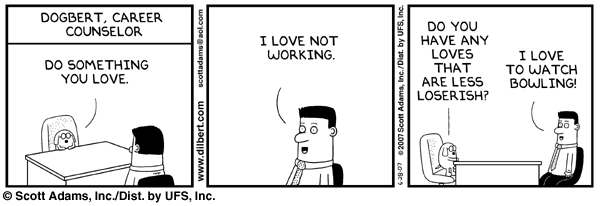
An optimist is simply a pessimist with no job experience.
“Dogbert” in Scott Adams, Build A Better Life By Stealing Office Supplies
For someone who can count on one hand the number of times he’s been out of the U.S. (even taking the San Diego trolley to Tijuana), I am fascinated by other countries. I decided to indulge myself last weekend with two books I just heard about. I’m certainly glad I did.
The first was The SFWA European Hall of Fame: Sixteen Contemporary Masterpieces of Science Fiction from the Continent, edited by James and Kathryn Morrow. I came across it in a reference to a panel at Readercon, which I’m attending next week. A number of years ago I read a collection of Soviet science fiction edited by Isaac Asimov and was intrigued. This work outshines that one.
The 16 stories do not depart greatly from traditional SF memes and subjects. Yet they present just a slightly different view or slant, one not so different as to be off putting but enough that you sense a somewhat fresh and unique feel. Translated from French, Russian, Italian, Finnish, Czech, Polish and Romanian, to name a few, the stories seem to have an inherent sense of place that I may well overlook in the works of the well-known American and British SF authors. As such, excellent stories were enhanced by touches both distinct and distinctive.
The other book — purchased at the same time — is equally inimitable: Literature from the “Axis of Evil”, an excellent compilation from Words Without Borders. (Public Service Announcement: Go read WWB’s excellent online magazine, which has been on my blogroll for months; subscribe to its newsletter; and give a donation to support its efforts to promote international communication through translation of the world’s best writing.)
Don’t let the book’s title or subtitle (Writing from Iran, Iraq, North Korea, and Other Enemy Nations) mislead you. This is not prose and poetry fomenting, expressing or based upon contempt or hatred for America. This is, insofar as any particular country is concerned, straightforward writing by its citizens, some in exile. Not only is there the so-called “Axis of Evil” itself, there are also works from Cuba, Syria, Libya and the Sudan.
Not all of it is my cup of tea. But perhaps that is to be expected when I not only do not have but often have lacked the opportunity to learn about the cultural background. Besides, would it truly be foreign literature if some of it did not feel “foreign”? Suffice it to say that, at least to me, the works from the Middle Eastern countries seemed to share a somewhat common, although not universal, feel that stems largely from Arabic traditions, heritages and beliefs. Yet it also provides firsthand insight into those traditions, beliefs and everyday life, as well as some basic commonality to growing up and human existence. Likewise, the work from Sudan (of which I found “The Sweetest Tea with the Most Beautiful Woman in the World” particularly compelling) and Cuba also carried their own feel firmly rooted in their unique culture.
Yet what struck me most — and perhaps best explains why reading literature from our “enemies” helps us understand the people — is the North Korean works. Although certainly unintended by the authors, the stories may be the most explicit portrayal of just how bleak life must be in this authoritarian state. Given state control of the arts and literature, every piece glorifies the North Korean government and, particularly, “the Great Leader,” Kim Il Sung. There are also plenty of barbs at Americans, the Japanese and anybody else on Kim’s list. Given that this is literature as it is known in North Korea, it paints a better picture of North Korean life and society than anything I have read to date.
I fully endorse and understand the purpose of works like these. I think the editors at Words Without Borders said it quite well in their book’s introduction:
Our hope was that with this book we might simply celebrate diverse works of literature and through them, provide fresh perspectives on the notion of the “enemy nation.” Is the “enemy” a particular leader, or a more pervasive ideology? A system of government, a people, a social group? …. we aim simply to stimulate international conversation through literature, with all its complexity and nuanced insights into the ideas, beliefs, daily lives and articles of reference of people of other cultures, who are thinking and writing in languages other than English.
Literature from the “Axis of Evil” undoubtedly succeeds in that regard. And while The SFWA European Hall of Fame comes from an entirely different angle and genre, it, too provides an opportunity to reduce our ignorance of other parts of the world and the thought, traditions and culture that helps create any person’s sense of place.
[T]he last thing we should do in these dark times is shut ourselves off from seeking greater knowledge of foreign experience.
Editors’ Note, Literature from the “Axis of Evil”
Some admittedly date back to last week but they are among the things that have caught my interest over the last 10 days or so:
- I’ve used the Google translate feature on a couple occasions but never thought about the flip side. Hence, I found this is very cool, although I have no idea how accurate it is. (FWIW, my site tracker tells me this came from a visitor in the Ukraine.)
- The American Journalism Review explains what the mainstream media can learn from Jon Stewart.
- An interesting observation on the (in?)consistency of the free speech views of Chief Justice Roberts in light the two free speech decisions the Supreme Court handed down Monday in “Bong Hits 4 Jesus” and political advertising.
- Marc Andreessen comes up with a list of the top 10 SF novelists of the ’00s. While I haven’t read works by all of them, it is a very impressive cast of authors. (Via.)
- Among the authors on Andreessen’s list is Peter Watts. I was thrilled to see he will be doing a 30-minute talk on how he wrote his latest work, Blindsight, at ReaderCon next week. It is one of the better SF works I’ve read this year and a deserving finalist for the Hugo Award for best novel.
- As a follow-up to my LibraryThing post, I have begun “tagging” the books in my library so you can know see my subject cloud.
- Not that I need it, but Lifehack has a list of 14 ways to cultivate reading as a habit. (Via.) For some of us, habit = obsession but I’m proud to say I’ve passed the addiction on to each of my children.
Each book to me is not just the words within its pages, but the story of its provenance.
Matthew Cheney, “All Those Books”, Strange Horizons
|
Disclaimer 
Additionally, some links on this blog go to Amazon.com. As an Amazon Associate I earn from qualifying purchases. There is no additional cost to you. Contact me You can e-mail me at prairieprogressive at gmaildotcom.
|