|
|
Perhaps some people won’t find it surprising but were you aware that each branch of the U.S. Armed Forces has its own official “reading list” for its members? That’s right, the Air Force, the Army, the Marines and the Navy all have lists of suggested reading broken down by rank.
Containing just under 200 books among the four lists, what’s perhaps most interesting is the book that shows up the most. Dereliction of Duty: Johnson, McNamara, the Joint Chiefs of Staff, and the Lies That Led to Vietnam by H.R. McMaster appears on the Air Force, Army and Marines lists. It — not The Art of War (Army, Marines) or On War (Air Force, Army) — is the only book to appear on three lists. Each puts the book on the list for officers of the rank of colonel to general.
Along with The Art of War and On War, the following books show up on two lists and a couple could just as easily be found on the reading list for an MBA program:
- Band of Brothers (Army, Marines)
- Battle Cry of Freedom (Army, Marines)
- Ender’s Game (Marines, Navy) [Winner of the 1986 Hugo Award for best science fiction novel!]
- The Face of Battle (Army, Marines)
- Flags of Our Fathers (Marines, Navy)
- For the Common Defense (Army, Marines)
- Leadership: The Warrior’s Art (Army, Navy)
- The Lexus and the Olive Tree: Understanding Globalization (Army, Marines)
- Lincoln on Leadership: Executive Strategies for Tough Times (Air Force, Navy)
- Makers of Modern Strategy from Machiavelli to the Nuclear Age (Air Force, Army)
- Masters of War: Classical Strategic Thought (Army, Marines)
- The Savage Wars Of Peace: Small Wars And The Rise Of American Power (Marines, Navy)
- Supplying War (Army, Marines)
- Thinking in Time: The Uses of History for Decision-Makers (Army, Navy)
- This Kind of War (Air Force, Marines)
The military isn’t alone in having reading lists. In July, a foreign affairs professional reading list the State Department helped create was announced. That same month, the CIA updated its suggested reading list of “intelligence literature.”And while it may not be a formal reading list, in August the FBI accepted a bid of just under $20,000 to buy 26 different books, ranging from one copy of Microsoft Office Project Step by Step to 385 copies of The True Believer: Thoughts on the Nature of Mass Movements.
One sure window into a person’s soul is his reading list.
“Book Notes,” Mary B.W. Tabor, N.Y. Times (June 14, 1995)
Two debuts this weekend. First is the new design. I just felt like a change and came across a theme I really liked and that is easier to tinker with than my old one. It may still require a bit of adjustment here and there but let me know if you think it’s an improvement or not.
The second debut is Weekend Edition begins, patterned after the Saturday Review concept at The 3 R’s. It will appear at some point each (I hope) weekend and serve as a place for various announcements, linkage and occasional general randomness. Because this is the first edition, a couple items are more than a week old.
Bulletin Board
The South Dakota Festival of Books begins in Sioux Falls next weekend (Sept. 26-28). Here’s the full schedule.
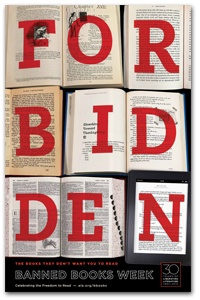
The festival coincides with the kickoff of Banned Books Week, which runs Sept. 27 to Oct. 4.
I’d like to think it’s because someone took note of my new interest in foreign literature but this year’s Big Read is called The Big Read Egypt/U.S. The selected book is The Thief and the Dogs, a 1961 novel by Nabuib Mahfouz, who won the Nobel Prize in Literature in 1988.
Linkage
I don’t know that the time is worth the effort.
Why do publishers and the public allow classic SF series to be bastardized by prequels, additions and sequels? I will do what I have done with other efforts. Ignore it.
Print-on-demand publisher not liable for defamation, unlike mainstream publishing houses.
Confessions of a compulsive buyer.
Hockey’s response to the now best known “hockey mom.”
I guess I don’t need to read the Booker Prize finalists. (HT.)
Salon, the online magazine, has created a Literary Guide to the World. (HT.)
For some reason, I imagine North Korean fiction as somewhat drab. (HT.)
Blogosphere notes
There’s several newer South Dakota blogs I’ve been remiss in not mentioning previously. Welcome to Dakota 21, Cranium Creek, the So Dak NORML Blog (likely a carryover from the 2006 medical marijuana initiative), and agree2disagree.
I’m going to repeat it (and undoubtedly will do so again in the future). If you don’t regularly check or have an RSS subscription to The Big Picture, you are missing one of the best sites going these days. If it doesn’t impact your perceptions of the world, it will certainly educate them.
My personal hobbies are reading, listening to music, and silence.
Edith Sitwell, quoted in Reader’s Digest (October 1977)
The term meme gets bandied about (overused?) in the blogosphere and, like Richard Dawkins suggested, has mutated in that environment. In the blogosphere, the term refers to an idea that spreads from blog to blog. Memes generally propagate in the blogosphere in two ways: bloggers posting on the same topic on a particular day (as I have been doing) or “tagging” another blogger, usually with a list of questions or topics the tagged person should address.
I’m sure it is just coincidence, but just days after I started the book memes here, John Scalzi reposted the book reading meme he created. Here it is in all its glory:
1. Open the book you’re currently reading to page 133.
2. Read the fourth line on the page.
3. Put the book back where it had been resting.
4. Tell no one of what it was you just did.
5. Think of five friends to tag with this meme.
6. Do not actually tag them. They are busy and have lives.
7. Go about your life as if nothing has happened.
8. Carry the secret of this meme to your grave.
Sorry, John, I violated step 8 and, therefore, have spread this meme even more. But my views are mostly like his when it comes to the tagging memes and he just summarizes things so nicely. He hasn’t, though, dissuaded me from continuing the weekly themed meme posts — yet.
When you plant a fertile meme in my mind you literally parasitize my brain[.]
Richard Dawkins, The Selfish Gene

Autumn is starting (here in the US, anyway), and kids are heading back to school–does the changing season change your reading habits? Less time? More? Are you just in the mood for different kinds of books than you were over the summer?
Autumn probably tends to mark the beginning of the biggest impact on my reading habits. While the reduced hours for outdoor activity provide more time to read, that gets eaten up once hockey season starts. (Regular season for the USHL starts Oct. 3, the NHL starts Oct. 4 and the college hockey regular season starts Oct. 10. What a wonderful time period!) Between Stampede home games and NHL Center Ice, I probably spend less time reading. While I do tend to read between periods of TV games, that doesn’t provide much uninterrupted time to concentrate, especially when I can — and often do — flip between games on Center Ice.
Hockey also impacts what I read to a minor extent as it probably increases my interest in hockey-related books. That’s not a big impact though and I don’t think autumn affects what I read otherwise. I figure that’s because what strikes my fancy seems to depend as much on what new books are out or some other quirk than anything else.
The seasons they are turnin’ and my sad heart is yearnin’
To hear again the songbird’s sweet melodious tone
“Moonlight,” Bob Dylan, Love and Theft
We Americans like “up close and personal” stories, at least if they’re about athletes, celebrities, inspirational figures or the like. Yet it may be another story if we’re talking about getting up close and personal with those our government accuses of being terrorists. Yet many of those stories are ones we probably need to hear.
Steven T. Wax, the head of the federal public defender’s office in Portland, Ore., gives us such a look through the prism of what happened to two of his clients in Kafka Comes to America: Fighting for Justice in the War on Terror. One, Brandon Mayfield, made headlines across the country. He is the Portland lawyer who the FBI claimed a fingerprint tied to the March 2004 Madrid train bombings. The other is unknown to probably 99 percent of Americans. Adel Hamad is a Sudanese national who worked for an international Muslim non-governmental organization as a hospital administrator in Pakistan. He was hauled from his Peshawar apartment to a Pakistani prison and eventually flown in chains to the United States military prison in Guantanamo Bay, labeled and detained as an enemy combatant.
The two stories serve as excellent bookends for the ramifications of the policies and practices the U.S. has employed in the so-called War on Terror. Mayfield’s story shows the impact of the Patriot Act and a tendency to rush to judgment in terrorism cases on a relatively average American citizen and family. Hamad’s story shows the Kafkaesque limbo in which some innocent foreign civilians have been left for years. Both stories are frightening.
Wax’s office was appointed to represent Mayfield shortly after he was arrested as a “material witness” in the Madrid bombings by the FBI. It is, in large part, a story of a process dictated in large part by Washington, D.C., that went amok. The FBI looked at a fingerprint provided by Spanish authorities that was found on a plastic bag containing detonators and concluded with “100 percent certainty” that was Mayfield’s. It certainly didn’t help that Mayfield had converted to Islam from Christianity, handled a variety of immigration matters for Muslims and Middle Eastern natives, and represented an accused terrorist in a child custody proceeding.
The FBI’s suspicions led to “sneak-and-peek” searches (made without notice or a warrant) of Mayfield’s home, including taking DNA swabs and making copies of home computer hard drives; obtaining bank and other information via “national security letters,” which the recipients are legally forbidden to say they received; surveillance of his daily activities; and, wiretaps and electronic eavesdropping of his home. Federal terrorism officials were not dissuaded when Spanish authorities told the FBI on April 13, 2004, that their comparison of the fingerprint to Mayfield’s was “NEGATIVE.” Instead, the FBI concluded that since “[t]he problem is there is not enough other evidence to arrest him on a criminal charge,” it would arrest him as a material witness. In other words, Mayfield would be held without charges being lodged against him while the government continued to investigate and sought to force him to give a statement to them under oath or testify before a grand jury.
This is not a nail biting trial saga because there never was a trial. Instead, this is more of a story of a struggle against bureaucracy and blinders to get Mayfield released. Although the FBI ultimately admitted it made a mistake and that the print was not Mayfield’s, his client files and computers were seized and much of the information the FBI gathered was disseminated to law enforcement and intelligence agencies throughout the government. The government eventually reached a $2 million settlement with Mayfield but his case serves as a glaring example of what can happen in a rush to conclusions conducted in an atmosphere of fear and politics.
Hamad’s story likewise is not an cliffhanger tale of the Perry Mason school. In fact, Wax had only one court hearing and only met one of his two adversaries from the Department of Justice — once — in more than two years on the case. Instead, this is a story of the strategy of delay and roadblocks the Bush Administration employed to prevent those detained at Guantanamo and other military facilities from even getting hearings. This struggle led to three different U.S. Supreme Court cases and years of delay for the detainees. Even when the detainees were appointed attorneys to assist them with habeas corpus petitions, things were not easy.
The Department of Justice wouldn’t even tell Wax what country Hamad was from for three months. He, his staff and the other habeas attorneys were subject to protective orders that seriously constrained them.
The Protective Order prevented me from writing directly to Adel or receiving mail directly from him. Instead, all correspondence went through a Privilege Team from the Department of Justice. When I visited Adel, I could not take my notes out of the prison; instead, I had to give them to my military escorts. If I wanted to get the notes for use in my office, I had to let the Privilege Team read them, a process that can take anywhere from one to four weeks. Anything they thought should be classified was censored and locked in the secure facility outside Washington. And everything Adel told me, including such things as the name of his wife and his brother-in-law’s phone number, … was presumptively classified.
Thus, where Mayfield at least had the right to counsel, the benefit of full attorney-client privilege and hearings before a judge, Hamad did not. Just as he was blindfolded and chained en route to Guantanamo, he and his lawyers were figuratively in the same situation in the political and procedural battles being waged in Congress and the courts. The discussion and analysis of the lawyering here, though, is far closer to the real practice of law than what appears on television or movie screens. It is the formation of legal strategies to serve a client in the best way possible and the grunt work of investigating facts, gathering evidence and interviewing witnesses.
This all runs the risk that some readers will think the book lacks excitement or tension. In addition, Wax has the difficult but necessary task of explaining the background and history of such things as habeas corpus, the Patriot Act and the various actions taken by the Administration, Congress and the courts in the ongoing contest over the status and rights of the Guantanamo detainees. His effort is not helped by occasional diversions into his own background and occasional somewhat lofty statements about analogous points in history. For example, Wax relates that during one of his jail house meetings with Mayfield he was “seeing the fences” of the detention centers used to hold Japanese Americans during World War II.
But it takes lofty ideals and a strong devotion to them to do the type of work Wax and his office do. If anything, the “how can you defend those people?” cry must sound even more loudly when you agree to represent someone accused of being a terrorist. Yet most anyone who puts credence in America’s protection of civil liberties and human rights would condemn their erosion and the relentless struggle to deny detainees such simple due process rights as a hearing and seeing the evidence against them. But Wax recognizes that another strong principle is at play in his representation of Mayfield, Hamad and other detainees. There likely is no other country in the world whose government would pay a government lawyer to fight the government’s incarceration of an individual.
While Kafka Comes to America is largely a clarion call we would be well advised to heed, it also demonstrates that even when civil liberties are threatened, other core American principles can be used to help ensure and restore the nation’s place as a bulwark and symbol of justice.
While we can lose our freedoms overnight to foreign invaders, we can also lose them slowly through a day-to-day acceptance of a series of incremental steps that will alter our lives forever.
Steven T. Wax, Kafka Comes to America
|
Disclaimer 
Additionally, some links on this blog go to Amazon.com. As an Amazon Associate I earn from qualifying purchases. There is no additional cost to you. Contact me You can e-mail me at prairieprogressive at gmaildotcom.
|