|
|
Blog Headline of the Week
Teen Prodigy: Smart Enough to Go To Law School at 19, Dumb Enough to Go To Law School
Bookish Linkage
This is probably how I would end up using a Kindle.
The Browser offers a selection of books on Burma. (Via.)
A children’s novel, Neil Gaiman’s The Graveyard Book, won the Hugo Award for Best Novel last Sunday. The book previously won the 2009 Newbery Medal “for the most distinguished contribution to American literature for children published in English in the United States.”
The Not the Booker Prize Prize has “a (very) longlist.”
“The Pulitzer Prize in fiction takes dead aim at mediocrity and almost never misses.”
The AV Club’s “Gateways to Geekery” series looks at alternate history novels. (Via.)
Nonbookish Linkage
At 68, of course Bob Dylan is an “eccentric-looking old man.”
So, my bumper sticker about my Labrador retriever and your honor student is accurate.
Amateur space pron.
I got shit running through my brain
So intense that I can’t explain
Title Track, Ben Folds, Rockin’ the Suburbs
I was just shy of seven years old when The Great Escape came out. I’ve watched it perhaps more times than any other movie and loved the book on which it was based almost as much. And in the course of three months this summer, it’s received some manly recognition: it not only made a list of the 75 Movies Every Man Should See, it tops another list of the 100 Must See Movies for Men.
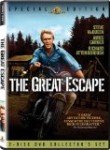 But other than a manliness award, The Great Escape is greatly underappreciated. It isn’t on the American Film Institute’s list of the 100 Greatest American Films. The only Academy Award nomination it got was for best film editing (it didn’t win). It did receive a Golden Globe nomination for best drama — but didn’t win. In fact, according to IMDB, the only award the movie won was a best actor award for Steve McQueen — at the 1963 Moscow International Film Festival. I’m guessing that wasn’t a highly prestigious award in the Cold War U.S. But other than a manliness award, The Great Escape is greatly underappreciated. It isn’t on the American Film Institute’s list of the 100 Greatest American Films. The only Academy Award nomination it got was for best film editing (it didn’t win). It did receive a Golden Globe nomination for best drama — but didn’t win. In fact, according to IMDB, the only award the movie won was a best actor award for Steve McQueen — at the 1963 Moscow International Film Festival. I’m guessing that wasn’t a highly prestigious award in the Cold War U.S.
Loosely based on a true story of a mass escape from a German prisoner of war camp, the film, like many World War II movies of the 1960s and 1970s, had a star studded cast. Richard Attenborough as an RAF squadron leader and comander of the priosners, Charles Bronson as a Polish pilot in the RAF, James Coburn as an Australian flyer, James Garner as an American who joined the RAF before the U.S. entered the war and Steve McQueen as the irascible and cocky American pilot. In addition, one of the screenwriters was James Clavell, whose book about experience in a Japanese prisoner of war experience, King Rat, was a bestseller in 1962. Clavell would go on to write, produce and direct 1967’s To Sir With Love and the bestselling novel Shogun in 1962 would
For whatever reason, the movie didn’t sit with critics. Part of it was probably the length, with the movie being just shy of three hours). But it’s a movie that had everything. There were the brutal Nazis. To borrow a more modern phrase, the Germans gathered the “worst of the worst,” the Allied soldiers who were escape artists or had serial escape attempts, into the highest security prisoner of war camp. There was the indomitable spirit of the prisoners plotting a mass escape. There was McQueen, whose character, Captain Virgil Hilts, epitomized “cool.” That was reinforced by the fact Hilts was known as “the cooler king” for the amount of time he spent in solitary confinement in “the cooler” (where, of course, he passed the time with a baseball and glove). But the cool went beyond simply the screen. The film is recognized for having one of the screen’s best motorcycle chases, as McQueen tries to outrun Nazis after the escape. Those scenes were put in the movie at McQueen’s request.
So there you have it. Evil Nazis, heroic heroes and American cool. If you’re a boy growing up in the ’60s and see this movie then, how could it not become one of your favorites?
Kommandant von Luger: Are all American officers so ill-mannered?
Captain Virgil Hilts: Yeah, about 99 percent.
von Luger: Then perhaps while you are with us you will have a chance to learn some. Ten days isolation, Hilts.
Hilts: Captain Hilts.
von Luger: Twenty days.
The Great Escape
When it comes to First Amendment concepts, I’m pretty close to an absolutist. But decisions like the one made this week by Yale University Press pose one of those conundrums that can arise if you believe strongly in free expression and freedom of religion.
Later this year, Yale University Press is publishing The Cartoons That Shook the World, an account of the uproar and riots that occurred in September 2005 when a Danish newspaper published 12 caricatures of the Prophet Muhammad. But the book will not include the cartoons themselves — or any other illustrations of Muhammad that were originally to be included in the book.
According to the NYT, Yale University Press made the decision based on an “overwhelming and unanimous” recommendation from two dozen consultants, including diplomats and experts on Islam and counterterrorism. The fear, evidently, is that republishing the cartoons could lead to another round of violence and deaths. Author Jytte Klausen said she reluctantly agreed. The premise of her book is that the reaction to publication of the cartoons was “orchestrated, first by those with vested interests in elections in Denmark and Egypt, and later by Islamic extremists seeking to destabilize governments in Pakistan, Lebanon, Libya, and Nigeria.” As a result, she says this was a political conflict, not a cultural misunderstanding.
Now, granted, the First Amendment doesn’t preclude a publisher or author from making editorial decisions like this. Still, this highlights the struggle that can occur between between free expression and freedom of religion or, more accurately, respecting the right of someone to hold certain beliefs. What are the boundaries when one person’s expression is offensive or, more accurately, contrary to another’s faith or creed? And that core issue is even one step removed here. The book is not the complained of expression. Rather, it is an examination of that expression and its aftermath, an examination that presumably does not adopt the expression or reject the religion.
Yet Yale’s decision may be the only middle ground between the two positions. As Yale believes the cartoons can be accurately described in words, it believes it is fostering expression on and exploration of the issue without treading upon Muslim beliefs. For me, though, the scales probably trip toward publishing all the images. First, the middle ground strikes me as undercutting not only free expression but the flip side of freedom of religion, i.e., freedom from religion. Second, I question whether words can adequately substitute for visual expression. Finally, what is being withheld is not just the source of the controversy but other, previous images. To some extent then, it ignores or seeks to rewrite reality.
What is freedom of expression? Without the freedom to offend, it ceases to exist.
Salman Rushdie, Imaginary Homelands
You have to be of a certain era for the name Bill Chase to mean much. And it actually could mean something to you in two different contexts. Yet both contexts have an untimely limit. Bill Chase died in a plane crash on August 9, 1974, near Jackson, Minn..
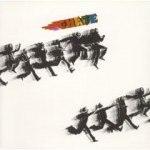 One context is a pure jazz one. In the 1960s, Bill Chase was the lead trumpet player for Woody Herman’s Thundering Herd. Then, as Miles Davis, Frank Zappa, Chicago and Blood, Sweat & Tears were fusing jazz and rock, he launched his own jazz-rock band named Chase. The band’s debut album, also called Chase, was released in 1971 and produced a single, “Get It On,” that spent 13 weeks on the charts that summer and actually reached number one. Chase (the band) quickly became one of the hottest acts in the country. In fact, the band received a nomination the Grammy Award for Best New Artist in 1972. (Carly Simon won the award.) One context is a pure jazz one. In the 1960s, Bill Chase was the lead trumpet player for Woody Herman’s Thundering Herd. Then, as Miles Davis, Frank Zappa, Chicago and Blood, Sweat & Tears were fusing jazz and rock, he launched his own jazz-rock band named Chase. The band’s debut album, also called Chase, was released in 1971 and produced a single, “Get It On,” that spent 13 weeks on the charts that summer and actually reached number one. Chase (the band) quickly became one of the hottest acts in the country. In fact, the band received a nomination the Grammy Award for Best New Artist in 1972. (Carly Simon won the award.)
From the outset, Chase (the album) left no doubt what you were in for — a high octane and often high register performance by a seeming wall of trumpets. Although it went through various incarnations, Chase (the band) always had four trumpet players, including Chase (the musician). “Open Up Wide” opened the debut album and the title couldn’t have been more accurate. It starts with about 20 seconds of piercing trumpet riffs played, of course, by Chase (the musician) that move from channel to channel. And when I say piercing, I mean at or surpassing the level jazz fans have heard from Maynard Ferguson (with whom Chase (the musician) played and recorded for a while in the late 1950s). Quickly, though, the other three trumpets and the rhythm section jump in full throttle and you are engulfed in a cascade of sound.
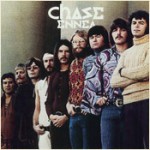 Although Chase (the band) had a vocalist to create more commercial appeal, “Open Up Wide” was an instrumental, the only one on the album. There was little doubt the album was aimed at a radio audience. Four of the seven songs — including “Get it On” — were just under three minutes in length. Two others were on either side of three and a half minutes. A five-part “suite” called “Invitation to a River” closed the recording, clocking in at just over 14 minutes. Almost every step in between is a high energy flood of brass, bass and wah-wah guitar. In fact, the album contains perhaps my favorite cover version of “Handbags and Gladrags.” Although Chase (the band) had a vocalist to create more commercial appeal, “Open Up Wide” was an instrumental, the only one on the album. There was little doubt the album was aimed at a radio audience. Four of the seven songs — including “Get it On” — were just under three minutes in length. Two others were on either side of three and a half minutes. A five-part “suite” called “Invitation to a River” closed the recording, clocking in at just over 14 minutes. Almost every step in between is a high energy flood of brass, bass and wah-wah guitar. In fact, the album contains perhaps my favorite cover version of “Handbags and Gladrags.”
But public popularity can be short-lived. When Chase (the band) released its next album, Ennea, in 1972, it came nowhere near the sales of the debut release. There’s a couple possible reasons. First, the “hook” for the band was the brass and the growing fusion market. Ennea, though, moved a bit more toward progressive rock. There was still plenty of jazz influence and stellar trumpet playing but it seemed the recipe had been altered somehow and evidently a bit too much for the general audience. Second, although the second side of the LP is a six-song jazz suite from which the album took its name, the tunes all have names from and the lyrics are based up Greek mythology, again perhaps taking outside the ken of the average listener.
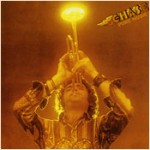 That year, Chase (the band) went into a brief hiatus during which, unfortunately, Chase (the musician) filed for bankruptcy. Despite seemingly ongoing personnel changes and an on-again, off-again schedule, Chase (the band) did release Pure Music in early 1974. This release seemed almost a direct counterpoint to the debut release. It had more of a jazz influence than the first album. The rhythm section was more prominent part, although the four trumpets were still there. Where the debut album was made up of radio-sized pieces, none of the six songs on Pure Music were under three minutes and two exceed seven minutes. Finally, two-thirds of the songs on Pure Music were instrumentals. The two with vocals featured Jim Peterik, former lead singer for the horn band The Ides of March, who wrote one of them and co-wrote the other with Chase (the musician). That year, Chase (the band) went into a brief hiatus during which, unfortunately, Chase (the musician) filed for bankruptcy. Despite seemingly ongoing personnel changes and an on-again, off-again schedule, Chase (the band) did release Pure Music in early 1974. This release seemed almost a direct counterpoint to the debut release. It had more of a jazz influence than the first album. The rhythm section was more prominent part, although the four trumpets were still there. Where the debut album was made up of radio-sized pieces, none of the six songs on Pure Music were under three minutes and two exceed seven minutes. Finally, two-thirds of the songs on Pure Music were instrumentals. The two with vocals featured Jim Peterik, former lead singer for the horn band The Ides of March, who wrote one of them and co-wrote the other with Chase (the musician).
The band toured in support of the new album and actually began working on another. On August 9, 1974, however, Chase (the musician) and three other members of the band chartered a plane to get to the band’s appearance at the Jackson County Fair in Jackson, Minn. The plane went down short of the runway in Jackson, killing the musicians and the pilot and co-pilot. Although a tribute album was later released, the crash brought Chase (the band) to an end. But the music has not gone away. In fact, last year all three LPs were combined on a single two-disc CD release.
In looking at the band’s catalog, some see an element of irony — or, the more gullible, an eerie foreshadowing. As noted, the debut album opened with “Open Up Wide,” written by Bill Chase. The last track on Pure Music was called “Close Up Tight,” also written by Bill Chase.
We may be runnin’ out of heroes
It seems they tumble every day
Chase, “So Many People,” Ennea
As has been evident recently, I get a kick out of lists of books perceived to have been the “best” or “greatest” of a particular time period, genre or overall. Yet over the weekend, I was again struck by something I’d pondered a while ago. Specifically, a “best” list is a mirage to a certain extent. Any book and, thus, any list of books, are filtered not by individual tastes but how our perceptions change with time.
My idea isn’t anything new. While it, of course, posits there is no objective measure of literary greatness, I don’t think anyone can contend reading is not a wholly subjective experience. More important, that experience necessarily is directly influenced by our age — and who we are — when we read any particular book. The the impact or evaluation of a book necessarily depends on the psyche of the reader at the time they read the book.
I can think of several examples that support and illustrate the point from my perspective. One is The Catcher in the Rye, which makes many lists of great books. I didn’t read it until I was in my mid-40s. Was I impressed? Not so much. I would be surprised, though, if my view of the book weren’t dramatically different had I read it when I was in my teens.
The process works the other way, too. Two of my favorite books of the last several years are Out Stealing Horses and Gilead. Both narrators are older men looking back on their lives and contemplating such questions as how our lives got to where we are and how they made us who we are. These books would not speak to me near as much in my teens or even in my 30s. Rather, it is the “me” who existed when I read them, a person different in many ways from its earlier incarnations, that found them to be among the best I’ve read.
Thus, while best book lists may represent some sort of consensus of books that are widely praised, they necessarily are filtered by tastes that change along with the reader. Just as beauty is in the eye of the beholder, the shimmer of today’s best book lists could well be a mirage tomorrow.
People bring their prejudices [to reading], whether friendly or adverse. They are lamp and spectacles, lighting and magnifying the page.
Robert Willmott, Pleasures of Literature
|
Disclaimer 
Additionally, some links on this blog go to Amazon.com. As an Amazon Associate I earn from qualifying purchases. There is no additional cost to you. Contact me You can e-mail me at prairieprogressive at gmaildotcom.
|