Blogroll

Weekend Edition: 8-8

Bulletin Board

Welcome Prairie Home Dysfunction to the SD blogosphere. Jeffrey, what took you so long?

Blog Headline of the Week

Mass Hysteria As Twitter and Facebook Slowdowns Cause People to Have to Talk to Other Real People!

Bookish Linkage

The Lost Art of Reading” speaks to many of us in today’s modern society — although it may be a tad disconcerting that the book editor of the LA Times says he has a hard time devoting the necessary attention to readingn. (Via.)

The Encyclopedia Britannica blog, of all places, makes a strong bid for book-related blog post of the year.

Those damn Leftists!!!! Hugo Chavez has the audacity to start a Revolutionary Reading Plan that includes giving away thousands of free books and sending “book squadrons” around the country that are intended to encourage reading. (Via.)

I wonder, though, if Hugo has checked this out. The New Statesman, a British magazine “created in 1913 with the aim of permeating the educated and influential classes with socialist ideas,” has a list of Red Reads, “50 books that will change your life.” (I am somewhat surprised I have only read four.) (Via.)

Retired (as of today) U.S. Supreme Court Justice David Souter has bought a new home in part because, according to a friend, his current home wasn’t structurally strong enough to hold the thousands of books he owned.

For some reason this strikes me as odd. The subject of Ian McEwan’s next novel? Climate change. (Via.)

Oxfam opens used bookstores in the UK and other secondhand booksellers cry foul.

A list of 100 book blogs for history buffs. (Via, who made the list; yours truly did not.)

Was Billy Shakespeare his century’s Hunter Thompson?

Obama impacts books sales once again: One of my favorite books in college, Saul Alinsky’s Rules for Radicals, is undergoing a revival.

Nonbookish Linkage

China makes another technological leap ahead of us.

Want to conserve water? Pee in the shower. After all, it’s all pipes.

Maybe I should go on a hunt for the Netflix location in Sioux Falls. (Via.)

Rehabilitating Judas. (Via.)


Reading is an act of contemplation, perhaps the only act in which we allow ourselves to merge with the consciousness of another human being.

David Ulin, “The Lost Art of Reading

Friday Follies 1.9

Layoffs and pay cuts at law firms are one thing but “ratcheting up the cost of my soda by 150% is where I draw the line!

You’ll be happy to know Korean restaurants (as in restaurants actually in Korea) will no longer be able to reuse food — although there are some exceptions.

Those in the financial industry might want to keep this news away from Congress: “China executed two business people for defrauding hundreds of investors out of more than $127 million, calling the scam a serious blow to social stability.” (Via.)

The dangers of “friending” a judge on Facebook: after a lawyer asked for a continuance one day because of the death of her father, the judge saw “a string of status updates on Facebook, detailing her week of drinking, going out and partying.”

So what does a U.S. Supreme Court justice do during the Court’s summer recess? According to the wife of Justice Clarence Thomas, she and her husband have traveled through 27 states in their recreational vehicle, and they love to stay in Wal-Mart parking lots. “Actually,” she said, “it’s one of our favorite things to do.”

Why my wife and I never thought of divorce.

“Moorestown Patrolman Robert Melia, 38, is every criminal defense attorney’s nightmare. First, Melia was charged with aggravated sexual assault on three underaged girls. Now, he has been arrested for sex with cows.”


Lawyers spend a great deal of their time shoveling smoke.

Oliver Wendell Holmes, Jr. (attributed)

A “white-washed” book cover gets replaced

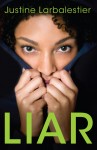
FinalLiarYou may recall last week’s post about a so-called “white-washed” book cover. It stemmed from a forthcoming YA novel whose main character is “black with nappy hair which she wears natural and short” but whose cover pictured a Caucasian girl with long straight hair. Common sense has prevailed.

At left is the new cover. Author Justine Arbalestier reports that although her U.S. publisher thought about using the Australian cover (also pictured in the prior post), “given the paucity of black faces on YA covers, and the intensity of the debate around the original Liar cover, Bloomsbury felt really strongly that a more representative approach was needed.”

What prompted the original cover was a belief that books with “black covers don’t sell.” Arbalestier now hopes “we can prove (again) that it’s simply not true that a YA cover with a black face on the cover won’t sell. But let’s also put it to the test with books written by people of color.”


Common sense is the knack of seeing things as they are, and doing things as they ought to be done.

Calvin E. Stowe

Booking Through Thursday: Recently serious

btt21

What’s the most serious book you’ve read recently?

Again, I’m too picky with words as my response depends on the definition of “serious.”

I consider the just-reviewed The Challenge a serious book because it deals with serious issues. If the term is meant in a more cerebral context, then it would probably be Society Without God, an examination of Scandinavian countries where religion is not as important as in the U.S., or We Are All Moors, which contends the Moors serve as a metaphor for all minority peoples in the West and a historical antecedent to modern debates over Islam and immigration.


What gunpowder did for war the printing press has done for the mind.

Wendell Phillips, Speeches, Lectures and Letters

Another book list: 60 years of books

I know. I’m to the point of addiction with these things. And you’d think I’d know better, particularly when the list comes from England, counts Twilight as the best book of 2005 and has already selected a best book of 2009.

That said, here’s the best 60 books of the past 60 years, at least according to The Times. This time, books I’ve read are in bold while those I started but never finished are underlined. Plainly, the books from the mid to late 1970s are in my wheelhouse.

1949 — Nineteen Eighty-Four, George Orwell

1950 — The Lion, the Witch and the Wardrobe, C. S. Lewis

1951 — The Catcher in the Rye, J. D. Salinger

1952 — Pigs Have Wings, P. G. Wodehouse

1953 — Casino Royale, Ian Fleming

1954 — Lord of the Flies, William Golding

1955 — Lolita, Vladimir Nabokov

1956 — The Hundred and One Dalmatians, Dodie Smith

1957 — Doctor Zhivago, Boris Pasternak

1958 — Our Man in Havana, Graham Greene

1959 — The Leopard, Giuseppe di Lampedusa

1960 — To Kill a Mockingbird, Harper Lee (I suppose one of these days I just better read this book!)

1961 — Catch 22, Joseph Heller

1962 — The Golden Notebook, Doris Lessing

1963 — The Bell Jar, Sylvia Plath

1964 — Funeral in Berlin, Len Deighton

1965 — Dune, Frank Herbert

1966 — Wide Sargasso Sea, Jean Rhys

1967 — Towards the End of the Morning, Michael Frayn

1968 — 2001, Arthur C. Clarke

1969 — The French Lieutenant’s Woman, John Fowles

1970 — Play it as it Lays, Joan Didion

1971 — Americana, Don DeLillo

1972 — Watership Down, Richard Adams

1973 — Crash, J. G. Ballard

1974 — Fear of Flying, Erica Jong

1975 — Salem’s Lot, Stephen King

1976 — Even Cowgirls get the Blues, Tom Robbins

1977 — A Scanner Darkly, Philip K. Dick

1978 — The World According to Garp, John Irving

1979 — Smiley’s People, John le Carré

1980 — Earthly Powers, Anthony Burgess

1981 — Lanark, Alasdair Gray

1982 — The House of the Spirits, Isabel Allende

1983 — Waterland, Graham Swift

1984 — Money, Martin Amis

1985 — Love in The Time of Cholera, Gabriel Garcia Marquez

1986 — Tourist Season, Carl Hiaasen

1987 — More Die of Heartbreak, Saul Bellow

1988 — Mother London, Michael Moorcock

1989 — Sexing the Cherry, Jeannette Winterson

1990 — Get Shorty, Elmore Leonard

1991 — The Famished Road, Ben Okri

1992 — The Secret History, Donna Tartt

1993 — Trainspotting, Irvine Welsh

1994 — How Late it Was, How Late, James Kelman

1995 — Northern Lights, Philip Pullman

1996 — Angela’s Ashes, Frank McCourt

1997 — Harry Potter and the Philosopher’s Stone, J. K. Rowling

1998 — The Wind-up Bird Chronicle, Haruki Murakami

1999 — Disgrace, J. M. Coetzee

2000 — The Blind Assassin, Margaret Atwood

2001 — The Corrections, Jonathan Franzen

2002 — Atonement, Ian McEwan

2003 — The Time Traveler’s Wife, Audrey Niffenegger

2004 — The Line of Beauty, Alan Hollinghurst

2005 — Twilight, Stephenie Meyer

2006 — The Road, Cormac McCarthy

2007 — A Thousand Splendid Suns, Khaled Hosseini

2008 — Netherland, Joseph O’Neill

2009 — The Little Stranger, Sarah Waters


I would sooner read a time-table or a catalogue than nothing at all

W. Somerset Maugham, The Summing Up