|
|
Ireland outlaws blasphemy.
And this ain’t your father’s Russia: the leadership of Russia’s equivalent of the s House of Representatives has “agreed to refer the legislative agenda and the legislative calendar to the Moscow Patriarchate of the Russian Orthodox Church for confirmation.”
Sorry, ma’am, you were right. You aren’t a prostitute. (Via.)
Lawyer disbarred for his actions while serving on a jury.
A teacher who burned a cross into a student’s arm has filed suit against the school claiming he was discriminated against because of his personal religious beliefs. (Via.)
No, reading this far convinces me you’re a total asshole.
Large sign on government building at US-Canadian border saying “United States” taken down because it “could be a huge target and attract undue attention.” (Via.)
Establishing respect for the law does not automatically ensure a better life for that, after all, is a job for people and not for laws and institutions.
Václav Havel, The Power of the Powerless
A unanimous South Dakota Supreme Court has vacated the death sentence of Briley Piper on the basis he did not validly waive his right to have a jury determine if he should be sentenced to death. Piper’s case will be sent back for another sentencing proceeding that will allow him an opportunity to have a jury decide whether the death penalty should be imposed. The ruling also raises questions about a decision Piper’s co-defendant, Elijah Page, made three years ago.
On July 11, 2007, Page was executed by lethal injection, the first execution in South Dakota in 60 years. Like Piper, Page pleaded guilty to the brutal murder of Chester Allen Poage in March 2000. Like Piper, Page waived his right to a jury, allowing the judge to determine if the case justified the death penalty. The South Dakota Supreme Court affirmed both death sentences in January 2006. Later that year, Page sent a handwritten letter to the judge, his attorneys and the news media requesting that further challenges to his sentence be waived and that he be executed. The initial execution date was delayed due to concern over South Dakota’s method of legal injection but the sentence was carried out just more than two years to the day that Piper’s sentence is vacated.
When Piper and Page initially appealed their death sentences, they both argued the state’s capital punishment scheme was unconstitutional because it did not provide defendants who plead guilty to a capital crime an opportunity to have the jury determine if the aggravating circumstances necessary for a death penalty as opposed to a judge. The Supreme Court rejected those arguments in its January 2006 decision. In the new decision, though, the Court said “the issue of whether Piper constitutionally waived his right to have a jury decide the death penalty was not raised on appeal.” The Court also said that the current habeas corpus proceeding brought the issue “squarely before us for the first time.” It turned out to be the reason the Court vacated the death penalty.
This doesn’t necessarily mean Page’s sentence would have been vacated. The Piper decision hinges in large part on what the judge told Piper before he waived his right to a jury. I don’t know what was said at Page’s proceeding so it is unclear if the same issue existed even if so whether what transpired was sufficient to have caused the Court to throw out the sentence.
One thing is certain. Page’s decision to relinquish any appeals and be executed means no one will ever know if that sentence would have been set aside.
The fact that one juror has the potential to save a defendant’s life cannot be underplayed.
Piper v. Weber, 2009 SD 66
Okay, I know I’ve got a thing with book lists. But I can’t resist looking at a list compiled when other listeners of NPR (the station(s) on which my car radio is set 99 percent of the time) picked the 100 Best Summer Books Ever. I didn’t cast a vote in the poll but do have an observation below about who did.
As 100 is a lot of books, I’m just going to look at the top 50. The books I’ve read are in bold and those unread on my bookshelves are underlined.
1. The Harry Potter series, J.K. Rowling (How can a “series” hold one position? I’ve read the first three, or maybe four).
2. To Kill a Mockingbird, Harper Lee
3. The Kite Runner, Khaled Hosseini
4. Bridget Jones’s Diary, Helen Fielding
5. Pride and Prejudice, Jane Austen
6. Divine Secrets of the Ya-Ya Sisterhood, Rebecca Wells
7. The Great Gatsby, F. Scott Fitzgerald
8. The Hitchhiker’s Guide to the Galaxy, Douglas Adams
9. Fried Green Tomatoes at the Whistle Stop Cafe, Fannie Flagg
10. The Poisonwood Bible, Barbara Kingsolver
11. The Time Traveler’s Wife, Audrey Niffenegger
12. Life of Pi, Yann Martel
13. The Joy Luck Club, Amy Tan
14. The Hobbit, J.R.R. Tolkien
15. The Catcher in the Rye, J.D. Salinger
16. Gone with the Wind, Margaret Mitchell
17. Bel Canto, Ann Patchett
18. The Lord of the Rings, J.R.R. Tolkien
19. Middlesex, Jeffrey Eugenides
20. Water for Elephants, Sara Gruen
21. The Adventures of Huckleberry Finn, Mark Twain
22. The Bean Trees, Barbara Kingsolver
23. The No. 1 Ladies’ Detective Agency, Alexander McCall Smith
24. The World According to Garp, John Irving
25. Catch-22, Joseph Heller
26. The Prince of Tides, Pat Conroy
27. Like Water for Chocolate, Laura Esquivel
28. The Princess Bride, William Goldman
29. The Accidental Tourist, Anne Tyler
30. Twilight, Stephenie Meyer
31. A Confederacy of Dunces, John Kennedy Toole
32. East of Eden, John Steinbeck
33. The Red Tent, Anita Diamant
34. Beach Music, Pat Conroy
35. One Hundred Years of Solitude, Gabriel Garcia Marquez
36. Rebecca, Daphne Du Maurier
37. Ender’s Game, Orson Scott Card
38. Lonesome Dove, Larry McMurtry
39. The Thorn Birds, Colleen McCullough
40. The Amazing Adventures of Kavalier & Clay, Michael Chabon
41. Pillars of the Earth, Ken Follett
42. Anna Karenina, Leo Tolstoy
43. Interview with the Vampire, Anne Rice
44. Cold Mountain, Charles Frazier
45. Empire Falls, Richard Russo
46. Under the Tuscan Sun, Frances Mayes
47. The Count of Monte Cristo, Alexandre Dumas
48. Even Cowgirls Get the Blues, Tom Robbins
49. I Know This Much Is True, Wally Lamb
50. Murder on the Orient Express, Agatha Christie
My results for the second 50 are roughly the same, having read eight with another two on my shelves unread. So, I’ve read 20 percent of the list. I attribute my performance to a perhaps sexist observation that the books on the list indicate a majority of those casting votes were women. Part of that stems from the fact I think my wife would do far better than me on this list — and she doesn’t even listen to NPR.
The good of a book lies in its being read.
Umberto Eco, The Name of the Rose
We didn’t realize it at the time but one of them there paradigm shifts occurred in music on August 1, 1971. That afternoon and evening, more than two dozen famous and not so famous musicians performed at two sold out shows at Madison Square Garden. Gathered by George Harrison, the performances were benefit concerts for the newly established independent nation of Bangladesh, whose people were suffering the effects of war and starvation. Harrison had been motivated to act by his close friend, Ravi Shankar, a Bengali
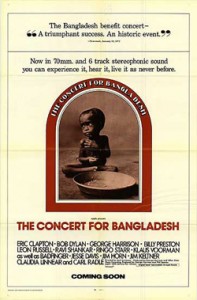 Benefit concerts were nothing new. After all, folk musicians had performed at benefits for one cause or another for decades and benefit performances undoubtedly stretched back several hundred years. But this was different. As its permanent website notes, the Concert for Bangladesh was “the first benefit concert of its kind in that it brought together an extraordinary assemblage of major artists collaborating for a common humanitarian cause – setting the precedent that music could be used to serve a higher cause.” Benefit concerts were nothing new. After all, folk musicians had performed at benefits for one cause or another for decades and benefit performances undoubtedly stretched back several hundred years. But this was different. As its permanent website notes, the Concert for Bangladesh was “the first benefit concert of its kind in that it brought together an extraordinary assemblage of major artists collaborating for a common humanitarian cause – setting the precedent that music could be used to serve a higher cause.”
Certainly, no one can say with without this concert events like No Nukes, Live Aid or Farm Aid would never have occurred. But Harrison’s approach helped create fundraising synergy. Rather than rely only on proceeds of ticket sales, the concert produced not only a three-LP box set — delayed in part because of the record companies of the various artists — but a movie that had worldwide release. As a result, not only did the two performances provide about $243,000 to UNICEF, the UN organization devoted to providing humanitarian relief to children affected by natural and man-made disasters, sales of the movie and album ultimately generated more than $15 million.
Yet at the core of it all is the music. The quality may be reflected in the fact the box set not only won the Grammy Award for Album of the Year, it reached number 2 on the U.S. music charts and number 1 on the U.K. charts. Not bad for a three-LP set — although Harrison took the three-LP All Things Must Pass to number one worldwide early in 1971. There are also certain moments that make the shows historic, some of which the general public never knew at the time.
What we did know was this was the first time Bob Dylan had performed in concert in two years. What we didn’t know is that Harrison wasn’t sure until moments before introducing him whether Dylan would show up. We knew Eric Clapton dueted with Harrison on “While My Guitar Gently Weeps,” the song on the Beatles’ so-called White Album on which Clapton played lead guitar. And while simply listening to the song wouldn’t reveal it, actually seeing Clapton on film indicated he was out of it. What we didn’t know is that Clapton’s drug problems kept him from all the rehearsals and, as he writes in his autobiography, he has only “a vague memory” of playing the show and “wasn’t really there.”
That aside, there’s plenty to love on the album and film. Harrison picked a top-notch selection of his own music, blending some of my favorites from All Things Must Pass to his best known songs with the Beatles. There’s Leon Russell singing a chorus of Harrison’s “Beware of Darkness” that helps uncover the song’s blues roots. There’s “Bangla Desh,” the song Harrison released just before the concert and which closed both performances. On film, there’s s Billy Preston so taken up in “That’s The Way God Planned It” that he leaves his keyboards to dance front stage. There’s the opportunity to watch Ringo Starr and Jim Keltner play drums side by side (and to also see highly regarded but rarely seen bass player Klaus Voorman). These are just a few of the highlights from what was unquestionably a historic day.
By the way, ticket stubs for “Harrison & Friends” on the middle of the five seating levels at MSG sold for $6.50 and $5.50 at the time. Those two stubs, each less than four inches square, went on auction this week. The starting bid? $200.
My friend came to me
With sadness in his eyes
He told me that he wanted help
Before his country dies
Although I couldn’t feel the pain
I knew I had to try
Now I’m asking all of you
To help us save some lives
George Harrison, “Bangla Desh”
The U.K.’s biggest online bookstore, The Book Depository, has launched its U.S. site. The site indicates it’s not taking on Amazon but a quick perusal can’t help but make you wonder.
The site’s “About Us” section says, “We are not in competition with Amazon, we complement Amazon by providing books which have poor availability, offering considerable discounts on certain titles which Amazon are [sic] unable to. On the other hand, we recognize that our customers want books quickly and, so, if we do not have stock — or if Amazon is considerably cheaper — our customers are able to order direct from Amazon via a link from our website.” That’s a nice touch but their Amazon links also serve to emphasize one focus of potential competition.
The Book Depository’s home page proudly announces: “Free shipping on everything!” and “Free shipping worldwide on all our books.” Then, when you locate a book a legend right below the price reiterates, “Free shipping worldwide.” In contrast, the Amazon link shows the Amazon price with shipping. Thus, a book on my wish list is $22.99 from The Book Depository and the page says the Amazon total is $27.09, adding in smaller print, “($23.10 plus $3.99 shipping to United States)”. Another showed a Book Depository price of $16.99 and an Amazon price of $21.12, again including $3.99 shipping.
What about unavailable books? The Book Depository did have one of my wish list books that’s not available on Amazon and at a 16 percent discount. That could work to The Book Depository’s benefit, especially for people who start looking for books such as appeared on today’s s announcement of the Man Booker Prize longlist. On the flip side of the coin, when I found one wish list book that was out of stock at The Book Depository, the Amazon “link” on the site said, “We don’t have Amazon.com information available on this title.” The book, though, is available and in stock at Amazon.
One thing to keep in mind is that the price quoted for Amazon shipping is for standard delivery of one item. Additional books in the same shipment cost another 99 cents each. Most books ship within 24 hours and Amazon says standard shipping “typically takes 3-5 business days.” The Book Depository books are shipped within 48 hours “from our fulfillment centre in Gloucester, United Kingdom.” They are sent via Royal Mail standard delivery, which is estimated to take 7–10 “working days.” Thus, you balance speed of arrival against cost.
Granted, this is just a cursory look at one aspect of the efforts to complement/compete with Amazon. Even if you’re willing to pay shipping to get the books more quickly, The Book Depository should be a welcome addition and potential alternative for those who shop for books online.
I went to a general store but they wouldn’t let me buy anything specific.
Steven Wright
|
Disclaimer 
Additionally, some links on this blog go to Amazon.com. As an Amazon Associate I earn from qualifying purchases. There is no additional cost to you. Contact me You can e-mail me at prairieprogressive at gmaildotcom.
|