|
|
To the extent hockey gets much national attention, it begins this week with the opening of the NHL’s Stanley Cup playoffs. The NHL, though, is simply the tip of a huge iceberg. The men’s NCAA Division I hockey championships concluded last weekend. Most other minor and junior leagues likewise are in the midst of or wrapping up their playoffs. The vast majority of the players in those leagues are there for love of the game, not a paycheck. And how long that love affair lasts is demonstrated by 64-year-old Bruce Valley’s hockey memoir, Seahawk: Confessions of an Old Goalie.
The book is a mix of a historical look at hockey in Valley’s home town of Rye, N.H., and a paean to the sport. It is stronger as the latter.
Valley’s memoir takes its name from that of the town’s amateur hockey team, the Seahawks. Formed following World War II, the team began as largely a collection of World War II vets. Despite the town’s small size — about 1,500 people — the team not only made it to the semifinals of the New Hampshire Class B championship in 1950, it made it to the semifinals and the championship game of the New England Senior “B” championship in 1950 and 1951, respectively. Although it did not win the title, the team lost in the 1950 semifinals only after six overtimes. Valley was recruited as the Seahawks goalie in 1959 at age 14 and played in the team’s last two years of existence.
This was an era of hockey much different than today. Valley, for example, not only wore no face mask, he wore a baseball catcher’s chest protector and fashioned his catching glove out of a first baseman’s mitt. But it wasn’t just the players’ equipment. The outdoor rinks didn’t have a maintenance crew — except for the players themselves. In the pre-Zamboni days, the team would go to the rink in the morning, shovel off the snow and then flood the rink with a thin layer of water. After a day at their jobs, they would return to the rink for practice or a game. At the end, they would scrape the ice with shovels and hand plows and again flood the surface. Game schedules were equally as demanding. During one stretch in 1951, the Seahawks played 21 games in 19 days — all outdoors.
Valley would continue playing goalie while attending the U.S. Naval Academy. Of course, back then the Academy had no rink or organized team. And the times dictated there was little hope of NHL glory for all but a minuscule number of players. From 1942 until 1967, the NHL had a grand total of six teams, made up largely of Canadians. Yet it was injury, not lack of opportunity, that would force Valley to ultimately hang up his pads. Some of the best portions of his story are recounting how watching part of an alumni game during a visit to the Naval Academy in the late 1990s led him to overcome those problems and go back to playing goalie, something he does to this day — all for love of the game.
When Valley uses the Seahawks to portray Rye as a typical New England hockey town of its era, the book seems to struggle. It tends to be reminiscent of the locally-written histories found in virtually every village and town in the country. Such works recount names and events and reprint pictures that, generally, don’t mean a heck of a lot to anyone not familiar with the people or the places. Seahawk falls into some of the worst traps of those histories, with a roster of all those who played for the Seahawks, a list of all its opponents and more than 40 pages of reprinted newspaper articles about the team’s games. Additionally, Valley tends to be a bit repetitive, something you wouldn’t normally expect in a work with only about 90 pages of text.
While Seahawk leaves no doubt that ice hockey was part and parcel of New England life, it is most effective in showing the lengths to men will go for such a demanding sport simply because the love the game.
[Goalies] stand on the ice in front of a net attired in equipment right out of the Crusades while men skating at highway speeds shoot a frozen-hard rubber disk at them with a stick. Seen in that particular light, can anything any goalie says or writes have a connection to the rational?
Bruce Valley, Seahawk: Confessions of an Old Goalie
Guilty pleasures. We all have them. They’re the albums or movies that grab you but that most people toss off and even impugn. Grand Funk’s Survival is one of mine.
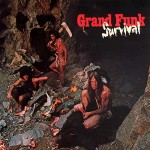 Most would agree that Survival, the band’s fourth studio album, is the most polished and clear from an audio standpoint. Where people start to wonder is with the caveman cover art and, more importantly, the music. Most would agree that Survival, the band’s fourth studio album, is the most polished and clear from an audio standpoint. Where people start to wonder is with the caveman cover art and, more importantly, the music.
Released 38 years ago today, the album was the band’s fifth release in 20 months, counting a two-LP live album. Yet it still sold a million copies on its first day of release. It went gold and reached number six on the album charts inside two weeks. It was yet another example of how Grand Funk found a widespread audience despite being roundly criticized by “experts.” At the same time, I don’t think there’s any question that Survival is a demarcation point.
The first thing a fan notices is the difference in sound. Whether intentional or not, the first three studio LPs were somewhat muddy, almost emphasizing a garage band feel. Survival, in contrast, seems pristine in comparison. It also continues moving Grand Funk closer to a more mainstream feel. In addition to covers of “Feelin’ Alright” and “Gimme Shelter,” guitarist Mark Farner plays keyboards on several songs. Having played keyboards in a garage band, I found it a nice touch at the time. And not only would that addition continue on the next LP, E Pluribus Funk released just seven months later, by 1972 the trio added Craig Frost as a fulltime keyboard player.
Farner’s songwriting also embarks into new areas. With the Vietnam War still going on, he takes on the draft in the opening cut, “Country Road” (“Protect your country and for this you must die/They take your life but they don’t tell you why”). Also in this tenor was “I Want Freedom” and the theme would return on E Pluribus Funk with the unabashedly titled “People Let’s Stop the War.” Perhaps more significant with hindsight is Farner’s compositions, “Comfort Me” and “I Can Feel Him in the Morning.” Farner would release four so-called “Christian rock” albums in the 1980s and early 1990s and these two tracks seem to contain the seeds of that development.
Yet “I Can Feel Him in the Morning” is one of several tunes that led to some of the disdain for this LP. Some thought — perhaps correctly — that opening the song with recordings of children describing God and a choral touch was a tad hokey. Still, the song itself is actually quite good. Others found “All You’ve Got is Money” a bit galling, what with a rock trio generating millions of dollars a year bemoaning the fact that some people befriend others because “all they’re after is your money.” In addition, others considered the two cover songs as indicating the band was at a loss for ideas and panned “Gimme Shelter” as uninspired and boring. Personally, though, “Gimme Shelter” is perhaps my favorite cut on the album, followed closely by “Comfort Me” and “I Want Freedom.”
All these slings and arrows have probably led to Survival becoming a guilty pleasure for me instead of just a pleasure. I know, though, that it is the first Grand Funk album I reach for when I’m in a Grand Funk state of mind.
I want the freedom, the kind that makes me feel strong
But let me tell you, something is wrong
“I Want Freedom,” Grand Funk, Survival
Being out-of-town and refusing to pay a Hilton-owned hotel for internet access when Holiday Inns and the like provide it free, this edition is a day late.
Bulletin Board
It’s National Library Week
The NCAA men’s Division I hockey championship game is tonight was last night. Boston University’s come from behind overtime win over Miami (Ohio) again showed why college hockey is so much fun to watch.
Bookish Linkage
“Reading is the best way to relax and even six minutes can be enough to reduce the stress levels by more than two thirds, according to new research.” Listening to music reduced stress levels 61 percent.
I’m one who always says, “As long as it encourages people to read.” Still, I have a hard time believing that books in Stephanie Meyers’ Twilight series accounted for about 16% of all book sales tracked by USA Today in the first quarter of 2009.
I missed this when it came out last month. Although a survey showed that a significant majority (83%) of parents read to their children daily, they do so for an average of 32 minutes a day, compared to spending an average of about 59 minutes a day watching TV with their child.
SF awards: Ken MacLeod’s The Night Sessions (not yet available in the US) won the British Science Fiction Association award for best novel. And the Philip K. Dick Award ended in a tie between Adam-Troy Castro’s Emissaries from the Dead and David Walton’s Terminal Mind.
Nonbookish Linkage
The A.V. Club picks up my rant about how certain albums are made to be listened to in order. While not all of the 25 on its list would be on mine, the contributors at least understand my point.
[A library] is the most democratic of institutions because no one – but no one at all – can tell you what to read and when and how.
Doris Lessing, African Laughter: Four Visits to Zimbabwe
Looking at television and news stands, it sometimes hard to believe it’s the 21st Century. Recent polling shows that 44 percent of the American public believes in ghosts, another 36 percent believe in UFOs, and 31 percent believe in witches. Thankfully, books like Jo Marchant’s Decoding the Heavens: A 2,000-Year-Old Computer — and the Century-Long Search to Discover Its Secrets help the average reader understand the importance of rational thought and analysis.
 Decoding The Heavens details the discovery of and century-long effort to solve the mystery of an ancient mechanical device known as the Antikythera mechanism. The device gained its name because it came from a shipwreck discovered in 1900 when a storm forced Greek sponge divers to take shelter on the lee side of the tiny island of Antikythera, located to the northwest of Crete. A government-funded effort to recover items from the first century BCE wreck produced a variety of statutes, jars and other objects, including a heavy corroded portion of a device made largely of bronze. In 1902, someone noticed Greek inscriptions on the object and, more important, what appeared to be precise gear teeth of varying sizes. The teeth gave the object the appearance of a clock. History, though, said that such precise gear mechanisms and teeth didn’t come into use until more than 1,400 years after the ship sunk. Decoding The Heavens details the discovery of and century-long effort to solve the mystery of an ancient mechanical device known as the Antikythera mechanism. The device gained its name because it came from a shipwreck discovered in 1900 when a storm forced Greek sponge divers to take shelter on the lee side of the tiny island of Antikythera, located to the northwest of Crete. A government-funded effort to recover items from the first century BCE wreck produced a variety of statutes, jars and other objects, including a heavy corroded portion of a device made largely of bronze. In 1902, someone noticed Greek inscriptions on the object and, more important, what appeared to be precise gear teeth of varying sizes. The teeth gave the object the appearance of a clock. History, though, said that such precise gear mechanisms and teeth didn’t come into use until more than 1,400 years after the ship sunk.
While archaeologists and scientists struggled for a century to figure out the creation and purpose of the device, pseudoscience easily came up with other explanations. Erich von Däniken, for example, concluded the Antikythera mechanism was a navigational instrument used in extraterrestrial spacecraft. Others claimed that because it exceeded the scientific and mechanical knowledge of the ancient Greeks it is evidence of advanced ancient civilizations still undiscovered or that these civilizations were provided advanced technology by extraterrestrials. Marchant’s lucid and generally engaging story shows the value of — and hard work involved in — the scientific method.
Marchant, a British writer, became intrigued with the Antikythera mechanism when she wrote a story on it in late 2006 for Nature magazine, for which she was then news editor. That led her to further investigate the history of the device and efforts to unlock its mysteries, ultimately leading to Decoding The Heavens. She takes us from its initial discovery — also filling the reader in on the challenges that alone presented — through the use of 21st century techniques to gather more detail for analysis. Though a non-scientific mind (like mine) may occasionally stumble as she tries to describe the inner workings of the mechanism and the various calendar cycles that might have played a role in it, the book consistently makes the story not only understandable but interesting.
Decoding The Heavens is a mystery story perhaps unlike any other. Unlocking the mystery requires knowledge of astronomy, mechanics, mathematics and language. It involved a chain of individuals whose lives seemed to be consumed by the mysteries the mechanism presented. In detailing the twists and turns in trying to determine just what the mechanism was. Marchant uses these individuals as a focus to provide a more personal perspective on how the hypotheses developed. The primary investigators included German Albert Rehm in the first part of the century, Yale professor Derek de Solla Price from 1958 to 1983, British musueum curator Michael Wright from about 1983 through today (and whose collaboration with Australian Allan Bromley would be both productive and personally trying) and, finally, a multidisciplinary international team utilizing newly developed imaging techniques and who continue working to this day.
Marchant’s straightforward prose helps make the various theories generally understandable to the lay person. The theories evolved from the device being a type of astrolabe, used to tell the time and determine latitude with reference to the position of the stars, to a type of mechanical planetarium to an ancient mechanical “computer” that could calculate astronomical events. (Use of that term, however, may have given unintended support to von Däniken and others who contended it was impossible for such a mechanism to have been produced in the first century BCE.) Both Price and the latest team have produced working models of the mechanism, although they differ in exactly what it incorporated in its display and calculations.
Equally important, Decoding The Heavens explores not only how the Greeks could have had such technology but how western civilization could have erroneously believed it could not have existed until some 1,400 years later. Thus, the Antikythera mechanism also represents not only a revolution in the history of science but demonstrates how and why ancient history should never be considered to be cast in stone.
Decoding The Heaven is a top-notch portrayal of the intellectual sweat involved in trying to decipher scientific or historical mysteries. It also demonstrates the triumph of and need for rational thought and the scientific method over more seductive, easy explanations for such mysteries.
Imagine some future civilization judging our scientific knowledge based purely on hints from Friends and Big Brother.
Jo Marchant, Decoding the Heavens
Honestly, I was gonna leave it alone. I even deleted the draft I started earlier last week. But then the local fair, trying to recover from an embezzlement scandal, indicated one step toward restoring its credibility is the music acts it announced for this year, a roster that includes Alice Cooper and Peter Frampton. Listen, I was amidst their prime audience growing up and even I don’t want to go.
 But that truly isn’t the main focus of this rant. I did indicate at the outset of this series that it would include things that set me off. And Frampton Comes Alive! is one of those things. That album became the number one selling LP in America on April 10, 1976. And even though acts like the Eagles, Led Zeppelin, Wings and the Rolling Stones would temporarily displace it, the album would log another nine weeks at the top of the charts in the ensuing six months. But that truly isn’t the main focus of this rant. I did indicate at the outset of this series that it would include things that set me off. And Frampton Comes Alive! is one of those things. That album became the number one selling LP in America on April 10, 1976. And even though acts like the Eagles, Led Zeppelin, Wings and the Rolling Stones would temporarily displace it, the album would log another nine weeks at the top of the charts in the ensuing six months.
I’m sorry. I just don’t get it. Do yourself a favor. Find a copy of Humble Pie’s Performance: Rockin’ the Fillmore, the 1971 recording made while Frampton was still in the band. Compare the 14 minutes on side four of that LP — “Hallelujah, I Love Her So” and “I Don’t Need No Doctor” — to the 14 minutes of bloat on side four of the Frampton album called “Do You Feel Like We Do?”. Just because Frampton’s tune was a monster hit doesn’t mean it holds a candle next to what Frampton and Humble Pie were doing. Performance resounds with emotion. Frampton Comes Alive is coated in a sheen of pop sweetness. What the monster hit has going for it is a gimmick — the so-called “talkbox” that allowed Frampton to make his guitar “talk.”
Now others used the talkbox before Frampton: Joe Walsh on “Rocky Mountain Way” in 1973 and Aerosmith on “Sweet Emotion” in 1975, to name just two. But, for whatever reason, people were enthralled by Frampton’s use of it. The audience went wild (although there is some suggestion that some of the enthusiastic audience response on the LP is “canned”). Yet as overblown and overlong as “Do You Feel Like We Do?” is, it isn’t the only tune that leads me to immediately reach for the “off” button on any device from which it emanates. “Show Me The Way,” which also features the talkbox, and “Baby, I Love Your Way” are pieces seemingly tailored for and aimed at a largely female audience looking for the latest pop idol. Do you really think the album cover was aimed at any other audience either?
Sadly, “Baby, I Love Your Way” is the best of the acoustic set of love songs on the album. The competition, though, is plenty weak, what with lyrics like “I don’t care if they cut my hair/All I wanna be is by your side” from “All I Want to Be (Is by Your Side)”. Yet the electric sets are equally weak. While Frampton is a skilled guitarist, whatever hard rock chops he displayed in Humble Pie rarely appear on Frampton Comes Alive. When Frampton wants to get “funky,” the band plays “Doobie Wah,” which sounds like it belongs on a Doobie Brothers album. Now there’s nothing wrong with the Doobies but funky they aren’t. The closest this LP ever comes to reflecting Frampton’s roots is with “(I’ll Give You) Money.” Even the cover of “Jumpin’ Jack Flash” is pitiful.
Sure, the album sold a bazillion copies and you couldn’t escape it in 1976. But as one website devoted to classic rock bands noted with a perhaps unintended but clear understatement, “Quite why the record was so successful has perplexed many rock critics.” Me? I’d call it one of the most overrated albums of all time.
You know that I live a lie
Take me away, take me away, faking my way through
“Wind of Change,” Peter Frampton, Frampton Comes Alive!
|
Disclaimer 
Additionally, some links on this blog go to Amazon.com. As an Amazon Associate I earn from qualifying purchases. There is no additional cost to you. Contact me You can e-mail me at prairieprogressive at gmaildotcom.
|