|
|
Coming towards the end of April, we’re a third of the way through the way through the year. What’s the favourite book you’ve read so far in 2009? What about your least favourite?
I haven’t done a lot of book memes lately because they either were on things I’d previously written about or just didn’t strike my fancy. But it is kind of interesting to think about looking back this early in the year.
I don’t have much problem identifying my favorite so far: Hans Fallada’s Every Man Dies Alone. The story of sincere but futile personal protest against the Nazi regime balanced psychological strain against the commands of personal conscience. Written shortly after World War II, the novel’s imperfections are offset by the authentic feel of life in Berlin during the war.
I have much more trouble picking a “least favourite.” I can’t say any of the more than two dozen books I’ve read so far were disappointments or failures. Limiting it to books published this year, I would say The Magic Bus and Seahawk fell short of my expectations. The emphasis in that sentence is on “my” expectations. Both succeeded in their own regard, they just didn’t perhaps use a focus I might have preferred.
At least you resisted evil.
Hans Fallada, Every Man Dies Alone
Bulletin Board
My former RCJ compatriot Michael Sanborn is bringing his myriad talents to the blogosphere. Go visit The Decorum Forum, which has also been added to the blog roll.
Can’t beat this — books and music. A bookfair at the local B&N on April 26 will help raise money for the Sioux Falls Jazz & Blues Society.
Bookish Linkage
Reading Is Fundamental has launched its 2009 Read with Kids Challenge. This year’s goal is to log five million minutes of reading with kids between April 1 and June 30.
Here’s a worthwhile idea to encourage reading in major metropolitan areas: a volunteer group has started “Choose What You Read,” where free books are handed out to commuters outside five London Tube stations.
The Campaign for Reader Privacy, a joint initiative of the American Booksellers Association, PEN American Center, the American Library Association, and the Association of American Publishers, has again requested Congress to exempt bookstores and library records from a provision of the Patriot Act that allows investigators to obtain “any tangible thing” if the records are sought “in connection with” a terror investigation. In addition, anyone served with such a request is forbidden from disclosing they received it.
Now who do you think is in the target audience for a book like Excrement in the Middle Ages or How to Shit in the Woods (the second revised edition of this “international best seller”)?
Nonbookish Linkage
Exhibits 1 and 2 conclusively establishing that Twitter has jumped the shark.
How hard up is Detroit in this economy? Enough that the Detroit Red Wings offered discounted tickets to the fan club of the Columbus Blue Jackets, their first round NHL playoff opponents, since Detroit can’t fill the seats in its home arena.
The secret to happiness is low expectations.
Barry Schwartz, July 2005
Welcome to the first installment of a new feature which will appear occasionally, hopefully once or twice a month. It’s a compilation of things I’ve come across that struck me as inane, frivolous, asinine or any combination of similar adjectives. Many will be legal related, thanks in part to some already existing blogs that keep better track of things like this than I do, with a particular tip of the hat to Overlawyered. These will appear on Friday because that tends to be the best day of the work week. This will be my blog version of “fountain pop Friday” (if you don’t know what it is, you wouldn’t understand), of a good way to head in to the weekend.
Here’s the first entrants:
- A former New York City teacher’s aide is suing a grammar school student for running into her with an ice cream cone in the halls when he was eight years old. The suit claims students were specifically told not to run for ice cream and that eight-year-old Joseph didn’t follow the rules.
- A Texas state legislator had an
interesting asinine idea in a discussion of voter identification legislation. “Rather than everyone here having to learn Chinese — I understand it’s a rather difficult language — do you think that it would behoove you and your citizens to adopt a name that we could deal with more readily here?,” Rep. Betty Brown, a Republican from Terrell, Tex., told a representative of the Organization of Chinese Americans who testified on the bill.
- A Minnesota pet sitter accused of abuse for allowing a potbellied pig to triple its weight has received a year’s probation and must repay veterinary bills that could exceed $1,000.
- “A 78-year-old Monroe (Wisc.) woman who was banned from a city-owned senior center in Monroe after complaining about how a card game was being scored filed a federal lawsuit against the facility, alleging the center violated her free speech rights and that its code of conduct is vague and overly broad.”
- A Quebec father lost an appeal of a June 2008 court decision that said his grounding of his 12-year-old daughter was too severe for the wrongs he said his daughter committed.
Don’t lend your hand to raise no flag atop no ship of fools.
“Ship of Fools,” Grateful Dead, From the Mars Hotel
For generations, we have placed physicians on a pedestal. Sure, we complain about them and the cost of health care but when it comes down to it, we pay attention because we respect and rely on their knowledge and training. Dr. Sherwin B. Nuland, a surgeon, has spent much of his equally successful writing career trying to not only demystify medicine but showing that the people who practice it are as human as the rest of us. His latest work, The Soul of Medicine, is another step along that road.
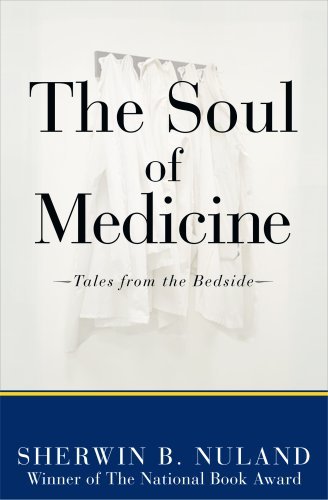 Nuland gained acclaim with How We Die: Reflections on Life’s Final Chapter, which won the National Book Award in 1994. Highly informative yet unflinching, it sought to detail just what happens when we die. He gave us a doctor’s view with, among others, The Uncertain Art: Thoughts on a Life in Medicine, a collection of essays. And he showed us just how human doctors are when he was brave enough to pen Lost in America: A Journey with My Father, a memoir in which he detailed a depression so severe that he almost had a lobotomy to try to cure it. Nuland gained acclaim with How We Die: Reflections on Life’s Final Chapter, which won the National Book Award in 1994. Highly informative yet unflinching, it sought to detail just what happens when we die. He gave us a doctor’s view with, among others, The Uncertain Art: Thoughts on a Life in Medicine, a collection of essays. And he showed us just how human doctors are when he was brave enough to pen Lost in America: A Journey with My Father, a memoir in which he detailed a depression so severe that he almost had a lobotomy to try to cure it.
The Soul of Medicine is not as strong or compelling as How We Die or Lost in America. Because it collects the personal stories of more than a dozen physicians regarding their most memorable patients, it is closer to his essay collection. Nuland tells each story from the first person perspective of each narrator in the unrelated tales. In the prologue, he explains that he does so to help mask details that might breach confidentiality and to also allow him to provide commentary on various stories. Nuland indicates he wants this to be “a sort of Canterbury Tales of medicine,” one by which to examine the dynamic relationships, particularly doctor-patient, that arise in the practice of medicine.
While Nuland seeks to illuminate personal aspects of the practice of medicine and Canterbury becomes the name of the hospital in many of the stories, the book cannot invoke as many perspectives as The Canterbury Tales. Just as the stories span a time frame from World War II through today, they cover a broad range of issues — some seemingly more relevant than others — and characters both heroic and despicable. Several show how the doctor learns from the patient. Others are inspiring or touching, such as the elderly man whose stroke-like episode left him having hallucinations of his deceased wife’s face. When offered a drug that would stop the hallucinations, he declined it. He preferred seeing his wife’s face.
Nuland himself tells of the doctor-patient relationship from the perspective of him being the father of the patient. With that exception, these stories are told from the standpoint of the doctor. Often, they are as much about the doctor as their teacher or patient. And some are not afraid to relate tales where the conduct was not exemplary. Thus, an anesthesiologist recalls a respected and talented surgeon with bipolar disorder who went off his meds while on vacation. Upon entering the operating room for a routine gall bladder operation, the surgeon groped a nurse and sped into the operation, including removing and discarding part of a healthy stomach and slashing the patient’s aorta before being restrained by three orderlies. Then there’s the chest surgeon who admits still having “a perverse pride” in getting a night nursing supervisor fired before she could report his sexual tryst with a student nurse
Yet one public breach of decorum is also one in which the actions are most understandable. A neurosurgeon recalled a two-and-a-half-year-old boy who suffered a fatal brain injury when his mother’s boyfriend threw him against a wall. During their efforts to save the boy, the medical team discovered a body covered in days old bruises and with an extensive tear in the rectum. As the neurosurgeon went to tell the mother the child had died, he spotted the boyfriend, already in police custody.
I could not help turning to the behemoth and positioning myself on a chair so that my face was within inches of his bloodshot and now terrified eyes. I wanted to be sure that he could see the bits of brain clinging to my gown, the front of which was soaked in the fresh still-scarlet blood of the child he had killed. “This is what you did,” was all I was able to say, because I was afraid I would vomit if I tried to speak another word.
To make sure there was no doubt left for law enforcement, the doctor concluded the operative chart with the handwritten entry, “The mother and her boyfriend are the stuff of worst nightmares.”
Fortunately, most of the memorable patients in this collection are not involved in nightmare tales. And while their stories may not always end happily, they do help illuminate the range of experiences in the day-to-day practice of medicine.
To be told by your patient that he has confidence in you, even as your inability to help him becomes increasingly clear, is to feel like the worst hypocrite in the world.
Sherwin Nuland, The Soul of Medicine
I try to stay away from politics. But sometimes I can’t, such as when its sanctimony is on display in adjoining headlines on two local front page stories in this morning’s local daily.
Headline 1: “Thousands protest federal spending”
Headline 2: “Water project reaps windfall”
That’s right. We held a tea party to haughtily throw tea boxes, including one labeled “Stimulus,” into Covell Lake. The same day we rejoiced in the fact the stimulus package provided a $56.5 million grant to speed completion of the Lewis & Clark Regional Water Project. The latter comes barely a week after the project received record funding in the federal budget.
Excuse me, but isn’t there a bit of a disconnect? Do the protesters, who also brought a pig wearing a “No More Pork” banner, want to ship the sides of ham for Lewis & Clark back to Washington? But then, I’m forgetting a cardinal rule of politics: if it’s yours, it’s pork; if it’s mine, it’s essential funding.
Of course, the organizers say the Covell Lake event “was not political” (nudge, nudge, wink, wink). Since this apolitical event focused on government spending and the federal debt, let me make an equally apolitical observation. Cost of the stimulus package: $152 billion. Cost of the Iraq War: Approaching $650 billion.
Even setting aside my understanding that construction projects and jobs generate tax revenue, rudimentary math tells me the latter plays a bigger role in the debt. But I suspect it wasn’t in any of the tea boxes at the party.
(Originally posted at KELOLand Blogs.)
All issues are political issues, and politics itself is a mass of lies, evasions, folly, hatred and schizophrenia.
George Orwell, “Politics and the English Language“
|
Disclaimer 
Additionally, some links on this blog go to Amazon.com. As an Amazon Associate I earn from qualifying purchases. There is no additional cost to you. Contact me You can e-mail me at prairieprogressive at gmaildotcom.
|