|
|
Having waded through the book journal for the A to Z list, time for the top 10, even though my list probably isn’t as important as other lists of favorite books. As I indicated, some books on this list weren’t on the A to Z list because of that list’s limitation of one book per letter. The top 10 are listed in alphabetical order and I would bet one or more might change if I made the list next week or next month.
1984, George Orwell — There may not have been many classics on my A to Z list but there was little doubt this one would end up here. Not only is this a standard setter for dystopian novels, there aren’t a lot of novels whose title and terms (“Big Brother”, “newspeak”) are ubiquitous worldwide some 50 years after being published.
Darkness at Noon, Arthur Koestler – To a certain extent, this novel is Orwell writing during the heart of the Cold War. Its examination of Stalinist purges, the self- and reevaluation of a longtime party leader and its stark imagery make it an incomparable political novel. While the end of the Cold War tends to date the book a bit today, its lessons are timeless and it will always be a masterpiece from my standpoint.
Gilead, Marilynne Robinson — I don’t know that I can say much more than I did in my review almost two years ago. As I said then, Robinson’s deliberate pace leads to our enjoyment as she “cultivates a literary garden she spent much time preparing.” One of the few Pulitzer Prize winners for fiction that I truly liked loved.
Letter to a Christian Nation, Sam Harris — Simply one of the most cogent and concise indictments of the role and effect of religion in modern society and life.
A Million Little Pieces, James Frey — While I don’t know if this is considered fiction or nonfiction today, I still stand by the fact this book ranks near the top, if not the very top, of any list of books I considered “unputdownable.”
Notes to Myself: My Struggle to Become a Person, Hugh Prather — Perhaps it is ironic to have this book on the same list with Letter to a Christian Nation given it is written by a Methodist minister and his collection of thoughts and observations are often spiritual in nature. But you don’t have to agree with everything to recognize the value of some things. Besides, if it helps you learn something about yourself, who cares where it comes from?
Saturday, Ian McEwan — I know some people didn’t like it or don’t think this was McEwan at its best. And I really don’t care whether it is indicative of a post-9/11 genre in fiction or what it may say about post-9/11 life. The main character’s thoughts on music and life with a parent with Alzheimer’s are just one indication of what a masterful novel this is.
The Sparrow, Mary Doria Russell — Other than Orwell, this is the only SF work on the list. Considering how many SF classics I’ve read and that my library is packed with books by Arthur C. Clarke, Isaac Asimov and every Hugo Award winning novel, that perhaps says more than anything could about how much I love this book.
The Things They Carried, Tim O’Brien — There have been and undoubtedly will continue to be dozens of books, both fiction and nonfiction, looking at the Vietnam War. I sincerely doubt that any will ever compare with O’Brien’s collection of short stories from the viewpoint of the men who fought in that war.
A World Lit Only by Fire, William Manchester — When people think of the Middle Ages it often tends to be with images of knights, damsels in distress and the plague. In an almost brilliantly concise and readable way, Manchester shows the average reader what that time period really was like and its role in the overall history of humanity.
I’m not quite sure what anyone else will derive about me or my tastes from this and the A to Z lists. From my standpoint, I think it reinforces what I’ve long thought. My reading tastes tend to be just a tad bit eclectic.
Perfectionism is a slow death.
Hugh Prather, Notes to Myself
The second half of the alphabet was the harder of the two parts of the “A to Z” list. One reason is not surprising. I haven’t read a lot of books beginning with “Q” or “Z”, thereby severely narrowing the field of contenders. On the other hand, I was surprised how many books I consider among my all-time favorites started with “S”. The choice there was difficult and, although I haven’t quite completed it yet, I speculate at least two books from there will make my list of 10 books I can’t live without. One interesting note. While Part 1 of the list was heavy on books I read in the 1970s, today’s list is populated most with books from this decade.
N — Notes to Myself: My Struggle to Become a Person, Hugh Prather (1975). Okay, so this is touchy feely stuff but these thoughts and observations from Prather’s journals gave me some insight at various times I felt things weren’t going well. It is perhaps the most worn and underlined book in my library.
O — The Outsider: A Journey Into My Father’s Struggle With Madness, Nathaniel Lachenmeyer (2001). A son’s memoir about his father isn’t unusual. But when that father goes from university sociology professor to homelessness, mental institutions and squalor due to paranoid schizophrenia, the take is more than a bit different. After his father’s death, Lachenmeyer tries to reconstruct his father’s life, using letters he received after his father left the family and interviewing those who knew him in those intervening years. It is one of the more compelling stories of mental illness — and the disappearing safety net for those who suffer them — I have read.
P — Perdido Street Station, China Mieville (2002). This is one of two books on today’s list that are near impossible to describe. At best, you can call thise one a combination of fantasy, science fiction and horror. However you describe it, Mieville creates a fascinating world that leaves part of you wanting to read faster to see what is going to happen and another part of you saying slow down because you’re enjoying it so much.
Q — QB VII, Leon Uris (1985). A respectable choice given the few books eligible here. This is a fictional account of a British libel suit against an author who identifies a noted doctor as having worked at a Nazi death camp. How much you enjoy the book may depend on how much you like its rather faithful adherence to British legal practices, which are unfamiliar to most Americans.
R — The Russians, Hedrick Smith (1977). This letter, like the following one, had plenty of contenders for some reason. In fact, I went back and forth among several books. Ultimately, though, this intimate portrait of Russians and their country won out. Somewhat dated now because it was written in the Cold War era, it is one of those books that lets you see the people of a country and the reality of their lives, not just its politics and government.
S — The Sparrow, Mary Doria Russell (1996). Despite several excellent contenders, there ultimately was no doubt which would end up on this list. Russell’s tale centers on a Jesuit priest assigned to a Jesuit-organized mission to a planet from which a radio signal of beautiful music has been received. The story unfolds from two perspectives — one telling of the journey, the other of accusations made against him in the aftermath of the mission, of which he is the only survivor. A brilliant use of SF as a vehicle to explore issues of faith, religion and morality.
T — The Things They Carried, Tim O’Brien (1999). Quite simply the finest book about the Vietnam War I have ever read. It is comprised of short stories that have enough commonality to almost make it a novel. Although fictional, it feels more like memoir. O’Brien, who hails from Worthington, Minn., won the National Book Award for his earlier novel, Going After Cacciato. I not only found this book to be better, it was so “unputdownable” I was irritated by the interruption caused when the plane I was on when I began reading it landed.
U — Undaunted Courage, Stephen Ambrose (1996). This highly readable rendition of the Lewis and Clark is my favorite work of Ambrose, who did as much over the last couple decades to popularize American history as any other author. Although relying heavily on the journals of the expedition, Ambrose goes far beyond that and helps us understand the magnitude of this undertaking and journey.
V — Voices from Chernobyl, Svetlana Alexievich (2006). This book is exactly what it purports to be — an oral history of the Chernobyl nuclear disaster told exclusively in the voices of those directly affected by it in one way or another. Journalist Alexievich simply lets those she interviewed tell their stories with no commentary or narrative (or even questions) of hers. Not only does the book help us understand the magnitude of the disaster, it shows its impacts and effects at the personal level.
W — A World Lit Only by Fire, William Manchester (1993). Granted, you can’t tell an in-depth history of the Middle Ages in approximately 300 pages. Yet in-depth history was not Manchester’s goal and his book is a masterpiece for grasping a basic understanding of that time period. It is written so well it started me on a medieval history kick for several years. Along with the much longer and more detailed A Distant Mirror by Barbara Tuchman, it remains my favorite work on the period and Manchester is the only author to appear twice on this list.
X — The X-President, Philip Baruth (2003). This is the story of a woman hired in 2055 to help write the official biography of the 109-year-old former president known only in the novel as “BC.” And if you can’t figure out who “BC” is, you haven’t been awake over the last 15 years. Baruth has an interesting take on the effect of decisions “BC” made and some he didn’t that led to a the US being in a losing world war. How to solve that problem? Time travel, of course.
Y — The Year of Magical Thinking, Joan Didon (2005). Didion’s award-winning memoir of her husband’s sudden death and the ensuing year was one of my favorite books of 2005. Yet it isn’t just about sorrow. It gives us a broader insight into grief and grieving and the impact of loss on life as a whole. As I said in my review, her recounting of how even minor things could set off what she called a “vortex” of memories is one of the things that makes the book stand out.
Z — Zanesville, Kris Saknussemm (2006). Almost a year ago, I asked, “In what part of the universe does this guy’s mind reside?” That question still exists today as Zanesville remains one of the most unclassifiable works I have ever read. Trust me when I say Saknussemm’s description of the book as “techno-theological post-American monster vaudeville” is as good a description as any. He takes us to Texas, New York, South Dakota (where “the speed of culture” runs slower) and “LosVegas, Nevadafornia” in a wonderfully weird vision of a future America.
I really resent the idea that the only reason someone might be good or moral is because they’re religious. I do what I do . . . without hope of reward or fear of punishment. I do not require heaven or hell to bribe me or scare me into acting decently.
Mary Doria Russell, The Sparrow
For some reason, it didn’t sink in until a couple minutes after I put up the last post, which had an item dealing with the so-called “Lost Tomb of Jesus.”
Turns out the archaeological site from which these ossuaries were recovered was discussed in the introduction to James Tabor’s The Jesus Dynasty, which I reviewed last October. Tabor has been keeping up on developments on his blog, including his appearance at the press conference announcing the discovery and forthcoming television program, in which he apparently appears.
I have no clue whether the assertions being made are anywhere near the mark. That said, I find it irritating that people are already staking out positions on both sides of this. How about we watch the program, perhaps read the accompanying book and give some thought and evaluation to it all? Of course, I understand that is an approach that is far too foreign (or dangerous) to traditional concepts of religious belief and faith. At the same time,non-believers cannot already pronounce this determinative without looking deeper into the facts.
The trouble with having an open mind, of course, is that people will insist on coming along and trying to put things in it.
Terry Pratchett, The Bromeliad Trilogy: Diggers
A couple of things drove me a bit crazy (not a long trip) over the last few days. No, it wasn’t the weekend snow or even the reports more are on the way. On Saturday night, my MP3 player died. You know things aren’t looking good when the message “Hard Drive Failure” appears when you turn it on. Serious and repeated resuscitation efforts proved fruitless. Thus, I am sans MP3 player and not happy.
Then yesterday I was finalizing arrangements for a trip to Washington, DC. I fail to understand why it costs $200 a person less to fly from Omaha to Washington than from Sioux Falls to Washington when the connecting flight into and out of DC is the same. And why take connecting flights out of Sioux Falls if you can fly direct from Omaha and save $800? Likewise, I do not understand how a standard hotel room in downtown DC can run $399 a night plus about 15% tax. I’m sure I could find something cheaper in outlying areas but it complicates getting to and from the CLE I’m attending and coordinating with the wife and kids in connection with their adventures while I’m at the CLE.
But just to show I’m not the only one running around half-crazed, here’s a couple items from the last several days dealing with the crazed or fanatical:
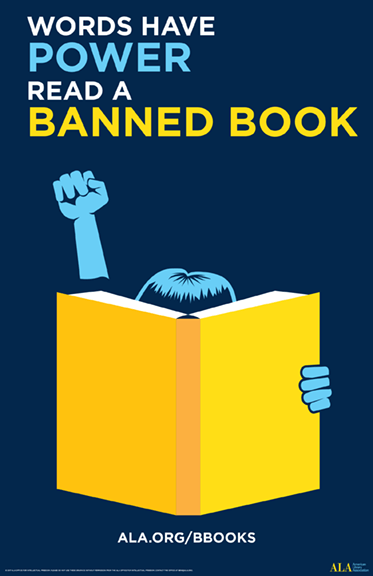
- Why follow any defined procedure or process to get rid of books you don’t want in the school library? Just check them out and never return them. (Via Book Chase.)
- A wonderful t-shirt response to other book banners.
- NASA is ready if any astronauts go crazy — in space, that is.
- If you haven’t heard already, James Cameron, the director of Aliens and Titantic fame, claims to have found the family tomb of Jesus Christ, including his wife. I’m guessing that not only won’t this divert the media from important things like Anna Nicole Smith and Britney Spears, true believers won’t care what the evidence actually may be, greeting it simply with “outrage.”
If we couldn’t laugh, we would all go insane
Title Track, Jimmy Buffett, Changes in Latitudes, Changes in Attitudes
The seed for this post and its second part was planted with a Maureen Dowd column two years ago. In it, she wrote about making a list of books from A to Z that would help someone perhaps gain some insight into the person making the list. It’s something I’ve thought about doing ever since but just got around to actually doing in the last couple weeks.
Having completed the task, I’m not sure what, if anything, it reveals and leave that to you. The biggest problem Isee with the list has two aspects. First, some books made the list simply because of the sparsity of choices for certain letters (“Q” comes to mind) and might not otherwise be on a favorite books list. On the flip side, some of my favorite books aren’t included because some letters seem to have an abundance of excellent choices.
The list comes from the book journal I’ve kept since 1975 (and which is not complete for that year). Thus, any book I read before my second semester of college is not included. While that may eliminate a number of classics, I figure if I haven’t taken the time to reread it over the last 30 years, it probably wouldn’t make the list any way. Thanks to the book journal, I am also putting the year I first read the book in parentheses in the entry.
Here’s the selections for the first 13 letters (the words “A” and “The” were ignored at the beginning of titles). This installment indicates I read a helluva lot of great books from 1975 to 1978.:
A — Accelerando, Charles Stross (2005). As I said in my review, this is SF that will make your brain hurt — but in a good sort of way. As our reliance on technology and the power of that technology increases, this work explores the future societal implications of the convergence of the two. And after all, isn’t that one of the main themes of SF, looking into and speculating about our future?
B — The Boys on the Bus, Timothy Crouse (1975). Certainly dated now, this book went inside the campaign press corps during the 1972 presidential election. As a straightforward counterpoint to Hunter Thompson’s Fear and Loathing: On the Campaign Trail, it had a significant impact on me, pushing me more toward political reporting.
C — Cat’s Cradle, Kurt Vonnegut (1978). This was the first of four or five letters that are really tough. There were at least four other books I seriously considered here. This book won out, though, when I realized it was really the Vonnegut work that led me to start consuming his books, something that ultimately made him one of my favorite authors.
D — Darkness at Noon, Arthur Koestler (1976). This fictional account of a party leader who falls subject to a Stalinist purge gave me more insight into the reality of life in the Soviet Union and the Eastern Bloc than probably any other written works, including Solzhenitsyn’s. I don’t reread a lot of books, particularly ones originally assigned for a class. I’ve read this one once every decade.
E — The Execution of Private Slovik, William Bradford Huie (1976). I still vividly recall the 1974 TV adaptation of this book, first published in 1954. In fact, it led me to read the book, which tells the story of Eddie Slovik’s execution in January 1945, making him the only American soldier to be executed for desertion since the Civil War.
F — The Foundation Trilogy, Isaac Asimov (1975). Okay, this is probably unfair since it really is three books but the combination of them makes one of SF’s greatest masterpieces that much better. Besides, I read all three titles (Foundation, Foundation and Empire, Second Foundation) in a row and they are/were available in a one volume set.
G — The Glory and the Dream, William Manchester (1975). Originally published as a two-volume hardcover, the subtitle of the book says it all: A Narrative History of America, 1932-1972. This well written and highly readable book may be in part responsible for a growing interest in history and, ultimately, a history minor in the ensuing years. As an aside, this is not the only Manchester work on the list that sparked an interest in history.
H — The Hitch Hiker’s Guide to the Galaxy, Douglas Adams (1982). Who would have ever thought such a thoughtful and great work of SF could also be so hilarious. This is SF for both the fan and those who claim to hate the genre.
I — I Will Bear Witness: A Diary of the Nazi Years, 1933-1941, Victor Klemperer (1998). This is the first of two books of the actual diaries of a man who was the son of a rabbi, a Protestant convert, a decorated World War I veteran and a professor of French literature at Dresden University. His accounts of Nazi policies and their effects mixed in with the course of his everyday life build as gradually and inexorably as the policies themselves, making this one of the finest firsthand accounts of life in Hitler’s Germany.
J — Julian, Gore Vidal (1977). For those who don’t know, Julian was the last pagan Roman emperor. He, in fact, converted to paganism from Christianity and sought to restore polytheism as the leading religion and to reduce the influence of Christianity in public affairs. Vidal’s fictional account of Julian’s life may be one of the best works of historical fiction I’ve ever read. As the first Vidal work I ever read, it led me to many of his other fictional works and made me a big fan.
K — Kooks: A Guide to the Outer Limits of Human Belief, Donna Kossy (1994). I happened to pick this book up on a lark in a New Age type shop near Big Sur. It turns out to be an interesting guide to what one blurb calls “the growth science of Crackpotology.” Collecting a variety of kooky or bizarre beliefs ranging from religion to politics to the origin of species, including reprints of handbills handed out on street corners, it is a wonderful survey of fringe beliefs.
L — Letter to a Christian Nation, Sam Harris (2006). It should be no surprise that a book I bought copies of to give away would make the list. I called this commentary on the role of religion in our nation “a must read book of the year.” Let me modify that a bit. It is simply “a must read book.”
M — A Million Little Pieces, James Frey (2003). I know. It’s real easy to roll your eyes or just dump on this book given Frey’s misrepresentations. But I really don’t care if the entirety of the work is made of whole cloth. The style and story are so compelling that I’ve never questioned whether the book would make this list.
Never let your sense of morals prevent you from doing what is right.
Isaac Asimov, Foundation
|
Disclaimer 
Additionally, some links on this blog go to Amazon.com. As an Amazon Associate I earn from qualifying purchases. There is no additional cost to you. Contact me You can e-mail me at prairieprogressive at gmaildotcom.
|