|
|
With apologies to Warren Zevon for the title, today’s local daily confirmed I’m on a bad streak.
First, I learn the Red Willow Band is playing in the Great Hall on September 16. Then, the daily announces Bob Dylan is returning to Sioux Falls Stadium on September 8. All though both are within days of a milestone birthday, I, of course, will not be around either date.
Blame it on a simple twist of fate.
“Simple Twist of Fate,” Bob Dylan, Blood on the Tracks
Although his writing covers everything from cyberpunk to space opera to alternate history and fantasy, Charlie Stross is, for good or bad, viewed as one of the leading SF authors exploring the Singularity. Fans of that aspect of his writing will be pleased to know that his latest novel, Glasshouse, continues delving into the Singularity. Fans who appreciate Stross’ other works will be equally happy to know that Glasshouse explores much more ?— and that may make it a perfect introduction for the uninitiated.
The novel opens in the 27th century, centuries after the Singularity, which, as in his Hugo Award-nominated Accelerando, Stross calls “the Acceleration.” Broadly speaking, the Singularity is a point in the future where technological and societal change produce such superhuman intelligence that those who precede the event are unable to comprehend it. This “Rapture of the Nerds” produces a “posthuman” society in which technology and biology are almost seamlessly interconnected and interdependent.
Glasshouse is told from the viewpoint of Robin, who is just adjusting to “identity reindexing.” Robin had a “radical rebuild,” in which he had virtually all his memories purged. His only clues to his past are a letter he wrote himself (he thinks) before the procedure. He lives in a society still recovering from the “censorship wars.” The post-Acceleration humans of Robin’s universe travel by teleport gates that can transport them interstellar distances. Some “cognitive dictatorships” infected the gates with a virus that allowed the the gates to censor elements of the personalities and memories of those using them, often to suit the needs or desires of the society or ruling party where the destination gate is located.
Occasional flashes of memory tell Robin he was a warrior in the battles to control the virus and those behind it. But even that isn’t clear to him. Was he “a tank regiment,” an intelligence operative, both or more?
Struggling with the psychological aspects of his situation, Robin volunteers for the Glasshouse, an experiment created by archaeologists, historians, psychologists and social engineers. This “experimental polity” is meant to resemble life during the period from 1990-2010, “the middle of the dark ages.” The dark ages, generally the period from 1950 to 2040, are considered such because of the frequent incompatibility caused by the rapid change in methods of storing data. Because data from one period (e.g., magnetic tape) was not compatible with or always transferred to later storage forms (e.g., digital), significant gaps exist in knowledge of that period that led up to the Acceleration. The experiment hopes to recreate how society developed during that time. To encourage historical accuracy, participants are awarded or lose credits based on how their behavior comports with what are believed to have been the standards of that time.
Yet that gap also means those setting the rules governing the polity do not fully understand those bits of knowledge they do possess. For example, they view as a standard, rather than an option, the male going to work and, upon returning home, sitting on the couch watching TV with the female relegated to the role of homemaker. As usual, though, Stross delves deeper. Not only does he play with gender and gender roles, using posthuman characters who do not understand the historic meaning and significance of the rules by which they must live allows Stross to explore and comment on religion, politics, security, relationships and numerous cultural habits, customs and mores of today’s society.
Once in the Glasshouse, Robin begins experiencing states in which more parts of his memory are restored. But, again, Robin is never quite certain whether they are real or a manifestation of a psychological disorder. These events also lead Robin to suspect evil is afoot in the experiment. The investigation of that suspicion and changes in Robin’s own psychological state provide thriller-type plotlines that further enable Stross to simultaneously examine the history of the Acceleration and post-Acceleration society.
A few plot devices used to resolve the mystery of the experiment and the intent of its creators left me feeling make this a slightly weaker work than Accelerando. Yet in the scheme of things, that is a quibble. With Stross once again blending of Acceleration/Singularity concepts, what some might analogize to “hard SF,” with a more straightforward story examining today’s world, similarly analogous to “soft SF,” solidifies his reputation and standing. Fans will welcome and enjoy Glasshouse. Hopefully, it will also lead scores more readers to discover his innovative work.
Time is a corrosive fluid, dissolving motivation, destroying novelty, and leaching the joy from life.
Charles Stross, Glasshouse
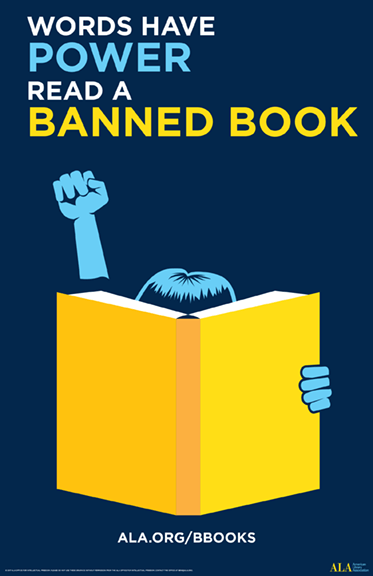
Although it’s still two months away, recent news stories reflect the importance of Banned Books Week, scheduled the last week of September. The handbook for the event includes both a list of banned and challenged books and the stories behind some of this year’s efforts.
Here’s some of the books appearing in the latter:
Strikes me that these are books you would expect to find in a quality library.
Ideas are only lethal if you suppress and don’t discuss them. Ignorance is not bliss, it’s stupid. Banning books shows you don’t trust your kids to think and you don’t trust yourself to be able to talk to them.
Anna Quindlen, New York Times, April 27, 1993
South Dakota J.A.I.L.er-in-Chief Bill Stegmeier says he wrote the Attorney General and asked for changes in the ballot explanation the AG’s office wrote. Of course, all the article establishes is that BS either is wholly ignorant of the amendment he supposedly authored or just has a compulsion to keep telling the same lies about it because the truth hurts so much.
According to the news article:
Stegmeier insisted that Amendment E only mentions judges in its language. In his letter to Long, Stegmeier said that he asked for an explanation of how accountability would fall on a school board member or another member of a governmental board.”(The board members) don’t make individual decisions, they vote as a group,” Stegmeier said. “They’re stretching it quite a ways to say that any board member would fall under the authority of the amendment.”
Maybe the supposed author of J.A.I.L. should read it, although some of his prior statements show that he has but has decided to forget what he said the measure meant then. While the proposal does speak in terms of judges, it defines a judge to include “all other persons claiming to be shielded by judicial immunity.” That includes the government officials mentioned in the ballot explanation.
Don’t believe me? Well how about the fact Stegmeier told residents of Madison that “with the passage of SD J.A.I.L., any governmental employee (of any stripe, shape, or flavor) previously accustomed to violating the rights of South Dakota citizens while hiding behind the bogus doctrine of ‘judicial immunity’, will now have to shape up or ship out.” (Emphasis added.)
Or how about Ron Branson, the Californian who is, in fact, the author of J.A.I.L. He said last year after J.A.I.L. was on the South Dakota ballot:
The criterion under J.A.I.L. is not what a person’s title is –it can be a janitor, a clown in a circus, –anything. The criterion under J.A.I.L. is if a person, regardless of title or position, who allegedly violates the law as specified in the Initiative, has been deemed by the judiciary to be shielded by judicial immunity. . . . .
* * *
Liability has to extend from the beginning participants, including administrative officials in an administrative case, through the final participants[.]
(Emphasis as in original.) In other words, the ballot explanation is right and Stegmeier is trying to hide the truth.
Stegmeier also told the newspaper he
objected to the assertion that jurors would fall under the amendment’s jurisdiction, since they only determine verdicts of guilty or not guilty or become deadlocked with a hung jury.”I don’t even see how a juror could come close to violating an individual’s rights, since a member of a jury doesn’t make that kind of a decision,” Stegmeier said.
Guess this is yet another case of the “author” not understanding what he wrote. Since the proposal defines judges as those entitled to judicial immunity and jurors are entitled to judicial immunity, they fall within J.A.I.L. That means, for example, that jurors could be brought before the special grand jury for rejecting a rapist’s alibi defense as that would be “deliberate disregard of material facts.”
But Stegmeier doesn’t limits his misrepresentations to the amendment itself. He told the reporter that “only South Dakota residents are working on its passage this fall.” Guess he forgot the recent fund raising letter listing Gary Zerman as in charge of “media relations” for the ballot measure. Guess he also forgot that the brochure sent with that letter said anyone with “questions or comments concerning” the measure should contact Zerman. Zerman, if you don’t already know, is a California lawyer who is legal counsel to Jail4Judges and its second in command.
While the South Dakota J.A.I.L.ers keep telling the same lies over and over, the ballot explanation tells the truth about J.A.I.L. No wonder Stegmeier and crew are so scared of it.
[H]e who permits himself to tell a lie once, finds it much easier to do so a second and third time, till at length it becomes habitual[.]
Thomas Jefferson, Letter, August 19, 1785
In part due to catching up on items from over the weekend, a sooner than usual installment of marginalia:
- I’d seen this a while ago but it’s certainly advanced since. Go play with the literature map. (Via So Many Books).
- Everybody wants a free t-shirt, right? So, go see my friend MinusCar, contribute 300 words and you could walk away with a nice shirt (even “preworn” if that’s your thing). Besides, I am beginning to come closer to the “minus is the new plus” view.
- Steely Dan takes a somewhat satirical exception to Owen Wilson’s You, Me and Dupree. (Via Rock & Roll Daily).
- I swear. I told someone a year or more ago that the FCC’s indeceny fixation would come to this. (Registration or BugMeNot required).
- Speaking of irrationality, here’s yet another example from a religious standpoint.
- If you’re a fan, Eos Books, the SF/F imprint of HarperCollins, has launched its own blog.
Imagine all the people
Living life in peace
“Imagine,” John Lennon, Imagine
|
Disclaimer 
Additionally, some links on this blog go to Amazon.com. As an Amazon Associate I earn from qualifying purchases. There is no additional cost to you. Contact me You can e-mail me at prairieprogressive at gmaildotcom.
|