|
|
Usually, I try to use album releases and recording sessions as the basis for these features. But something struck we when I realized that September 15 was the anniversary of the death of jazz pianist Bill Evans. When he died in 1980, he was barely 51. That’s what struck me. With my birthday this week, I am two years old than Evans was when he died. It brings home how young he was, at least from my perspective.
 Like many others, I place Evans in my pantheon of jazz pianists. He’s also one of the reasons I dislike use of the term “smooth jazz” to describe a relatively recent subgenre of jazz. To me, Evans is the epitome of what I consider smooth jazz, smooth as in silky and luminous. Many, including Evans himself, described the phrasings he used as like singing. Like many others, I place Evans in my pantheon of jazz pianists. He’s also one of the reasons I dislike use of the term “smooth jazz” to describe a relatively recent subgenre of jazz. To me, Evans is the epitome of what I consider smooth jazz, smooth as in silky and luminous. Many, including Evans himself, described the phrasings he used as like singing.
Even among those who aren’t true jazz fans, Evans is known for his contributions to Miles Davis’s Kind of Blue, for which, among other things, he co-wrote the classic “Blue In Green.” While his performance on that album is stunning, anyone who cares about music needs to listen to the trios Evans formed, particularly with bassist Scott LaFaro and drummer Paul Motian. That trio released just four albums before LaFaro’s death in a car accident in 1961.
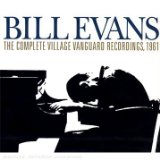
Two of those albums — Sunday at the Village Vanguard and Waltz for Debby — were recorded live at the Village Vanguard in New York City on June 25. 1961. (LaFaro’s fatal car accident was 10 days later). Both are stunning and must haves for anyone who loves jazz. As far as I am concerned there is only one item better in the entire Evans catalog — The Complete Village Vanguard Recordings, 1961. Released in 2005, this box set contains all three performances that day in order. It is, in my mind, one of the best jazz box sets available and, as I’ve said before, “a slice of heaven in a box.”
I’m one of those who view this stretch as the high point of Evans’s career. He released numerous albums as a soloist or leader in the ensuing two decades but they seem inconsistent. Undoubtedly, that had a lot to do with his drug problems. Evans became a full-blown heroin addict during his time with the Miles Davis Sextet in 1958 and 1959. Although he eventually kicked heroin, by the 1970s he was caught up in cocaine. In fact, in Peter Pettinger’s excellent biography, Bill Evans: How My Heart Sings, a close friend called Evans’s death “the longest suicide in history.”
Still, when his last gigs, performed from two weeks to a week before his death, were released in an 8-CD set in 2000, the release garnered rave reviews. My fellow Blogcritic Ted Gioia, who happened to see Evans perform during those last gigs, summed it up quite well a couple months ago: “You hear Evans’s harmonic colors and conception everywhere these days — and not just in the jazz world. In any attempt to gauge the impact of keyboardists from this era, only [Thelonious] Monk can rival Evans, and that only in the deepest inner sanctum of jazz.”
That, I think, is why the coincidence of the dates of Evans’s death and my birthday really struck me this year. The thought isn’t comparing how much he accomplished compared to me, it is wondering what more he could have given us had he lived longer.
Especially, I want my work — and the trio’s if possible — to sing.
Bill Evans, quoted in Bill Evans: How My Heart Sings
We hear a lot lately about the struggles of traditional news media in the Internet age. But it seems a lot of people believe the damage may be self-inflicted.
A new study by the Pew Research Center for the People & the Press indicates the fewest number of people in more than two decades believe the media accurately reports the news. The study shows that in July 2009 only 29% of Americans believe news organizations generally get the facts straight, while 63% say news stories are often inaccurate. That is a drastic change from when this was first surveyed in July 1985. Then, 55% said news stories were accurate while 34% said they were inaccurate.
What should be equally concerning to news organizations is that this attitude also seems to be reflected in views of its stature. Today, a full 70% say the press tries to cover up its mistakes, compared to 55% in 1985, while those saying the press is “highly professional” dropped from 72% in 1985 to 59% this year. The latter mirrors almost exactly the increase in those saying the press is “not professional,” up to 27% this year from 11% in 1985. These results also appear to reflect some degree of partisanship in American politics. For example, while 11% of both Democrats and Republicans considered the press not professional in 1985, this year it was 39% of Republicans and 18% of Democrats. Yet there is one area where the decrease in believability was more bipartisan. In 1985 37% of Republicans and 32% of Democrats said the media was often inaccurate compared to 69% of Republicans and 59% of Democrats this year.
Polarization in American politics over the last two decades in seen in other areas. For example, nearly three-quarters of Republicans (72%) view Fox News favorably compared to 43% of Democrats. While I’m surprised the last number is that high, I am even more shocked that in 2007 61% of Democrats viewed Fox News favorably. For comparison, only 16% of Republicans view the New York Times favorably compared to 39% of Democrats. While Fox News was the media outlet viewed most favorably by Republicans, for Democrats it was CNN at 75% (compared to 44% for Republicans).
What perhaps isn’t surprising is that, as a rule, local news outlets fare a bit better. A majority of people hold favorable opinions of local TV news (73%) and the daily newspaper they are most familiar with (65%). But there’s also bad news for newspapers which most people won’t find surprising. While television continues to be the main source of national and international news for most (715), the Internet is now second in that category. It increased from 24% in September 2007 to 42% now, while newspapers stayed roughly the same (34% and 33%, respectively). The only saving grace for newspapers appears to be local news, where 41% rely on newspapers and only 17% on the Internet. It isn’t clear, though, whether the survey distinguished between how many of those relying on the newspaper for local news were getting the news from the dead tree version or off newspaper web sites.
As the survey was conducted in July, they don’t reflect the impact of the coverage of the health care reform debate during the August Congressional recess. I speculate the media would fare even worse in the accuracy department across the board.
Media is a word that has come to mean bad journalism.
Graham Greene, Ways of Escape
I’m finally caving in on this meme, which has been floating around for a couple weeks. I figured since it’s my birthday I can do what I want, right? So, here’s the deal, the meme requires answering the following questions using only the titles of books you’ve read this year without repeating any of the titles. Not sure what it may tell you about me (or me about myself) but….
Describe Yourself: The Sixties
How Do You Feel?: Blameless in Abaddon
Describe Where You Currently Live: American Pastoral
If You Could Go Anywhere, Where Would You Go?: Amsterdam
Your Favorite Form of Transportation: Magic Bus
Your Best Friend Is: The Thief and the Dogs
You and Your Friends Are: American Rust
What’s the Weather Like?: Finding the Moon in Sugar
Favorite Time of Day: Private Midnight
What is Life to You: A Free Life
You Fear: Unforgiving Years
What Is the Best Advice You Have to Give?: Travel as a Political Act
Thought for the Day: Dangerous Laughter
How I Would Like to Die?: Serenity Found
My Soul’s Present Condition: Tranquility
A novel is never anything, but a philosophy put into images.
Albert Camus, Selected Essays and Note-books
Bulletin Board
I hate losing the variety of KAUR-FM but was pleased to get a letter from Minnesota Public Radio saying that, starting Sept. 15, it will become one of MPR’s all news stations.
Blog Headlines of the Week
U.S. Congress Resumes; Let Us Pray
Did Sept. 11 Make Us Fat? How The Attacks Affected The Weight-Loss Business
Interweb Stuff I Liked This Week
Exposed: The erosion of privacy in the Internet era (Via.)
Better world: Legalise drugs
How 9/11 Should Be Remembered
Bookish Linkage
The most popular books among inmates from the library at Guantanamo Bay? The Harry Potter novels, Don Quixote and Barack Obama’s Dreams from my Father. (I can hear the Joe Wilson, Michele Bachmann, Beck, Limbaugh, et al., already on the last one.)
The Daily Beast lists the three 9/11 novels worth reading. I fully agree with Saturday (it is, after all, a Desert Island Book), was not a fan of Netherland (and personally don’t really see it as post-9/11 lit) and haven’t read the third. The article never mentions Laila Halaby’s Once in a Promised Land, a novel I would definitely put on any such list list.
Another take: 9/11 and literary fallacy.
AbeBooks has opened a cyberspace Weird Book Room, “a celebration of everything that’s bizarre, odd and downright weird in books.” (Via.)
The shortlist for the 2009 Man Booker Prize was announced Monday.
Nonbookish Linkage
No wonder Osama bin Laden hates America. It made him a Whitney Houston fan.
Improved and upgraded space pr0n.
Through literacy you can begin to see the universe. Through music you can reach anybody. Between the two there is you, unstoppable.
Grace Slick, Artists for Literacy
Man who sued Match.com over unanswered e-mails is dropping the lawsuit because of “the amount of ridicule” he had to endure. (Via.)
Where’s Henry Fonda when you need him? A judge declared “a cooling-off period” for jurors deliberating in a product liability trial. The reports indicate one juror claimed she had been the subject of threats of physical violence by other jurors and had a chair thrown at her. (UPDATE: A mistrial was declared today.)
I imagine it is hard to meet people in his line of work: “A man suspected of robbing a North Side woman apparently couldn’t resist returning to her home to ask for a date.” (Via.)
But then, maybe thieves are just nice: When caught in the act, a burglar begged his victim not to call police and promised to return all the items and come back the next day to fix the door he kicked in. (Also via.)
What not to say to the police officers, Part ????: “I don’t have to do anything you say. I’m a law student.” (Via.)
Oh, great. It’s Swindle-Your-Law-Firm month.
Or your law firm could be part of a sweepstakes scam. (Via.)
A new honor in the college rankings? Duke is the Douchiest Law School, besting Hah-vahd in the finals.
But the legal job market may be improving. Now even fantasy sports disputes can be weighed on the scales of justice — or by “lawyers with plenty of spare time.” (Via.)
A lawyer without history or literature is a mechanic, a mere working mason.
Sir Walter Scott, Guy Mannering
|
Disclaimer 
Additionally, some links on this blog go to Amazon.com. As an Amazon Associate I earn from qualifying purchases. There is no additional cost to you. Contact me You can e-mail me at prairieprogressive at gmaildotcom.
|