|
|
A few more Michael Jackson law-related (at least tangentially) headlines: What will happen to Michael Jackson’s kids? and Michael Jackson: The Mother of All Malpractice Suits? (via) and, of course, Michael Jackson’s Will: The Details, an interview with a lawyer “who does not represent the Jackson family.”
“A York [G.B.] postman has been jailed for burning stacks of mail in his garden after smoking so much cannabis he was too lazy to deliver it.” (Via.)
Maybe it isn’t always a good thing to be named lawyer of the day.
After a hearing on a motion to dismiss his lawsuit, George Morgan sent the attorney on the other side a note written on toilet paper that said, “Dear Susan, Please use this to wipe your ass, that argument was a bunch of shit! You[rs] Truly, George Morgan.” Morgan was subjected to disciplinary proceedings — in the Texas prison in which he was incarcerated. A federal appeals court has now said the discipline did not violate his First Amendment rights. (Via.)
To quote Above the Law, “There are so many different reasons why one might get a severe rash from a Victoria’s Secret bra that the 17 suits filed in various states cannot be consolidated into one.”
Confidentiality agreement means ex-wife can’t talk about divorce — ever.
My decision to become a lawyer was irrevocably sealed when I realized my father hated the legal profession.
John Grisham, The Rainmaker
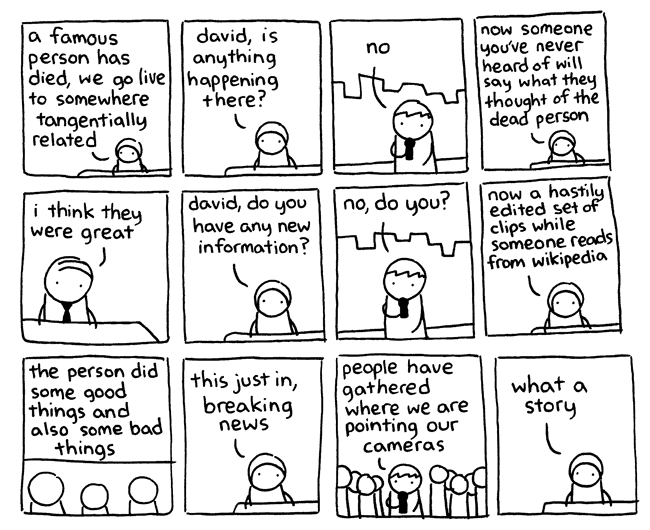
Never a big fan of MJ myself, his death again shows our culture in all its glory. A few examples:
All in all, though, I would say stereotypist sums up modern media the best:
 © John Campbell © John Campbell
One of my thoughts yesterday was how this would overwhelm the news of Farrah Fawcett’s death. As I think about it, though, maybe that’s to the benefit of her and her loved ones, who may be able to lay her to rest with a bit less of the intrusive media eye.
If you enter this world knowing you are loved and you leave this world knowing the same, then everything that happens in between can be dealt with.
Michael Jackson, speech at Oxford Union, March 6, 2001
Worried about retirement or maintaining your standard of living in your “old age”? The near-future country in which Swedish author Ninni Holmqvist’s first novel, The Unit, is set has a comfortable future in store for many women 50 and older and men 60 and older.
 Imagine this: Your own, fully furnished apartment in a complex of residents your age. Not only is the facility fully staffed, it has state-of-the art recreational facilities, a library, restaurants, shopping areas, theaters and virtually every other feature of the modern town. Not only that, it doesn’t cost you a cent. Even the shopping and medical care are free. Imagine this: Your own, fully furnished apartment in a complex of residents your age. Not only is the facility fully staffed, it has state-of-the art recreational facilities, a library, restaurants, shopping areas, theaters and virtually every other feature of the modern town. Not only that, it doesn’t cost you a cent. Even the shopping and medical care are free.
There are a few catches, though. For one, you can not leave the facility and surveillance cameras are everywhere, including your bathroom. More important, you are residing in a “Unit for Biological Material,” a facility for those who have been deemed “dispensable” because they are single, had no children and aren’t performing a job viewed as essential to the economy. Your payment, so to speak, is participating in medical experiments and donating “biological material”, such as your liver or corneas, as the need arises in the outside world. You will also probably be there only a few years before you make your “final donation,” whether it be a heart, your lungs or your liver. They will, of course, store any of your biological material that isn’t needed immediately.
While “final donation” has overtones of Hitler’s final solution, this is a dystopia in which coercion and tyranny come in the guise of care and succor. We view this highly civilized approach and supposedly humane approach to society’s needs through the eyes of Dorrit Weger, a woman who just turned 50. Rather than get married and have children, Dorrit pursued her own individual dreams and became an author. That makes her dispensable and she is taken to the Second Reserve Bank Unit with only the suitcase she packed, leaving behind her house and giving away her dog.
The Unit, translated by Marlaine Delargy, raises issues of love, gender, freedom, and social mores through the perspective of how we assess an individual’s contribution to society. Here, the focus is largely economic, where the dispensable sacrifice for the “necessary.” As Dorrit tells one of the facility’s psychologists, in this society “life is capital. A capital that is to be divided fairly among the people in a way that promotes reproduction and growth, welfare and democracy. I am only a steward, taking care of my vital organs.”
Viewing individuals as an inventory of human capital creates other subtexts. One is gender-based. There is one reason men have an additional 10 years before they might be deemed dispensable — they produce viable sperm longer than women produce viable eggs. That increased chance of producing more human capital automatically makes them more valuable.
Another subtext raises the question of the value of art and literature to society. A number of those we meet in The Unit, including Dorrit, are writers, musicians or artists. Yet such activities do not contribute as much to society as industry and commerce. As a result, those engaged in intellectual endeavors are dispensable while those who contribute to the economy are essential. In fact, the volunteer librarian has a good explanation for why the library in the unit is so busy. “People who read books,” he says, “tend to be dispensable. Extremely.”
Although thought-provoking, The Unit is not exploring entirely new topics. Still, Holmqvist’s ability to invest the reader in both the story and the characters is exceptional. It is a book you hesitate to put down. In fact, I consumed it in the space of a couple separate sittings in less than a day. Perhaps due to its feminist overtones, the book is reminiscent of Margaret Atwood’s The Handmaid’s Tale. Yet to classify or judge it as a feminist work alone is unfair. It certainly surpasses Kazuo Ishiguro’s widely praised Never Let Me Go and actually my belief that the acclaim for Never Let Me Go represented a victory of form over substance.
Hopefully, the fact this is a translated work and tends to be billed as feminist literature will not adversely affect the book’s ability to make it to bookstore shelves. The Unit deserves a wide readership.
Perhaps … the meaning of life is that it should be bearable.
Ninni Holmqvist, The Unit
Capturing the pulse or flavor of any particular place is difficult. One person perceives things differently than another. Some have access to places and locations others could never enter or may fear to enter. This is particularly so for a country as diverse as India. Aravind Adiga’s Between the Assassinations attempts to surmount that problem by putting together several loosely connected stories of life in fictional Kittur, India.
 Between the Assassinations was written about the same time as The White Tiger, for which Adiga won the 2008 Man Booker Prize. The book’s title refers to the period between the assassination of Prime Minister Indira Gandhi in 1984 and the 1991 assassination of her son, Rajiv Gandhi, who had also served as prime minister and was running for parliament at the time of his murder. Adiga considers 1991 “the great divide in modern Indian history,” the year in which Indian opened itself to the global market. While The White Tiger is set after that time, Between the Assassinations is set specifically in that time frame, a period he views as “years largely of squandered idealism and hope.” Between the Assassinations was written about the same time as The White Tiger, for which Adiga won the 2008 Man Booker Prize. The book’s title refers to the period between the assassination of Prime Minister Indira Gandhi in 1984 and the 1991 assassination of her son, Rajiv Gandhi, who had also served as prime minister and was running for parliament at the time of his murder. Adiga considers 1991 “the great divide in modern Indian history,” the year in which Indian opened itself to the global market. While The White Tiger is set after that time, Between the Assassinations is set specifically in that time frame, a period he views as “years largely of squandered idealism and hope.”
Adiga structures Between the Assassinations around the concept of a guidebook to his fictional city, located on the Arabian Sea in southwestern India. He lays out the history and geography of the town but the “tour guides” to the areas are the stories, each representing a different part of the city. The opening of the “guidebook” tells us that, because of the town’s “diversity of religion, race, and language, a minimum stay of a week is recommended.” Thus, Adiga gives the impression we are touring Kittur over the course of seven days. In fact, a review of the chronology at the end of the book indicates the sketches did not occur within such a timespan. Not only do they occur throughout the entire period between the two assassinations, the tales do not appear to be presented in chronological order.
Perhaps this is Adiga’s way of reinforcing that when it comes to India – and other nations – we should not rely solely upon what’s on the surface. In fact, many of the characters in this story would be largely invisible in the course of the city’s everyday life — the young Muslim who comes from his village and gains works as a gofer in tea and samosa shop, a youth from another village who arrives on the bus and rises to the level of a tram conductor before suffering a head injury that leaves him homeless two years later, or the girl who begs on the streets so her father can buy drugs.
But Between the Assassinations does not shine a light only on the seemingly invisible. One of the book’s strengths is that it cuts across lines, whether they be caste, religion or socioeconomic. Thus, other stories focus on those who have advantages in life, whether they are the mixed caste Hindu son of a plastic surgeon who sets off a bomb in his Jesuit school school, the owner of a clothing factory struggling with the bribes and corruption in local government or the newspaper editor whose search for the truth takes him into the realm of madness.
Still, underscoring most of the stories is a sense of injustice, be it social or economic, even if that sense is somewhat perverse. It is most appropriate and most often seen in the stories of the underprivileged.
Thus, the man who pedals a cycle-cart making deliveries to the rich in town is continually sees the differences in living standards created and reinforced by economic and caste status. His anger grows immensely each day. “The scent of basil from near him seemed like evidence that there were good things in the world. But when he opened his eyes, the earth around him was one of thorns and shit and stray animals.” In another story, a laborer observes, “The rich can make mistakes again and again. We make only one mistake, and that’s it for us.”
Between the Assassinations does not mince words about poverty, the caste system, corruption and greed. Yet at times it feels like the bell might be rung a few too many times. And while the concept of a guidebook is a somewhat unique approach, it is not strong enough alone to tie the stories together or to help create a more coherent whole. The book may well be an example of the parts being greater than the whole. In addition, given that the book examines life in a seven-year period nearly 20 years ago, the extent to which change has occurred and whether Adiga’s characters are or would be better off today is a pertinent, yet unanswered, question.
Although Adiga creates a strong dichotomy between rich and poor, higher caste and lower caste, honesty and dishonesty, many of the characters seem to share a broad characteristic. Most of them seem to have hope, a dream that life will get better. Some ultimately squander that hope, most often because they lack the power to effect change. Other stories leave the reader to speculate on whether life changed. In either event, Between the Assassinations does attempt to take us beneath the surface and provide unique and varying perspectives on life in India.
When you are this poor, you are not given the right to complain.
Aravind Adiga, Between the Assassinations
As with every music, rock music has gone through changes. Some changes are for the good. Others, though, are on the other side of the equation. Thirty-eight years ago, perceived changes for the bad brought about the end of two iconic rock institutions. On June 27, 1971, Bill Graham closed the Fillmore East in New York City. On July 4, 1971, Graham held the last concert at Fillmore West in San Francisco.
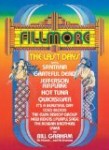 Although Graham would later reopen the Fillmore in San Francisco, this was unquestionably the end of an era. Graham actually started with just The Fillmore, named for its location on Fillmore Street in San Francisco. Graham first had concerts at the venue in 1965 and it became THE scene for the psychedelic and peace and love era. It also helped create a burgeoning art form, the rock poster. Today, they are collector’s items (and a number hang on the walls of my office and home). Although Graham would later reopen the Fillmore in San Francisco, this was unquestionably the end of an era. Graham actually started with just The Fillmore, named for its location on Fillmore Street in San Francisco. Graham first had concerts at the venue in 1965 and it became THE scene for the psychedelic and peace and love era. It also helped create a burgeoning art form, the rock poster. Today, they are collector’s items (and a number hang on the walls of my office and home).
In 1968, Graham opened an East Cost venue, called, appropriately, the Fillmore East. The first show, on March 8, featured Big Brother & The Holding Company, Tim Buckley and Albert King. Like it’s West Coast counterpart, it became one of the hottest places to hear live music, with appearances by The Doors, Hendrix, The Who, Santana and Led Zeppelin, to name just a handful. In fact, even in the year it was closing it was a huge venue. The Allman Brothers (The Allman Brothers at Fillmore East), Frank Zappa and the Mothers (Fillmore East: June 1971) and the Grateful Dead (Grateful Dead (Skull & Roses)) recorded classic live albums there that year before it closed.
Graham announced the closings in a letter to The Village Voice published on May 6, 1971. Graham said he was closing both venues because the “scene has changed and, in the long run, we are all to one degree or another at fault,” listing seven reasons in particular. Several were personal — lack of a private life, attacks in the press and simply being tired — but others show an astute assessment of the music world and where it was heading.
One problem was with a corporatization of rock music that was resulting in inflated ticket prices. “In 1965 when we began the original Fillmore Auditorium, I associated with and employed ‘musicians.'” he wrote. “Now, more often than not, it’s with ‘officers and stockholders’ in large corporations — only they happen to have long hair and play guitars. I acknowledge their success, but condemn what that success has done to some of them.” A consequence of that change was that for the Fillmores to remain economically viable, “I would be forced to present acts whose musicality fell below my personal expectations and demands.”
Marketing played a role in another respect. Graham wrote, “With all due respect for the role they play in securing work for the artists, the agents have created a new rock game called ‘packaging’; which means simply that if the Fillmore wants a major headliner, then we are often forced to take the second and/or third act that the agent or manager insists upon, whether or not we would take pride in presenting them, and whether or not such an act even belongs on that particular show.”
But Graham was astute enough to realize that the problems weren’t caused just by the industry, musicians or their agents. Audiences, too, were at fault. “In the early days of both Fillmore East and West, the level of audience seemed much higher in terms of musical sophistication.” Graham said. “Now there are too many screams for ‘More’ with total disregard for whether or not there was any musical quality.” And the penultimate paragraphs of his notice were all too prescient:
But whatever has become of [the rock music] scene, wherever it turned into the music industry of festivals, 20,000-seat halls, miserable production quality, and second-rate promoters – however it went wrong – please, each of you, stop and think whether or not you allowed it, whether or not you supported it regardless of how little you received in return.
I am not pleased with this “music industry.” I am disappointed with many of the musicians working in it, and I am shocked at the nature of the millions of people who support that “industry” without asking why. I am not assured that the situation will improve in the future.
So, nearly 40 years later the Fillmores and Graham are unforgettable parts of rock history. But nearly 40 years later, we can still say “amen, brother” to Graham’s insights.
All that I know is that what exists now is not what we started with, and what I see around me now does not seem to be a logical, creative extension of that beginning.
Bill Graham letter to The Village Voice
|
Disclaimer 
Additionally, some links on this blog go to Amazon.com. As an Amazon Associate I earn from qualifying purchases. There is no additional cost to you. Contact me You can e-mail me at prairieprogressive at gmaildotcom.
|