|
|
Newsweek, to which I haven’t subscribed for more than a year, must feel its books coverage is lacking. First there was the Fifty Books for Our Time. Now it’s got a “meta-list” of The Top 100 Books. It’s a meta-list because it is compiled from 10 separate lists of best books, including not only its Fifty Books for Our Time but lists from Oprah’s Book Club to Wikipedia to U.K. newspapers.
I’m not going to repeat the list given its length. I note that will I’ve read the top two (War and Peace and 1984), there’s only two others I’ve read in the top 20 (The Catcher in the Rye and Catch-22). And, surprisingly, that’s fairly constant, as this breakdown reveals:
1-20: four
21-40: four
41-60: five
61-80: four
81-100: zero (that’s right, zero!)
Thus, percentage-wise, I’m just slightly above where I was on the books for our time list. I think my showing here stems from the fact that about a quarter of the books are “classics” from the 19th Century or earlier and roughly another quarter are from the 20th Century but pre-date the Depression. That hits a gap in my literary background because, with most classics, unless a teacher or professor made me read it, I didn’t.
Many books require no thought from those who read them, and for a very simple reason — they made no such demand upon those who wrote them.
Charles Caleb Colton, Lacon
Newsweek is out with a variation of the “books you should read” list. Rather than simply a best of list, the magazine says its Fifty Books for Our Times “open a window on the times we live in.” I’m still struggling with how a couple of the choices, particularly the first, made the list — but since I haven’t read them I can’t say the description supporting the selection in the magazine is wrong.
Here’s the list, with the ones I’ve read in bold:
- The Way We Live Now, Anthony Trollope
- The Looming Tower, Lawrence Wright
- Prisoner of the State, Zhao Ziyang
- The Big Switch, Nicholas Carr
- The Bear, William Faulkner
- Winchell, Neal Gabler
- Random Family, Adrian Nicole LeBlanc
- Night Draws Near, Anthony Shadid
- Predictably Irrational, Dan Ariely
- God: A Biography, Jack Miles
- The Unsettling Of America, Wendell Berry
- A Good Man is Hard to Find, by Flannery O’Connor
- Underground, Haruki Murakami
- Disrupting Class, Clayton Christensen
- Air Guitar, Dave Hickey
- Leaves of Grass, Walt Whitman
- The Trouble with Physics, Lee Smolin
- City: Rediscovering The Center, William H. Whyte
- Do Androids Dream of Electric Sheep?, Philip K. Dick
- Benjamin Franklin, Edmund S. Morgan
- The Mississippi Books, Mark Twain
- Among the Thugs, Bill Buford
- Brooklyn, Colm Toibin
- Frankenstein, Mary Shelley
- Bad Mother, Ayelet Waldman
- Guests of the Ayatollah, Mark Bowden
- Whittaker Chambers, Sam Tanenhaus
- Midnight’s Children, Salman Rushdie
- American Prometheus, Kai Bird and Martin J. Sherwin
- The Lost, Daniel Mendelsohn
- Gilead, Marilynne Robinson
- Pictures at a Revolution, Mark Harris
- Kim, Rudyard Kipling
- Walking With the Wind, John Lewis
- The Line of Beauty, Alan Hollinghurst
- The Dark is Rising, Susan Cooper
- Persepolis, Marjane Satrapi
- Underworld, Don DeLillo
- Why Evolution is True, Jerry A. Coyne
- American Pastoral, Philip Roth
- The Botany of Desire, Michael Pollan
- The Regeneration Trilogy, Pat Barker
- Senator Joe McCarthy, Richard H. Rovere
- Year of Wonders, Geraldine Brooks
- The Elegance of the Hedgehog, Muriel Barbery
- Gone Tomorrow, Lee Child
- Things Fall Apart, Chinua Achebe
- American Journeys, Don Watson
- Cotton Comes To Harlem, Chester Himes
- The New Biographical Dictionary of Film, David Thomson
It would be a good thing to buy books if one could also buy the time in which to read them.
Arthur Schopenhauer, “The Art of Literature”
Now that we’ve come to the middle of the year, what do you think of your 2009 reading so far? Read anything interesting that you’d like to share? Any outstanding favourites?
My reading so far this year indicates my translated literature fixation continues. Not surprisingly, then, it accounts for one of my favorites this year — German author Hans Fallada’s Every Man Dies Alone. I also read his earlier work, The Drinker, which I didn’t find as strong but still demonstrates that the skill shown in Every Man Dies Alone is not a fluke.
My other favorite so far is actually a book that first came out a decade ago. Were it not for that fact, Stewart O’Nan’s A Prayer for the Dying would be a candidate for my novel of the year. I’m just glad I picked up the 10th anniversary release.
A book that is shut is but a block.
Robert Lanham, “Gnomologia“
Sense of place is not just a combination of geography and culture, it is a synergy of the two. Swedish author Kerstin Ekman doesn’t seek to describe sense of place in her novel God’s Mercy. She does something far more difficult. Sense of place so permeates the novel it moves from being a setting to almost its own unspoken character.
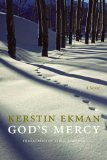 God’s Mercy is a captivating tale of life in northern Sweden in the early part of the 20th Century. Hillevia is a young, recently educated midwife who moves from Uppsala, a university town just north of Stockholm, to a forested area of northern Sweden called Blackwater in March 1916. It is amidst and inhabited by the Sami people, known to English speakers as Lapps. Life is not easy here. It is a land where there are eight seasons, each of which dictate the rhythm of survival and existence. Life here, Hillevia notes several years later, is “full of invisible agreements among the people,” agreements that are “in a language etched into the very earth.” The people live largely from working timber or herding reindeer. Not only do economic strata arise, so do language and cultural differences among the Norwegians, Swedes and Lapps, the last often viewed as inferior. God’s Mercy is a captivating tale of life in northern Sweden in the early part of the 20th Century. Hillevia is a young, recently educated midwife who moves from Uppsala, a university town just north of Stockholm, to a forested area of northern Sweden called Blackwater in March 1916. It is amidst and inhabited by the Sami people, known to English speakers as Lapps. Life is not easy here. It is a land where there are eight seasons, each of which dictate the rhythm of survival and existence. Life here, Hillevia notes several years later, is “full of invisible agreements among the people,” agreements that are “in a language etched into the very earth.” The people live largely from working timber or herding reindeer. Not only do economic strata arise, so do language and cultural differences among the Norwegians, Swedes and Lapps, the last often viewed as inferior.
When Hillevia is called on for her first delivery, it is at the home of a poor family in a remote village. The family patriarch is less than pleased by or accommodating to Hillevia’s presence. She is a newcomer, an outsider, intruding upon those who are outsiders themselves. The experience and its aftermath change her and the life of a boy in the house, Elis. Elis runs away from his family. Hillevia is left questioning the nature and extent of God’s mercy.
The novel follows both Hillevia and Elis over the next several decades. There are two narrative perspectives for Hillevia’s story. One is hers, the other is Risten, a younger woman whose relationship to Hillevia is not clear until later in the novel. Hillevia comes to develop her own sense of place there, loving the area and its people, even marrying and having a family. Yet some still view her as an outsider, a transplant from a higher social and economic class who is not part of their sense of place. The concept not only is the stage on which the story is played out but helps portray the people and Hillevia.
Elis’ story, meanwhile, has echoes of a Dickens character, as he combats abuse, illness and poverty to become an artist. He, too, is an outsider but in the reverse of Hillevia’s. Despite his talent, he struggles for acceptance in the cities and among the urbane society to which his art introduce him. His character, though, does not feel as developed and real as Hillevia’s and he can come off as almost a tangential part of the story. Yet Eckman’s time developing Hillevia’s story and the sense of place that imbues it is time very well spent.
The book, translated by Linda Schenk, is the first in Ekman’s “Wolfskin” trilogy. The other two novels follow the destinies of the characters in God’s Mercy, and their descendants, through the end of the 20th Century. Ekman has been widely translated and Blackwater is the locale for and title of what is perhaps her best known novel in the U.S., a detective thriller. God’s Mercy is her first work in the European Women Writers Series published by the University of Nebraska Press and is certainly a worthy addition.
I s’pose we’re all afeared of the truly poor.
Kerstin Ekman, God’s Mercy
Self-promotion
The blogosphere was all aflutter this week with word the FTC wants to regulate blogs. Remember, you read it here first more than two months ago.
My review of Masterpiece Comics was the featured item Monday in the Blogcritics Books section.
SD Blogosphere Goings On
The ACLU of South Dakota has launched its own blog, A Little Liberty on the Prairie. It has been added to the Blogrol but not just because of its catchy namel. (H/T Dakota Women.)
Denise Ross interviews GOP gubernatorial candidate (and one of my law partners) Dave Knudson at The Hoghouse Blog.
Achievement Awards
Headline of the week (winner by a shitboatload): So ugly, I wouldn’t even wipe my ass with it.
Bookish Linkage
Author who wrote Tom Waits biography, and to whom Waits would not talk, is sued for libel — by Waits’ former manager.
What????? The NEA hands out 269 grants worth $3.7 million for the 2009-2010 The Big Read and no South Dakota entity is included??? (Via.)
Can I can get a Kindle and make it a business expense?
Geek the library. (Via.)
The Guardian‘s books blog asks, Can publishing go any lower?
A book award I’d not heard of before: the Royal Society Prize for Science Books. And, somewhat to my surprise, I’ve actually read one of the six books on the shortlist.
SF Signal explores international SF.
Meanwhile, io9 looks at SF books that launched their own genres.
The WSJ suggests five best books on U.S. history.
What is evidently the U.K.’s version of Amazon, The Book Depository, is evidently going to enter the mouth of the beast, launching a U.S. website next month.
Nonbookish Linkage
“This week a homeless man in California hit a fellow transient in the face with a skateboard over a disagreement about quantum physics.”
How far will your salary go in another city? (Via.)
Earth pron (from space).
How ’bout this? You CAN get a grade worse than an “F”.
And across from the bar there’s a pile of beer cans
Been there twenty-seven years
Imagine all the heart aches and tears
In twenty-seven years of beer
Jimmy Buffett, “Ringling, Ringling,” Living and Dying in 3/4 Time
|
Disclaimer 
Additionally, some links on this blog go to Amazon.com. As an Amazon Associate I earn from qualifying purchases. There is no additional cost to you. Contact me You can e-mail me at prairieprogressive at gmaildotcom.
|