|
|
Bulletin Board
Most Americans have never heard of the winner of the 2008 Nobel Prize for Literature but The Literary Saloon rounds up quotes from some of his reviews and plenty of reaction. Interestingly, two of his books have been published in English by the University of Nebraska Press.
Evidently trying to be a bit more warm and fuzzy — at least for US citizens — the Customs and Border Protection agency has released a “traveler-centric” desktop widget. The widget provides a trip countdown timer and weather at the traveler’s destination and reminds them to obtain appropriate travel documents.
The 20 finalists for the 2008 National Book Awards will be announced October 15. Winners in the four categories — fiction, nonfiction, poetry, and young people’s literature — will be announced November 19.
Bookish Linkage
Six SF classics to help you pick the next president.
Sam Houston catches a book review thief, who changes his review when called out.
A famous SF author talks of his two diseases — Alzheimer’s and knowing he has Alzheimer’s. (HT)
Booktrust, a British charity devoted to encouraging reading, has launched a translated fiction website, that includes a blog by a prizewinning translator on process involved in his work on the book he is currently translating. Now if either would add an RSS feed….
Words Without Borders has its October newsletter up, focusing on “Turkish Delights.”
Non-bookish Linkage
Have a look at the women behind some of the great cartoon voices.
Exciting and more local “space porn.”
Another week, more stunning and relevant pics on The Big Picture.
The List Universe creates its list of the Top 10 Most Controversial Websites. I’m only familiar with one, rotten.com, and, frankly, while it is undoubtedly graphic and at times disgusting, I don’t know that I’d consider it among the “most controversial” sites.
Writing, writers, do not come out of houses without books.
Doris Lessing, 2007 Nobel Prize lecture>
I stopped in the local Best Buy Thursday to pick up a couple CDs and two things caught my attention.
First, I see Best Buy is stocking vinyl LPs. That’s right, the things I grew up listening to. Now perhaps vinyl has made some technological advances over the last 35 years and these are undoubtedly high fidelity pressings, but I still have to wonder about a $29.99 price tag for most of the LPs. If that’s the going rate, I may need to insure my shelves of vinyl.
I found it interesting how many of the LPs were from “my era,” including Blind Faith (with its original cover), The Allman Brothers at Fillmore East and John Lennon’s Imagine. I wonder if they’re targeting baby boomers (some of whom, like me, may still have the vinyl) or younger listeners now wanting vinyl.
One thing I forgot to investigate was turntable cartridges and “needles.” I remember a few years ago when I was looking for a replacement cartridge for my turntable Best Buy offered a selection of — one, and that with a plastic stylus. Long gone were the days where you’d go to the stereo store and drool over the cartridges from Stanton, Shure, Technics and the like. (I preferred loved the Stanton 681EE.)
Looking at the petrochemical-based vinyl made the other item of note an interesting contrast. I bought the new Pretenders release, Break Up the Concrete, and got one that is part of a limited number (50,000) with “ecologically-friendly packaging with handmade seed paper.” Instructions on the seed paper say
Soak this Handmade seed paper in water overnight and plant under a thin layer of soil. Keep moist. Seedlings may sprout in 1-4 weeks.
The paper does not indicate what type of flowers or plants may sprout and I suspect “may” is the key word in the instructions. While it’s an interesting concept, part of me wonders about the ecological impact of adding more paper, even handmade seed paper, if it’s just going to get tossed out. Still, the package also notes that the rest of the packaging was certified as eco-friendly by the Forest Stewardship Council.
And while it undoubtedly consumed more resources, I’ll take the liner notes, covers and the like from LPs any day over those from CDs.
I’m sick and tired of hearing things
From uptight, short-sighted, narrow-minded hypocritics
All I want is the truth
Just gimme some truth
“Gimme Some Truth,” John Lennon, Imagine

This week’s BTT offers a meme itself:
What was the last book you bought?
The Pets by Bragi Olafsson, part of my Open Letter subscription. As for store-bought books, it would be Marilynne Robinson’s Home. (One of the budgetary advantages of an excellent local library and publisher review copies.)
Name a book you have read MORE than once
Darkness at Noon by Arthur Koestler, one of my Desert Island Books.
Has a book ever fundamentally changed the way you see life? If yes, what was it?
Not really. The closest would be Notes to Myself by Hugh Prather (also a Desert Island Book).
How do you choose a book? eg. by cover design and summary, recommendations or reviews
Generally the following: subject/story, author, summary and reviews/recommendations. Cover design plays little, if any, role.
Do you prefer Fiction or Non-Fiction?
As I noted earlier this week, that has changed over the years to the point that I don’t know that I have a strong preference. The subject, story or author are primary, not necessarily fiction or non-fiction.
What’s more important in a novel – beautiful writing or a gripping plot?
Good, crisp writing. It need no be beautiful but what good is a gripping plot if the author’s style (or lack thereof) makes you quit reading?
Most loved/memorable character (character/book)
Probably Emilio Sandoz from Mary Doria Russell’s The Sparrow or Winston Smith from 1984.
Which book or books can be found on your nightstand at the moment?
Considering my “nightstand” is a three-shelf “to be read” bookshelf, there are way, way too many (more than 30, I hate to admit). But thanks to my local library, the small shelves in the headboard of the bed currently hold largely Bibliolust books:
What was the last book you’ve read, and when was it?
I finished The Forever War by Dexter Filkins last Sunday morning.
Have you ever given up on a book half way in?
Yes, although I don’t usually wait that long. The most recent book I gave up on (last month) I did so about a third of the way in.
Sanity is not statistical.
George Orwell, 1984
I had a feeling this was coming based on the last couple strips but Berkeley Breathed announced that, once again, Opus is leaving us. The end apparently will come in the Nov. 2 strip. Last month — on my birthday of all days — Opus was taken into custody by Homeland Security as an illegal immigrant. Opus is still locked up and what’s really sad is Breathed says, “I’ll be leaving Opus in a way that it should be very clear that this time there’s no going back home.”
The “existentialist penguin” was a fixture of Bloom County in the 1980s, a strip that won the Pulitzer Prize. Breathed retired the daily Bloom County in 1989 but Opus reappeared in a new Sunday-only strip, Outland. That strip didn’t have near the circulation of Bloom County and ended in 1995. Opus made a few book appearances in the ’90s but Breathed brought him back in his own Sunday-only strip in November 2003. Although aptly titled Opus, the strip had even less circulation.
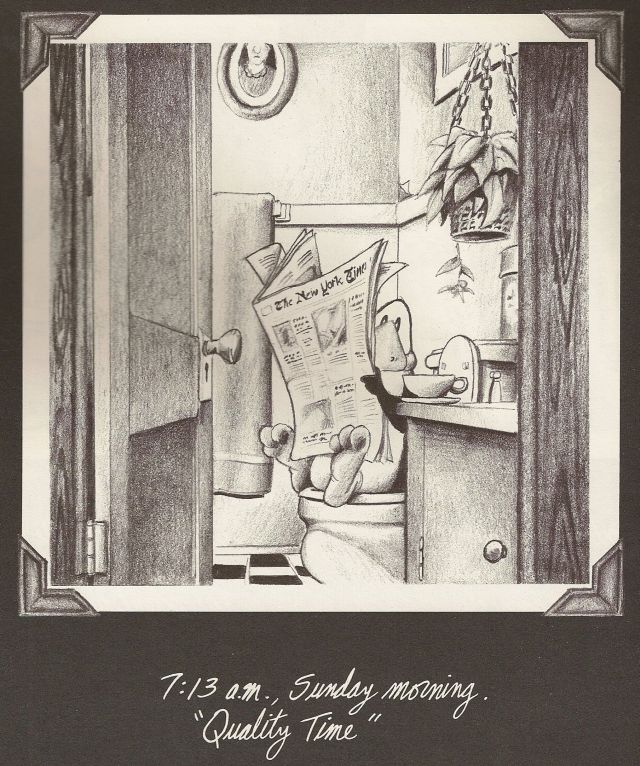
Now that strip is going away and, evidently, so is Opus. Opus is one of my favorite comic strip characters ever and in his honor, he shall close this post rather than the standard closing quote. Therefore, I offer my favorite single cartoon panel of all time, which appeared in 1985’s Penguin Dreams and Stranger Things.
Adieu, Opus, I and many others would not have survived the 1980s without you.
Cartoon ©The Washington Post Co.
Gen Xers probably don’t need, let alone want, advice from me. But if I may make one small suggestion. If and when you want to name a historian laureate, give serious consideration to Sarah Vowell.
I know, Vowell says she is not a historian and she’s not. But that elevates form over substance. History often played a part in Vowell’s earlier books. Her last two, Assassination Vacation and the just released The Wordy Shipmates, are squarely in the American history category. With them, the 39-year-old commentator and humorist may well reach and educate more people about American history than historians of other generations currently writing.
Vowell once attributed her ability to make history interesting to a lack of pretense, allowing the reader to learn along with her and being “kind of irreverent.” With the latter being perhaps a bit of an understatement, these elements were in full form in Assassination Vacation, where Vowell took readers on her pilgrimage to sites connected with the assassinations of Presidents Lincoln, Garfield and McKinley. With The Wordy Shipmates, Vowell applies the same talents as she moves from pilgrimage to Pilgrims.
Sure, Vowell now lives in New York City but you have to ask why a woman born in Oklahoma (and part Cherokee) and who was raised and attended college in Montana is fascinated by Pilgrims. And it’s not the Pilgrims from the Mayflower. Instead, it’s the Massachusetts Bay Colony, a group of Pilgrims headed by John Winthrop who arrived 10 years later and helped establish Boston. Her answer is that she believes the U.S. “is haunted by the Puritans’ vision of themselves as God’s chosen people, as a beacon of righteousness that all others are to admire.”
For Vowell, this is exemplified in large part by Winthrop’s “A Model of Christian Charity,” a sermon he wrote before or during the voyage. Although no one really took note of it at the time, a particular part of it has echoed in modern America: Winthrop’s vision that the colony was specially ordained by God to “be as a city upon a hill,” a model for others. That phrase, largely a “sound bite” today, was cited by President John F. Kennedy, repeatedly used by President Ronald Reagan and even employed by Sarah Palin in last week’s vice-presidential debate.
Vowell notes, though, that other portions of the sermon were and are too frequently overlooked. “A Model of Christian Charity” also urged that the principles of “Justice and Mercy” governed human relations and that to love your neighbor as yourself was the foundation of all moral law. Modern Americans, though, aren’t the only ones where there seems to have been a disconnect from those ideas. This language came from the leader of a colony whose official seal shows an Indian in a loincloth saying, “Come over and help us.” “The worldview behind that motto — we’re here to help whether you want our help or not,” Vowell notes, is the colony’s “most enduring bequest to the United States.” Not only do the concepts of loving thy neighbor, justice and wisdom go out the window in dealing with — at times massacring — Indian tribes, Vowell contends this view served as a basis for U.S. gunboats and troops being sent to various places in the world, from the Philippines to Vietnam to Iraq.
That is just part of the dichotomy explored in The Wordy Shipmates. Winthrop left England to find religious freedom. Yet in America, he insisted upon rigid adherence to proper doctrine, at least proper as he and most of his fellow white males saw it. Two disputes in particular draw Vowell’s attention.
One is with Roger Williams, who would be exiled from the colony because of doctrinal differences, including his contention that civil officials had no right to dictate or enforce religious beliefs. Williams would found Rhode Island, which would shortly thereafter guarantee “liberty of conscience.” Vowell notes it was Williams who first referred to a “wall of separation” between religion and government, a concept that would become a fundamental American principle.
The other is with Anne Hutchinson, strong, opinionated woman who had the audacity to open her home for women to engage in Bible study and discussion of religion. The meetings grew to attract others and Winthrop and other colony leaders contended her ideas were heretical. These include the concept salvation is not determined by the clergy judging a person’s works but by personal inner sanctification. Hutchinson was banished from the colony following a trial over which Winthrop, as governor, presided.
Vowell organizes the book more by concept than chronology, which can leave the reader slightly muddled at times. In addition, The Wordy Shipmates can occasionally be a bit of a trudge. That is not necessarily Vowell’s fault. Explaining the distinction between a “covenant of works” and a “covenant of grace” — a core issue in the colonies and the Hutchinson trial — is not easy, especially when most readers have little or no background in the concepts. Vowell manages to use modern comparisons to help the reader grasp some of the elements of Puritan theology, She also employs her usual eye for the offbeat and unique, whether it be a small replica of the Mayflower serving as a slide in a swimming pool, the fact it’s an Indian casino where she sees dioramas and films about tribal life and the massacres, or that the rock in the park supposedly marking the site where Williams founded his settlement was “mistakenly blown up” by city workers in 1877.
While presidential assassinations may be comparable to the car wreck that draws attention, Puritans likely are not a big draw for modern readers. As such, The Wordy Shipmates may not be as well received or as big a success as Vowell’s prior works. That does not change the fact that she may be unmatched in her ability to inject life into, create interest in and explore the modern ramifications of American history, especially a part that average readers may usually find dreary.
The only thing more dangerous than an idea is a belief.
Sarah Vowell, The Wordy Shipmates
|
Disclaimer 
Additionally, some links on this blog go to Amazon.com. As an Amazon Associate I earn from qualifying purchases. There is no additional cost to you. Contact me You can e-mail me at prairieprogressive at gmaildotcom.
|