|
|

How has your reading changed over the years? Have you started reading more “meaty” books (books with more substance)? Or, have you gone to more “fluffy” reads? Perhaps you’ve done neither, and you’ve just always read the same type of thing! If that’s the case, why? Are you willing to step out of your reading ‘comfort zone’ and try something new? What would you recommend to someone who needed to “branch out”?
Somewhat surprisingly, I think I’ve seen the most change in my reading over the last five years or so. For much of my life after college, I read mostly non-fiction, figuring that since I had little time to read I wanted to make that time “useful” and learn about something. If I wanted escapism, I turned to my old standby, science fiction.
Over the last several years, though, I have gradually moved to a more equal balance between fiction (other than SF) and non-fiction. There may have even been occasions in the past couple years where I read more fiction than non-fiction, particularly if SF is included. I don’t have a real explanation for it. I know my reading time has increased as my kids grew older and the number of school-related and extracurricular activities I had to attend dwindled. I speculate that the increase in available reading time led me to look for more variety.
The most significant change — one I’ve mentioned here several times — is an increasing attraction of foreign literature. I think I see that as a way to not only broaden the subjects I read but to use fiction as a way to learn about other cultures and places through the eyes of those who know it best.
In fact, that is exactly what I would recommend for those who want to branch out. Pick up some foreign literature — Per Petterson’s Out Stealing Horses, Sebastian Barry’s The Secret Scripture or Literature from the “Axis of Evil”: Writing from Iran, Iraq, North Korea, and Other Enemy Nations — and see what you’ve been missing.
Reading has always been life unwrapped to me, a way of understanding the world and understanding myself through both the unknown and the everyday.
Anna Quindlen, NYT, Aug, 7, 1991
The WaPo book blog had something I thought interesting. What books remain on your shelves that you’ve never read but continue to keep even though you’ve weeded out lots of others over the years?
Underworld by Don DeLillo immediately comes to mind. It’s been on my shelves for close to a decade but I never get around to reading it. Methinks the size (800+ pages) is largely responsible.
There’s also a number of history books and biographies I’ve held on to with the greatest of intentions. The history books in this group tend to be ones on the Middle Ages, World War II or Nazi Germany because I fear they may repeat books I’ve read previously.
One that isn’t in that category is The First Casualty, Phillip Knightley’s book about war correspondents. The title comes from the 1917 comment by U.S. Sen. Hiram Johnson: “The first casualty when war comes is truth.” Unfortunately, I’ve held on to mine so long that it only goes through 1975. The current edition has four more chapters and goes through March and April 2003 in Iraq. Thus, it may be time to weed it out in favor of the most recent edition.
While it’s not quite a history book, Tina Rosenberg’s The Haunted Land: Facing Europe’s Ghosts After Communism has been picked up a couple times to read. For whatever reason, I got distracted each time. I really should read it as it won both the Pulitzer Prize and the National Book Award.
Length is the issue with the biographies sitting on the shelves. I started Alan Bullock’s Hitler and Stalin: Parallel Lives when I bought it. But there remains a book marker at page 320, which is still in the 1933-34 time period.
I can’t say the same for Philip Short’s Mao: A Life. I ordered it through a book club and by the time it arrived, my lust for the book had disappeared. Thus, the 600+ page work sits on the shelf unread.
Sad to say, those certainly aren’t the only unread books on the shelves. I think, though, they may be the ones that give rise to a bit more guilt.
I would be most content if my children grew up to be the kind of people who think decorating consists mostly of building enough bookshelves.
Anna Quindlen, NYT, Aug, 7, 1991
October is rapidly becoming one of my favorite months. Wednesday night was the draft in the Puck Podcast keeper fantasy hockey league — which has members from the U.S., Canada, Switzerland and the U.K. (I had the first draft pick and took Ovechkin.) The USHL season started Friday night. The NHL Network brought me the two season-opening NHL games Saturday from Stockholm (Ottawa-Pittsburgh) and Prague (NY Rangers-Tampa Bay) with the same teams playing again today. Most important, the Stampede opened the season at home with a win. It was the first hockey game I’d seen in person since the NCAA championship game April 12.
In celebration, I thought I’d combine two addictions: hockey and books. Here’s a list of essential hockey books with the ones I’ve read in bold and comments on some of them. Several are out of print.
- The Game, Ken Dryden. Many consider this 1983 book by the Stanley Cup-winning goalie the top hockey book of all time. I didn’t think it did well with age.
- Net Worth: Exploding the Myths of Pro Hockey, David Cruise and Alison Griffiths.
- The Age of Longing, Richard Wright. The only novel on the list.
- The Red Machine: The Soviet Quest to Dominate Canada’s Game, Lawrence Martin. In looking around in connection with writing this post, I discovered this book is currently selling for $250 at one online used book provider.
- Searching for Bobby Orr, Stephen Brunt. This has been on my “wish list” for quite a while.
- Thunder and Lightning: A No B.S. Hockey Memoir, Phil Esposito.
- Tropic of Hockey, Dave Bidini. An enjoyable travelogue of hockey in places like China, Dubai and Transylvania.
- Open Net, George Plimpton. Paper Lion on ice, with Plimpton participating in training camp for the Boston Bruins as an “amateur goalie.”
- Zamboni Rodeo: Chasing Hockey Dreams from Austin to Albuquerque, Jason Cohen. A look at life in minor league hockey, focusing on the Austin (Tex.) Ice Bats that I’ve been pining after for quite a while. By coincidence, the Ice Bats announced in June they would not be playing this year because it couldn’t find an “acceptable venue.”
- Original Six: True Stories from Hockey’s Classic Era, Paul Quarrington (ed.).
- Crossing the Line: Violence and Sexual Assault in Canada’s National Sport, Laura Robinson. This examination of Canadian junior hockey also has been on my wish list for quite a while.
My only real complaint about hockey season? It cuts into reading time.
Why is a puck called a puck? Because ‘dirty little bastard’ was taken.
Goalie Martin Brodeur, quoted in Right On The Numbers
Bulletin Board
In case I haven’t mentioned it, hockey starts today!!
Bruce Springsteen, who endorsed Obama earlier this year, is performing at four events for the candidate in the coming week. The first three are rallies today through Sunday in Philadelphia and college campuses in Ohio and Michigan. Then he’ll perform Oct. 16 at “Change Rocks,” a fundraiser in New York City that includes Billy Joel “and friends.” This one ain’t free. Tickets, which will end up being a campaign contribution, range from $500 for balcony seats (already sold out) to $10,000 for “lounge” seats. (If you raise $25,000, you not only get a lounge ticket you are part of the “host committee.”)
Bookish Linkage
More proof of the adage that if you have to ask you can’t afford it. (But I sure wish I could!)
PC World gives some love to a brick-and-mortar bookstore’s internet presence, saying “Big, diffuse Amazon is fine, but Powell’s is the best online bookstore in America.”
Ouch! The top member of the award jury for the Nobel Prize in Literature says American authors don’t stack up because ”[t]he U.S. is too isolated, too insular.” The prize winner is to be announced next week.
Looking back at when books could change your life.
A positive SF manifesto. (HT)
Charlie Stross, meanwhile, says “it is not currently possible to write near-future SF.” And then clarifies what near-future SF is.
What happens to SF writers after they die?
One view of the 10 most disturbing novels. I admit having read none of them.
Non-bookish Linkage
Interesting thought: Foreign films with subtitles won’t put people off as much thanks to the increased use of text-messaging and e-mail.
Part of the reason I generally don’t watch local TV news noted by Scott H., who evidently does.
If you hadn’t noticed, Jon Swift has returned after temporarily suspending his blog to fix the nation’s economy.
Frank Zappa’s Joe’s Garage becomes an actual rock opera.
Want to know what McCain or Obama (or other politicians) said on a particular issue? Check out Google’s new In Quotes.
Here’s your chance to interview Sarah Palin. The site claims the answers are computer generated based on probabilities calculated from things she has actually said.
In addition to the 10 most disturbing novels list, there’s also The New Yorker‘s list of the five scariest movies ever. I admit having seen three of them.
Random notes
On a voice vote, the House of Representatives this week passed a bill that would preclude U.S. courts from enforcing defamation judgments from foreign countries unless the U.S. court determined that the judgment is consistent with the First Amendment. The bill is aimed at so-called “libel terrorism” where American authors and writers are used in foreign courts that offer few, if any, of the free speech protections of the U.S.
Time may heal all wounds
But time will steal you blind
Title track, Jackson Browne, Time the Conqueror
Through the LA Times book blog, I learned of DonorsChoose.org. It’s a site that allows you to donate money to help teachers fund class projects. The program is open to all public schools and the site currently has five South Dakota projects, two of which seek to bring books to students.
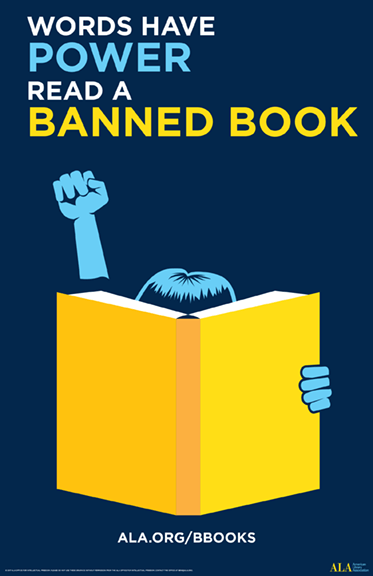
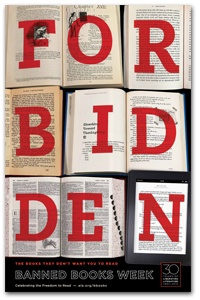
By chance, the site kicked off its 2008 Blogger Challenge Wednesday. Last year the challenge raised $420,000 to help education. In honor of Banned Books Week and believing books in the classroom are essential to our future, I created the Lending a Hand on the Prairie “giving page,” where you can donate to either or both of the projects in Tabor and Stephan. The giving page also gives the info and background on both projects.
Later today or tomorrow I will add a box in the right sidebar that will take you directly to the giving page and serve as a reminder during the Blogger Challenge without me reposting this.
Please remember, a donation isn’t to show support for this blog, anything on it or even the name I picked for the giving page. It is simply a mechanism to help South Dakota schools in need of books. I know times are tough but please consider helping literacy and education. And, for what it’s worth, your contribution is tax deductible.
You have the world at your fingertips
No one can make it better than you
“Prelude,” Spirit, Twelve Dreams of Dr. Sardonicus
|
Disclaimer 
Additionally, some links on this blog go to Amazon.com. As an Amazon Associate I earn from qualifying purchases. There is no additional cost to you. Contact me You can e-mail me at prairieprogressive at gmaildotcom.
|