|
|
Epitomizing the saw, “can’t take a joke,” woman sues her daughter-in-law, a professional comedian, for spreading false, defamatory and racist lies with in-law jokes. (Via.)
On the other hand, lawyer jokes “are OK” if you’re worried about getting sued. (Via.)
A good corollary to don’t drink and drive: don’t get tanked and tweet.
We all know the internet is a form of mass media. That’s not good in Kazakhstan, where recognition of all Internet resources as media outlets means all websites, including blogs, chat rooms, web forums, electronic libraries, online stores, must register with the government. (But, hey, at least Kazaks will be getting a fancy new library.)
“Only one crime was solved by each 1,000 CCTV cameras in London last year.” (Via.)
Denmark, usually a model of sanity and rationality, is considering legislation that would ban people from wearing burkas and niqabs in public.
Speaking of religion-related bans, Russia passed legislation outlawing all flags with an image of a cross as extremist materials. Seems someone forgot, among other things, that the Russian Navy uses such flags.
Meanwhile, back in Scandinavia, Finland wants the heads of many Americans to explode. It’s Parliament is drafting a law that would authorize police to inspect, without having established suspicion of commission of a crime, the private homes of persons holding gun permits. How much you wanna bet, though, that if the NRA and other U.S. organizations mention this, they will omit the fact the law would require police to give permit holders two weeks’ notice.
Everybody loves to see
Justice done on somebody else
“Justice,” Bruce Cockburn, Inner City Front
I grew up with Led Zeppelin. I even remember standing in a music store in the Twin Cities in about 1970 listening to “Whole Lotta Love” from Led Zeppelin II speed around me on the latest technological breakthrough, quadraphonic stereo. (Who’d a thunk it would take home theater setups before that concept really took hold.) Yet after Houses of the Holy, released in 1973, the bombastic nature of the band seemed to wear on me as my tastes moved out of what was, at the time, “heavy metal.”
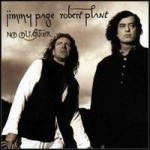 As a result, it was with interest that I heard that Jimmy Page and Robert Plant were going to appear on “MTV Unplugged”, although in a 90-minute program called “UnLedded.” Given that, as the name implies, the “Unplugged” series traditionally presented acoustic performances, I found the thought more than intriguing. But everyone should have known that when Page and Plant got together to record the show in London on August 25 and 26, 1994, they would go far above and beyond. As a result, it was with interest that I heard that Jimmy Page and Robert Plant were going to appear on “MTV Unplugged”, although in a 90-minute program called “UnLedded.” Given that, as the name implies, the “Unplugged” series traditionally presented acoustic performances, I found the thought more than intriguing. But everyone should have known that when Page and Plant got together to record the show in London on August 25 and 26, 1994, they would go far above and beyond.
Of course, Page and Plant had a backing band — that included a hurdy gurdy player and a mandolin player who also chipped in on bodhrán. But they also brought in an ensemble of Egyptian musicians and the London Metropolitan Orchestra. And when the show aired in October, it included material shot in Wales and on the streets of Marrakesh in Morocco. Yet the goal — which both the program and resulting CD achieved — was to display influences that were understated in the Led Zeppelin format.
The Moroccan footage and songs show the influence of world music, particularly Middle Eastern motifs and rhythms, on the two artists. The influence is also on display in the arrangement of some traditional Zeppelin tunes, such as “Friends,” “The Battle of Evermore” and “Four Sticks.” In fact, even “Kashmir,” which had a Middle Eastern influence when it was first released in 1975, has that flavor bolstered here. In fact, from my standpoint this may be the definitive version of the song, which closed the performance and even incorporated a bit of “Black Dog.”
The format and song selection of the performance also gives more opportunity to hear the range of Page’s talents. Page didn’t completely abandon his electric guitars and, in fact, used his famous double neck guitar to great effect on both “Four Sticks” and “Wonderful One,” one of the four tunes written for the show. And Page fully displays the blues that were the foundation of Led Zeppelin with his work on Zep’s “Since I’ve Been Loving You.”
As might be expected, the Led Zeppelin tunes are my favorites of the performance. Some 15 years later, I still appreciate the different take No Quarter gave on them.
I am a traveler of both time and space, to be where I have been
“Kashmir”
So, you’re going to spend a few months on the International Space Station and need a few diversions. Since you just can’t stroll to the nearest library or video store and even Amazon and Netflix don’t deliver there, you’ve got to hope it’s got some good entertainment on hand. Some idea of what’s available came last year when governmentattic.org obtained a list of the books, movies and television shows on the space station for recreational/off-duty use.
Of the roughly 90 books, there’s a few classics, some popular fiction, works on American history and both Darwin’s Origin of Species and Systematic Theology: An Introduction to Biblical Doctrine. But if any category predominates it appears to be science fiction. In addition, the only magazines I see on the list are Asimov’s Science Fiction and Analog Science Fiction and Fact.
There’s equally wide variety in the videos and television shows, with the latter ranging from The O’Reilly Factor to The Daily Show and The Colbert Report. Among the movies and DVDs, you’ll still find a significant number of SF works, including several of the Star Wars films and the first season of Stargate SG-1. One thing I found surprising is that the space station also has the complete first season of Millennium, a Chris Carter-created series that ran from 1996 through 1999 (and a personal favorite of mine).
I don’t find the amount of SF all that surprising. After all, we’re talking about people with a deep desire and drive to go into space. SF certainly seems consistent with that interest. I am curious about the room required and the weight involved, particularly for books. I wonder if the space station has gone e-reader?
What the space program needs is more English majors.
Astronaut Michael Collins, quoted in First on the Moon
Some authors take time creating an overall feel for their book. But when you’re writing a novella of well under 100 pages, you don’t have much time to set the tone. Mexican novelist Mario Bellatin doesn’t waste any establishing the tenor of Beauty Salon. He does it with the first two sentences: “A few years ago my interest in aquariums led me to decorate by beauty salon with colored fish. Now that the salon has become the Terminal, where people who have nowhere to die end their days, it’s been very hard on me to see the fish disappear.”
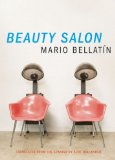 You could take it for dark humor, but there is only the slightests taste of that in this work. With that brief opening, Bellatin sets the stage for almost all that’s coming. The unnamed narrator is, in fact, more affected by the death of his fish than humans. That’s because the world of Beauty Salon is immersed in a plague so extensive and fatal that most bodies end up in mass graves at the cemetery. Death has become so prevalent that emotional attachment is no longer worth the psychological toll. You could take it for dark humor, but there is only the slightests taste of that in this work. With that brief opening, Bellatin sets the stage for almost all that’s coming. The unnamed narrator is, in fact, more affected by the death of his fish than humans. That’s because the world of Beauty Salon is immersed in a plague so extensive and fatal that most bodies end up in mass graves at the cemetery. Death has become so prevalent that emotional attachment is no longer worth the psychological toll.
The narrator is a transvestite gay hair stylist who first opened the doors of his beauty salon as a hospice to friends who were refused care at hospitals for fear of spreading the infection. It its heyday as a functioning business, he and his two co-workers wore dresses when fixing hair and when cruising for men at night. The plague has claimed both his friends and he now spends his time providing a refuge for men whose only other option is to die on the streets. No longer a beauty salon, it has come to be know simply as the Terminal.
Bellatin’s work, first published in Spanish in 1999 and making its first American appearance in a translation by Kurt Hollander, is about as allegorical as they come. Between the symptoms of the infectious plague and the narrator’s recollections, it would be difficult to mistake the novella from dealing with anything other than HIV/AIDS. At the same time, the discussion of the aquariums, the fish in them and their changes broadens the allegory from just the beauty salon to the world at large. And Bellatin’s description of the world is blunt and brutal.
Just as the city and country are unidentified, individual identity no longer exists at the Terminal. It accepts as “guests” only those in advanced stages of the disease. Yet even then the guests “are nothing more to me than bodies on the verge of disappearing.” Doctors and medicine are prohibited, along with spiritual or herbal healers or support from family or friends. That’s because, according to the narrator, the best option is “a quick death under the most comfortable conditions.”
Yet the concepts of dispatch and detachment impact the story in a unintended — or perhaps intentional — fashion. At only 63 pages, it perhaps even stretches the term to call it minimalist. Beauty Salon evokes the better elements of post-apocalyptic and dystopian literature but raises the question of whether it is too brief to stand alone. While the length may invite recurrent rereading and pondering, the story may be better served as part of a broader collection. Of course, if your main complaint about an author’s work is that it wasn’t long enough, maybe that is as telling a comment as you can make..
All our efforts were merely vain attempts to ease our conscience.
Mario Bellatin, Beauty Salon
Bulletin Board
Reporter Bob Mercer (one of the best) has started a “South Dakota Government blog” called Pure Pierre Politics. It has been accordingly added to the blogroll. (HT PP.)
A blog to which I contributed this year — Notable Books — has received a nomination for Best Literary Blog for Book Blogger Appreciation Week. In fairness, I should point out that only half the book reviews I contributed, which also appeared here, were of fiction works. I have never participated in BBAW but, as noted last month, was considering it this year.
Blog Headline of the Week
New Dan Brown book expected to create rip in space time continuum, reverting human beings to a preliterate culture.
Must Read Award
Roger Ebert’s latest post on universal health care. It is, Ebert says, “a moral imperative. I cannot enjoy health coverage and turn to my neighbor and tell him he doesn’t deserve it.”
Bookish Linkage
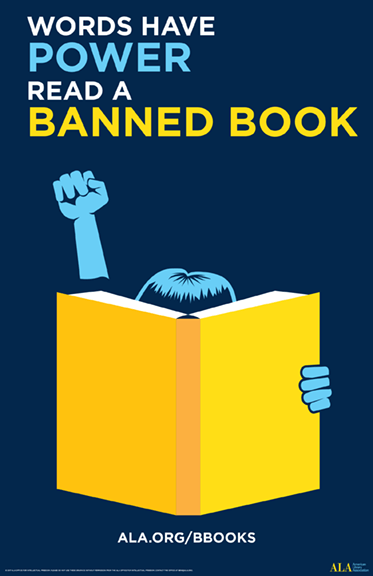
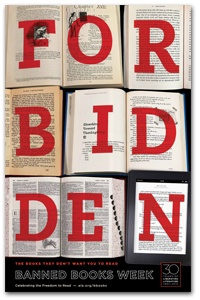
I was pleased to see that South Dakota didn’t get pinned in the map of book censorship, 2007-2009.
Sure, maybe the Kindle is “greener” but consider this: “What’s good for the planet may not be good for that other endangered species: the bookshop around the corner.”
Another sign of the times? Fiction about ecological catastrophe “is moving away from its roots in science fiction and is becoming part of mainstream literature.”
Margaret Atwood has launched a fairly impressive web site (and blog) in conjunction with the forthcoming release of her novel The Year of the Flood. And at least the Canadian portion of her book tour will include an hour-long performance featuring 14 hymns -– one for each chapter in the book — that Atwood wrote.
Nonbookish Linkage
I wonder if I can get a franchise and call it No Dog Left Behind? Probably not, since the point is the dog will be left behind, at least according to the Bible. (Via.)
As a longtime aficionado, I enjoyed 11 Things You Didn’t Know About Pinball History, even though a number of them are covered in the documentary, TILT: The Battle to Save Pinball.
Was Bob Dylan looking for Springsteen’s old home?
I couldn’t agree more: Tweets have no value.
It’s true. A broken heart really does hurt. (Via.)
I arise in the morning torn between a desire to improve (or save) the world and a desire to enjoy (or savor) the world. This makes it hard to plan the day.
E.B. White
|
Disclaimer 
Additionally, some links on this blog go to Amazon.com. As an Amazon Associate I earn from qualifying purchases. There is no additional cost to you. Contact me You can e-mail me at prairieprogressive at gmaildotcom.
|