|
|
Orwellian. Kafkaesque. Both terms are universally recognized shorthand for certain types of tales. Yet the terms are bandied about all too often. While the title of Detective Story by Imre Kertész calls to mind some noir novel, it is far more faithful to Orwell and Kafka than most other books for which those authors are invoked.
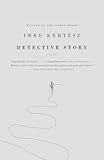 Kertész, an Auschwitz survivor, won the Nobel Prize for Literature in 2002, the first Hungarian author to do so. Originally published in Hungary in 1977, Detective Story is actually set in a fictitious Latin American country. Its appearance in the U.S. this year sadly reinforces it is still relevant. Kertész, an Auschwitz survivor, won the Nobel Prize for Literature in 2002, the first Hungarian author to do so. Originally published in Hungary in 1977, Detective Story is actually set in a fictitious Latin American country. Its appearance in the U.S. this year sadly reinforces it is still relevant.
Detective Story actually has three narrators. The main one is Antonio Rojas Martens, a career policeman who transfers into “the Corps,” a secret police outfit. His story, however, is introduced by a defense attorney representing Martens, who has admitted to and been convicted of various counts of murder after the regime he served has itself been overthrown. Essentially, Martens wants to explain his involvement with and what happened to “Federigo and Enrique Salinas, father and son, proprietors of the chain of department stores that are dotted all over our country, whose deaths so astounded people.” In so doing, Martens quotes extensively from Enrique’s diary, which was confiscated in a search of the Salinas home, making Enrique co-narrator of the memoir (although it beggars the imagination that Martens would have access to the diary while incarcerated.)
The country, led by “the Colonel,” has become a totalitarian society in which surveillance is endemic. “There are these police types everywhere, eavesdropping, sniffing around, and they think nobody is paying any attention to them,” Enrique notes in his diary. “They’re right, too, people don’t pay them any attention. All it has taken is a few months, and already they have grown accustomed to them.” For example, the Corps shoots 120 rolls of film when Enrique spends a bit of time at the beach with a group of college-aged acquaintances Martens calls “shaggy-haired weirdos.”
Enrique’s diary reveals that he is chafing under the government’s state of emergency, particularly since it has closed the universities. But other than what Orwell called “thoughtcrime,” Enrique has done nothing to attract the attention of the Corps, other than to be photographed with the presumably subversive “weirdos.” That matters not. “Any person who was in the records was going to end up a suspect sooner or later, no question,” Martens writes. Moreover, simply being in the records meant “Enrique was going to perpetrate something sooner or later. As far as we were concerned, his fate was sealed, even if he himself had not yet made up his mind.”
Thus, Kertész blends the Orwellian world with a Kafkaesque one. Whether Enrique or his father are guilty of treason or trying to overthrow the government is wholly irrelevant. They, like almost anyone else in the country, are powerless to change their destiny. Having been identified as a potential threat to “Homeland security” due only to association, Enrique and, in turn, his father are inexorably entangled in the jaws of the leviathan. Detective Story is, thus, like many detective novels. The story isn’t in the end result, it’s what brought the characters to that end.
At just more than 100 pages, this is more a novella than a novel. It is written in sparse, straightforward prose, something retained in Tim Wilkinson’s translation. In fact, Detective Story was on the longlist for the first annual Best Translated Book Award. Characters are portrayed more from a psychological standpoint than any other. Martens seeks to expiate his conscience, noting that although the Corps “brainwashed” him, it wasn’t enough. Yet he still invokes some bit of excuse, saying that as the “new boy” on his interrogation team, “I was aware that a different yardstick applied here at the Corps, but I thought there was at least a yardstick.”
Enrique’s conscience is similarly plagued by guilt, but guilt over the benefits his family’s status affords him and the perceived complacency of the citizenry, himself included. He expressly takes an existential view of the meaninglessness of life under the current regime and he burns to do something, anything, to bring value to his life. His father’s conscience, meanwhile, will suffer the repercussions of his own deceptions.
Thus, the power of Detective Story is not in its character description but showing how easily it is for evil to be viewed as a temporary necessity until it simply becomes accepted. As the defense attorney says in introducing the story, “Let me add, not in his defense but merely for the sake of the truth, that this horror story was written not by Martens alone but by reality, too.”
The present is just temporary.
Imre Kertész, Detective Story
Sometimes, a few seconds are all you need to know just what album you’re listening to. Sgt. Pepper’s, for example. Or you know you’re listening to Exile on Main Street when you hear the opening licks of “Rocks Off” (which may be the best first five seconds of any album). And for me, the opening ten distorted guitar notes in “Cinnamon Girl” immediately identifies Neil Young’s Everybody Knows This Is Nowhere.
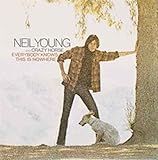 Released 40 years ago tomorrow, Everybody Knows This Is Nowhere was only Young’s second solo effort but it introduced a side that would eventually lead to him being called the Godfather of Grunge. Much of that was due to the fact it was Young’s first recorded collaboration with Crazy Horse, one that was seamless. Released 40 years ago tomorrow, Everybody Knows This Is Nowhere was only Young’s second solo effort but it introduced a side that would eventually lead to him being called the Godfather of Grunge. Much of that was due to the fact it was Young’s first recorded collaboration with Crazy Horse, one that was seamless.
“Cinnamon Girl” is one of several tunes off the album that would become classics. In opening the LP, it gave a clear indication of the approach of the other songs that would be considered classics, “Down By The River” and “Cowgirl in the Sand.” Young’s interplay with Crazy Horse guitarist Danny Whitten and bassist Billy Talbot produced a rock feel always on the edge of raw, a feel reinforced by heavy reliance on fuzz boxes. Or was it the fact that Young claims to have written all three songs while suffering a 103 degree fever?
Clocking in at just under three minutes, “Cinnamon Girl” actually hit the singles charts. It served as an excellent introduction to the quality of the music on the LP and Young’s now signature “one note” guitar solos. “Down by the River” and “Cowgirl in the Sand” ran nine and ten minutes, respectively, giving Young and Whitten time to explore tunes built on relatively simple framework. Closing side one and side two, respectively, the two songs were replete with driving guitar work. In trading notes and licks, Whitten and Young put on a demonstration to which any guitar-based jam band should pay heed.
Even with the rock edge, these songs had a slight country twang to them. That was to be expected, given the country-folk feel of Young’s debut solo album, released just months before. Young didn’t wholly abandon that style on this LP. “Round & Round (It Won’t Be Long)” and “The Losing End (When You’re On)” are patterned on that style. And “Running Dry (Requiem for the Rockets)” would have been a perfect fit for HBO’s Deadwood. As we would learn over the years, though, what one would think is straightforward isn’t when it comes to Neil Young.
Given the country flavor to the music, you might think “Cowgirl in the Sand” referred to some woman on the beaches of California. Yet Young told a concert audience in 1971, “This is a song I wrote about the beaches in Spain. I’ve never been to the beaches in Spain. It’s just my idea of what it’s like over there.”
Of course, who really cares where ideas come from when they are expressed so superbly?
I gotta get away from this day-to-day running around
Everybody knows this is nowhere
Title track, Neil Young, Everybody Knows This Is Nowhere
History, particularly ancient history, isn’t an American strong suit. In fact, I wouldn’t be surprised if watching 300, a retelling of the Battle of Thermopylae in 486 BC, is perhaps the lengthiest encounter much of that movie’s audience has had with Greek history. It’s an even safer bet that far fewer were aware that a line in the movie, a Spartan commenting that if the Persian arrows blocked out the sun they would at least be fighting in the shade, actually comes from some ancient Greek dude named Herodotus.
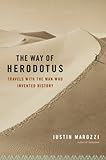 As a result, it should come as no surprise that a droll and enlightening look at Herodotus comes from a British writer. With The Way of Herodotus: Travels with the Man Who Invented History, Justin Marozzi uses his skills as a travel and history writer to introduce us to the fifth century BC Greek known as the West’s “Father of History”. More important, Marozzi does so using the prism of today. As a result, it should come as no surprise that a droll and enlightening look at Herodotus comes from a British writer. With The Way of Herodotus: Travels with the Man Who Invented History, Justin Marozzi uses his skills as a travel and history writer to introduce us to the fifth century BC Greek known as the West’s “Father of History”. More important, Marozzi does so using the prism of today.
Herodotus becomes Marozzi’s companion and guide as he travels to Turkey, Iraq, Egypt and Greece to follow in the steps of the man who helped document the birth of Western Civilization (with caps, of course) and a clash of cultures that still exists. To call Marozzi a Herodotean is an understatement. He is unquestionably passionate about not only Herodotus’ role in history, but his writing style and the approach to and breadth of his multi-volume history of the wars between Greece and Persia. In addition to being the world’s first historian, Marozzi writes in his introduction,
he is also its first foreign correspondent, investigative journalist, anthropologist and travel writer. He is an aspiring geographer, a budding moralist, a skilful dramatist, a high-spirited explorer and an inveterate storyteller. He is part learned scholar, part tabloid hack, but always broad-minded, humorous and generous-hearted, which is why he’s so much fun.
Marozzi seeks to prove these points with both a sense of adventure and a waggish touch, relying most heavily on his skills as a travel writer. This is as much a travel book as a history book and enjoyable in that sense alone. To Marozzi, the land and the people are an integral part of his pursuit of Herodotus, just as they were important to Herodotus. Marozzi is observant to detail and uses The Histories as not only a source of information but a tool to compare, contrast and entertain. Like Herodotus, he is not afraid to embark on tangents and digressions, particularly if he thinks they help make for good storytelling. He isn’t always successful in that regard.
Yet The Way of Herodotus may be most compelling as it explores just how little we may have changed in the last 2500 years and at least one effort to bring about change.
In the very first sentence of The Histories, Herodotus sets out his purposes, which include “especially to show why the two peoples fought each other.” Those “two peoples” were the Greeks — the West — and the Persians — the East. As Marozzi points out, while Herodotus was writing during the Peloponnesian Wars as they overshadowed the world, beginning in 2003 the war in Iraq “was doing the same thing.” It also presented “cultural confrontation and the clash of civilisations, democracy versus dictatorship, West versus East, religion, greed, hubris and its consequences.” All in all, it had “an unmistakably Herodotean echo.”
Marozzi gains firsthand experience with those echoes as he travels to post-Saddam Baghdad to help a British security company set up a civil affairs program. Yet his main goal and attraction is not Baghdad but Babylon, the site of civilizations that predated Herodotus by some 1,300 years but which even he could not resist.
One unmistakable subtext of The Way of Herodotus is that ancient history is not necessarily irrelevant in today’s world. Ethnic and geographic animosity still exist even if, like Iraq, it is cloaked in different purposes and reasons. Showing the potential for change, though, is an effort in an area where ethic enmity has been a constant for some time — the Balkans. Marozzi visits the head of a project that is trying to create a less ethnocentric and more balanced approach to history that more openly explores the differences and conflicts between and among peoples. With multinational involvement, the Greece-based Joint History Project created four new secondary school history workbooks that provide multiple perspectives on issues that have divided the Balkans. It is a long-term effort to make history a mechanism for critical thought rather than a nationalistic tool that may encourage ethnic hatred.
For the travel enthusiast and even the casual fan of history, the views of culture, society and history The Way of Herodotus provides outweigh the various diversions that tend not to lead much of anywhere. Additionally, given Marozzi’s praise for Herodotus’ storytelling, his writing style makes this an entertaining exploration of a long-dead Greek and the role of history in contemporary life and conflicts. Sadly, though, 300 will probably remain the main source of most Americans’ exposure to Herodotus.
As a species, we are inordinately vain. History is our mirror.
Justin Marozzi, The Way of Herodotus
Achievement Awards
MobyLives, the blog of Melville House Publishing (which brought us my book of the year so far, Every Man Dies Alone), earns honors again for blog post headline of the week: New Kindle to include button that vaporizes feelings of regret for having bought Kindle introduced just last month.
Bookish Linkage
In the e-book v. print debate, one blogger asks about what physical books actually cost. (Via.)
An author decides to use his book tour to also visit and blog about 100 independent bookstores. (Via.)
The PEN Literary Awards were announced this week, with Cormac McCarthy winning the PEN/Saul Bellow Award for Achievement in American Fiction.
The art of Penguin science fiction.
The finalists for the Sidewise Awards for Alternate History have been announced.
Nonbookish Linkage
Rogert Ebert waxes philosophical in a “you must read this” blog post that begins, “I know it is coming, and I do not fear it, because I believe there is nothing on the other side of death to fear.”
Given the year it had, it shouldn’t come as any surprise that AIG won the “golden poo trophy” for Worst Company in America.
If you only read the books that everyone else is reading, you can only think what everyone else is thinking.
Haruki Murakami, Norwegian Wood
Black helicopters — a symbol for conspiracy theorists and, for lack of a better term, wackos. Sadly, the U.S. has become a wellspring of goofy claims and theories and one of the more prevalent ones hit Sioux Falls this week.
Evidently, about 200 people showed up Thursday night to hear a Canadian physician, Dr. Andrew Moulden, warn about the dangers of vaccines. Of course, the media has been filled for a year or more with Jenny McCarthy and Jim Carrey talking about vaccines and autism. But there’s one flaw in all this: VACCINES DO NOT CAUSE AUTISM. While there are potential side effects, the risks of not vaccinating children are far greater.
Here’s a few things I bet people at this meeting didn’t hear. It turns out the study that began the whole controversy by claiming the measles-mumps-rubella (MMR) vaccine causes autism is based on altered data. Earlier this year, the so-called Vaccine Court ruled in three different cases — the strongest of the ones before it — that there is no causal connection between vaccines and autism. Not only do most studies show there is no link between vaccines and autism, within the last two weeks, a major study determined a tiny genetic variation on a particular chromosome was present in over 65 percent of autism cases.
Black helicopters may well be a good comparison to this presentation as it looks like Dr. Moulden also believes in them. He is a leader of something called the Canadian Action Party. In his 2008 “Leader’s Message” he made it a point to warn people that the “new world order” is on the way, promoted by elitist groups. You know, the Bilderbergs, the Trilateral Commission and their fellow travelers. The CAP also supports a more recent conspiracy fixation, the so-called 9/11 “truth movement”.
Believing in and advocating conspiracy theories is one thing. But it goes beyond the pale when it amounts to endangering the health of children. And it isn’t just the one unvaccinated child who is in danger. As the number of such individuals grow, there is greater risk to those who may not have been vaccinated for legitimate reasons.
The risk is easily seen. Since the MMR-autism scare began, there has been an unpredented increase in measles in the U.K. while incidences of mumps have increased 700 percent. In the U.S., there have been marked increases in diseases such as pertussis (“whooping cough”) and the number of measles cases in 2008 was the highest in more than a decade. More than two-thirds of those measles cases involved unvaccinated individuals and half of all the measles cases in 2005 were traceable to one unvaccinated person.
So let me repeat: VACCINATIONS DO NOT CAUSE AUTISM. Refusing to vaccinate children, however, can not only make them sick, they — and others — can die. It is the anti-vaccination movement, not vaccines, that put children’s health at risk.
The great irony of vaccine success is that parents today are unfamiliar with the diseases they prevent.
Denise Fields and Dr. Ari Brown, Baby 411
|
Disclaimer 
Additionally, some links on this blog go to Amazon.com. As an Amazon Associate I earn from qualifying purchases. There is no additional cost to you. Contact me You can e-mail me at prairieprogressive at gmaildotcom.
|