Bob Dylan was groundbreaking in many areas. But who’da thunk he’d foreshadow the day of the music video. Yet a filmed promo for his song “Subterranean homesick blues,” shot on May 8, 1965, on Dylan’s U.K. tour, not only was one of the first, it was ranked number 7 on Rolling Stone‘s 1993 list of the top 100 music videos.
It’s more than likely you’ve seen at least snippets of the video, which shows Dylan flipping over cue cards with some of the words to the song. The clip also opened Dont Look Back, the documentary of the 1965 U.K. tour.
The song was the opening cut on Dylan’s Bringing It All Back Home, his fifth LP. It was the first album on which we hear the “electric” Dylan that would create such an uproar at Newport and a subsequent U.K. tour later in 1965. In fact, the song kicked off the electric side of the LP.
The video was shot in an alley outside the Savoy Hotel, in which Dylan and his entourage stayed for his London performances. Several of the scenes in Dont Look Back were shot in the hotel. The clip is also memorable because beat poet Alan Ginsberg appears in the background on the left side talking with someone. Yet this wasn’t Ginsberg’s only connection with Bringing It All Back Home. In the liner notes on the back cover, Dylan wrote, “why allen ginsberg was not chosen t’ read poetry at the inauguration boggles my mind.”
The political, anti-establishment tenor of “Subterranean Homesick Blues” is also responsible for another significant cultural impact, one viewed far less pleasantly. In the song, Dylan sings, “You don’t need a weather man/To know which way the wind blows.” That lyric was the source of the name for the Weather Underground, “The Weathermen,” a radical splinter group of the Students for a Democractic Society in the 1960s. In fact, “You Don’t Need a Weatherman to Know Which Way the Wind Blows” was the title of one of the group’s foundational documents. With a goal of “destruction of U.S. imperialism,” The Weathermen embarked on a violent path, including several bombings, which eventually led several members to go “underground” for years to escape prosecution.
It’s amazing how one song from one artist can not only lead to the evolution of music videos but also contribute to radical political activity.
The pump don’t work
‘Cause the vandals took the handles
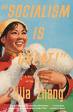
Zhang’s book is a personal memoir, not a political one. That’s why it is echoes Tolstoy’s argument. Zhang was growing into adulthood during the birth pangs of new capitalism and democratization in China in the 1980s. Her life reflects and is influenced by changes that were wrought in part because of what the people were doing and wanted, not because change was dictated from on high by a post-Mao leadership.
Zhang lived in Nanjing (Nanking), located on the Yangtze River. The city’s name means “Southern Capital,” as it once served as a capital of the country. It is, however, some 700 miles from Beijing so it was not the center of political or social developments in the country. Yet the fact the changes were also occurring there is indicative of how activities at the local level grew and expanded until they were reflected nationally.
“Socialism Is Great!” begins in December 1980, when. as a teenager, Zhang’s 43-year-old mother retires from her job at a state-owned missile production plant and she must go to work there. Her mother fears that if she doesn’t retire now, dingzhi — a policy under which retirees could be succeeded in the workplace by their children — will disappear. Zhang’s resentment losing any chance to go to college and her desire for a life other than as a factory worker helps drive her to further her education to the extent she can. Thus, she obtains a mechanical engineering degree through anew “TV University” program. She later learns English and becomes a translator largely through guided self-study. These pursuits reflect slowly growing change in the general population, a change where personal growth and freedoms begin to take precedence over the drab, gray and formalized structure under which the country has long operated.
These changes are reflected even in her mother. She soon goes to work as an administrator at a small free market bazaar in Nanjing. The market is not operated by the government. Rather, the rows upon rows of stalls selling almost anything is made up of “a new breed of businesspeople” who rent stall space to sell their wares on their own. As time progresses, the capitalistic sense grows more widespread. “‘Revolution is not a dinner party,’ our great leader Chairman Mao once warned,” Zhang writes. “But today’s revolution seemed to be all about dinner parties — most business deals, official or private, were concluded at a banquet table crowded with expensive items[.]”
Her comment reflects, though, that not all the trappings of the Mao era were on the way out. In fact, the book takes it title from the lyrics of a song Zhang’s TV University class performs at a celebration of the Communist Party’s 62nd birthday. Zhang makes clear in other ways that this is still a society locked into an authoritarian tradition.
For example, if the temperature reached a certain point, factories and government organizations had to close. Even when that temperature had been exceeded, the government reported a lower one, leading Zhang to note that in her society, “the authorities controlled even the temperature.” Likewise, while Zhang is becoming increasingly sexually active, the factory in which she works still has “period police,” family planning staff who verified each female worker had their monthly period.
In 1986, occasional public protests occur, even in Nanjing. By 1989, the push for freedom and democratization gave rise to the Tiananmen Square protests. Not only did they reverberate worldwide, they were reported and had great impact in China itself. Just days before the government brutally quashed the Tiananmen Square protests, Zhang helped organize a demonstration among the workers at her factory, who marched to join a far larger crowd in a Nanjing square. Zhang gives an impassioned speech there promoting democracy.
This overt political activity appears at the end of the book and almost comes out of nowhere. In fact, when first released last year, the book concluded with her signing a confession of her involvement after being questioned by police investigators. Fortunately, the just released paperback edition adds an epilogue explaining how Zhang’s life since and how she came to write the book. Although Zhang’s personal growth over the course of the book indicates her broader views on democracy and freedom, the suddenness of her explicit political activism and the rather abrupt conclusion of her story leaves the reader hanging.
This is one of several flaws that undercut Zhang’s memoir. Among other things, she has a tendency to use quick cuts. She will jump from a recounting on one page into totally unrelated events on the next. This is even more irksome because, in doing so, Zhang often begins with the aftermath of events and then, a few paragraphs or pages in, finally take us to the events to which we have shifted. Similarly, Zhang’s extensive use of Chinese idioms can be distracting at times. Whether this is simply cultural, reflective of an the intent to reinforce the “Chineseness” of the story or merely to show what such proverbs can encapsulate in a few words, their frequency seems to render them almost a crutch. Finally, there is perhaps an overemphasis on Zhang’s sexual awakening and relationships, particularly for those who are more inclined toward the political or societal aspects of the memoir. That also contributes to various instances of turgid writing, such as, “I guided his hand down to my jade gate where a misty cloud had gathered.”
These blemishes demonstrate Zhang’s memoir clearly is not a Tolstoyian work. But it does take us to the level where that great author believed real change occurred. As such, “Socialism Is Great!” is an eyewitness account of momentous times in China by a relatively average individual who did not realize her own life reflected and contributed to history until after the fact.
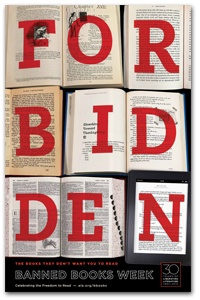
How many books (roughly) are in your tbr pile? Is this in increasing number or does it stay stable? Do you ever experience tbr anxiety in the face of this pile?
Sadly, my TBR pile has grown to the point it is now a now a three-shelf bookcase next to my side of the bed. (My wife has one next to her side of the bed, too.) Currently, between my book case, which is about two-thirds full, and the small bookshelf built into the headboard of the bed, there are 56 books.
I may need to start weeding it down some because the number has grown in the last month. There has been an increase in review books but I do at least get those read. The bigger issue is that I can’t seem to stay out of bookstores and libraries. Actually, that isn’t the problem. It’s that once I’m in them, it’s like putting a kilo of meth near an addict. It takes very strong will or extensive guilt about the number of unread books on the TBR shelves to walk out without a fix — or two or three or four. For example, in April alone, I know I bought at least a dozen books, probably 80 percent of which were used books (as if that makes a difference) and received probably at least as many review copies (although unsolicited review copies may not make it to the TBR shelves.) Add in the fact I checked out four or five books from the library and it’s no wonder the TBR book case is filling up.
I don’t feel anxiety about the number, though. As indicated, it is closer to guilt or even disappointment. For one, I wonder where I’m ever going to find the time to read the TBR books. At my average reading pace, that is more than six months of reading even if nothing else shows up. But I also feel like I’m depriving the books of their reason for existence. A book sits unread on my shelf when it could be bringing pleasure to me or anyone else who picked it up. Of course, maybe I’m just channeling some remnant of the recovering Catholic in me — or the inspiration for the title of Corey’s blog.
The unread story is not a story; it is little black marks on wood pulp. The reader, reading it, makes it live: a live thing, a story
At least in name, Georg von Trapp achieved international fame as the father of the family portrayed in The Sound of Music musical and film production. How accurate that character was has been challenged by von Trapp’s family. One aspect was right: von Trapp was a retired naval officer. Not only did he serve in the Austro-Hungarian Navy, he was a U-boat commander decorated for his actions in World War I and who rose to the rank of lieutenant commander and the command of a submarine base before the war’s end.
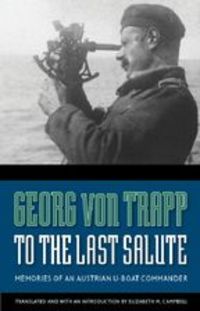
Long before any films or musicals were made about his family, von Trapp wrote a memoir of his World War I service. Originally published in Austria in 1935, it was not translated into English and published in the U.S. until 2007. Translated by a granddaughter, Elizabeth Campbell, To the Last Salute: Memories of an Austrian U-Boat Commander is now out in a paperback edition and provides a rare and intriguing perspective on U-boats in that war.
Much has been written about Germany’s U-boat campaign in the North Atlantic and the role it played in ultimately bringing the United States into the war. This memoir explores an entirely different aspect of the Triple Alliance’s naval effort. The handful of U-boats in the Austro-Hungarian Navy operated in the Adriatic and Ionian Seas and, less frequently, in the Mediterranean. These were not the U-boats most envision or even what the German Navy had. In fact, when a German U-boat commander visited von Trapp’s boat in 1915, the German officer said, “I would refuse to travel in this crate.”
In addition to being more primitive than the German equipment, when a quicker dive was needed in these U-boats, men would rush to the front of the boat so there would be more weight there. Most, if not close to all, of the sailors slept on the floor, not in berths. The only time the air could be recycled was when the U-boat was on the surface. As a result, the heat and the smell of petroleum and unwashed bodies and clothes would build up to the point it could leave crew members in a stupor, ill and prostrate. Not only did it mean “[e]verything tastes of petroleum,” things got worse in bad weather, when seasickness may strike even the most experienced sailors. In fact, von Trapp writes of one series of squalls endured by the crew of his second U-boat, a captured and converted French submarine. Coming from the conning tower into the interior of the submarine, “takes away your breath,” he wrote, as men confronted “a sickening mixture of oil, cooking odors, and sweat stench.”
Despite the conditions, von Trapp and his crew were successful. In the six months of his first command in 1915, his U-boat sunk three ships, including a French cruiser. Unrestricted U-boat warfare began while von Trapp was commanding his second U-boat. In the course of two and a half years, he and his crew sunk nearly a dozen cargo vessels. In language that reflects the era in which he was writing, he recounts the successful and unsuccessful efforts in some detail, including the tracking of the vessels and trying to evade the torpedo boats and other ships assigned to protect the cargo ships. His recollections also show how strategies, tactics and technology on each side changed as the war progressed.
Yet this isn’t simply a recitation of war feats. As a firsthand account, To the Last Salute also reveals the lives of the crew members and officers of these U-boats and the Austro-Hungarian Navy. We see the experience of having to ration water not only for drinking but for washing the human body. With such restrictions, just wearing clean clothes during a bit of time in port was a pleasure to “prolong and savor.”
While there is also no question of the crews’ patriotism and loyalty to an empire that would dissolve with the end of World War I, von Trapp recognizes the human aspect of what all military men were is doing. In recalling the sinking of the French cruiser, which had more than 700 men aboard, he writes:
So that’s what war looks like! There behind me hundreds of seamen have drowned, men who have done me no harm, men who did their duty as I myself have done, against whom I have nothing personally; with whom, on the contrary, I have felt a bond through sharing the same profession.
In fact, if anything, as the war progressed, any dismay appeared directed toward what was happening on the home front. There is anger toward the Wazachiten, those who not only avoid the front but take advantage of being in the military to obtain items to which the average citizen doesn’t have access. There is frustration in knowing, as von Trapp puts it, that Austrian children “don’t even know what white bread is; they eat turnips.”
Although To the Last Salute covers the point from the mobilization of the Austrian U-boats to the end of the war, reference to direct experience with home is minimal. In fact, although the book refers to various home leave taken by von Trapp, mention of his family or his time with them is almost absent and noticeably lacking in any detail. Perhaps this helped contribute to him later being portrayed as cold and distant from his family. It may, however, simply be that von Trapp simply wanted to portray life from the military aspect and not from a more personal perspective.
In addition, his recounting of conversations contain so many direct quotes that it suggests they are recreated. Yet the fact is that this is a memoir by a military man, not a historian’s account. As such, it focuses on the things and compatriots that were important to him. More important, it provides a rare insider’s view of an aspect of World War I of which we in the West know little to nothing.
In peacetime…it must be like being in a fairy-tale land.
I contributed to an ObamaRama — a review of Obama’s first 100 days — at the newly redesigned Blogcritics Magazine. My piece appears in Part 2 but there’s no reason not to start with Part 1. And I kept my vow about the political — my contribution is on Obama and books.
But on a somewhat political note, I find it absolutely fascinating that evangelical Christians (62%) and weekly church-goers (54%) are the largest percentage of Americans who believe torturing terrorist suspects is often or sometimes justified. And while weekly church-goers who believe torture is never justified matches that of the overall population (25%), only 16% of evangelicals think it is never justified. Must have something to do with that vengeful God idea.
I see the local daily is among those members of the media who now refer to the flu that’s percolating everywhere as the “winesay uflay.” Haven’t watched any local news to see if any of the broadcast outlets are doing the same.
Bookish Linkage
As a follow-up to my ObamaRama contribution, it looks like Netherland is the latest entry in the Obama Book Club. Personally, I found it okay but nothing exceptional.
This will teach any author to be critical of the U.S. Even though the plane they’re on includes plenty of other people and is not going to land in the U.S., refuse it access to U.S. airspace entirely.
Anyone who doesn’t go to the Small Beer Press warehouse clearance sale to buy Elizabeth Hand’s excellent Generation Loss for a buck is missing a helluva deal.
Nonbookish Linkage
I’ve actually seen all but one of the films on this list of the top 15 greatest epic history movies. For whatever reason, I just haven’t gotten around to Hotel Rwanda.
Unfortunately, I’ve found myself asking this question too often when I’ve seen some people and their children.
Speaking of space porn, I was thrilled this week to learn of a repository of NASA images operated by the wonderful folks at the Internet Archive and all of which are in the public domain.
Coming full circle, leave it to John Scalzi to give the real reasons Obama’s first 100 days were a complete and utter failure.
All this will not be finished in the first one hundred days. Nor will it be finished in the first one thousand days, nor in the life of this Administration, nor even perhaps in our lifetime on this planet. But let us begin.