|
|
The “Gotta Blame Someone” Society: A Harris Poll conducted on March 31 and April 1 showed that two-thirds of the adults surveyed believe advertising agencies should bear some responsibility for the current economic crisis “because they caused people to buy things they couldn’t afford.”
I’m guessing the judge probably didn’t take too kindly to this guy’s attempt to get out of jury duty. Although I must admit chuckling at the line, “I would rather count the wrinkles on my dogs balls than sit on a jury.”
This lede from a recent column in the U.K.’s The Times brings to mind far too many lawyer jokes: “Lawyers are sometimes criticised for screwing clients with unwarranted fees. In a case in London, a client has alleged a rather direct version of that, saying her lawyer charged for having sex with her.
A Texas man was arrested after he complained to his neighbors, including their 13-year-old daughter, that “I’m tired of your cats shitting in my flower beds.” He is the third person arrested for disorderly conduct in Galveston County in the last eight months for cursing.
Can you say “issues”? Son bashes father on head with flashlight and firewood, then cuts out father’s pacemaker with a pocketknife. (Via.)
Also in the poor judgment category: A 19-year-old Wisconsin man is arrested for burglarizing cars and tells police he did so because “he was in serious legal trouble and was trying to get money to help pay for a lawyer.” (Via.)
US Airways to charge fee for paying fee.
Justice Antonin Scalia: Privacy protection silly, unless you’re talking about information about him.
…you are the sum total of your data. No man escapes that.
Don DeLillo, White Noise
Like two months ago, the “books to review” stack is piling up again. As a result, this month’s s bibliolust is limited to books I will be reviewing in the coming weeks:
A Day in the Life: One Family, the Beautiful People, and the End of the Sixties, Robert Greenfield — Greenfield has long documented pop culture and rock music. This book traces one of London’s popular couples and their association with various music icons of the 60s and 70s.
Delete This at Your Peril: One Man’s Hilarious Exchanges with Internet Spammers, Bob Servant — I’ve always been a huge fan of spam baiters, the guys who string spammers along and even manage to turn the tables on some. I’m hoping this will be a humorous adventure along those same lines.
Detective Story, Imre Kertész — Fueling the continuing foreign lit addiction with the Hungarian author who won the Nobel Prize for Literature in 2002.
A Prayer for the Dying, Stewart O’Nan — A chance to read one of those books I probably should have read when it first came out. It’s supposedly rather dark but since life ain’t always sunshine and light, literature shouldn’t be either,
The Way of Herodotus: Travels with the Man Who Invented History, Justin Marozzi — Travel and history. Two of my favorite things.
We Are All Moors: Ending Centuries of Crusades against Muslims and Other Minorities, Anouar Majid — Surveying the 16th century to the present, this book looks at how Moors actually and symbolically represent scapegoated minorities. The fact the author is a professor at the University of Minnesota bolstered my interest.
So six books to read and review in the next few weeks. TI suspect that means I won’t get to the half dozen or so books I picked up thanks to a stop at a used book store in Omaha on Easter weekend. Lust. It will abide.
Of all the worldly passions, lust is the most intense. All other worldly passions seem to follow in its train.
Gautama Siddharta (Buddha), The Teachings of Buddha
“In what part of the universe does this guy’s mind reside?,” I asked when I reviewed Kris Saknussemm’s first novel. I’ll admit that his latest, Private Midnight, brings him closer to our universe. But his is still more than slightly bent.
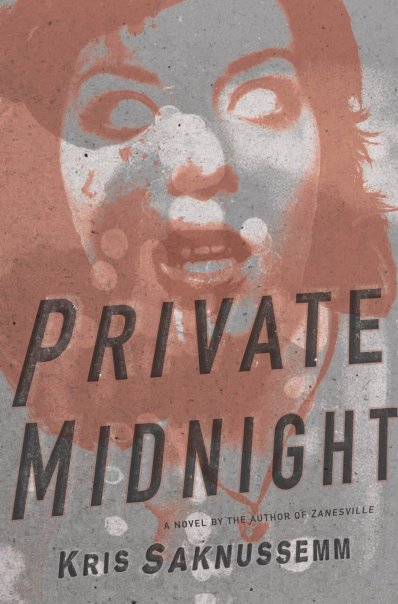 Saknussemm described that first book, Zanesville, as “techno-theological post-American monster vaudeville.” Private Midnight is of a different genre. The jacket flap calls it “a psychoerotic noir fairytale.” Makes sense. Saknussemm has taken noir crime fiction, infused it with a fantasy/horror/supernatural flavor and slathered it with kinky, at times graphic, erotica. Private Midnight‘s noir has a quintessential feel. The horror and eroticism seem to flow from those private dreams that strike at midnight or later. And it is a fairy tale to the extent the original Grimms’ fairy tales were at times quite gruesome and violent, albeit not so overtly sexual. Saknussemm described that first book, Zanesville, as “techno-theological post-American monster vaudeville.” Private Midnight is of a different genre. The jacket flap calls it “a psychoerotic noir fairytale.” Makes sense. Saknussemm has taken noir crime fiction, infused it with a fantasy/horror/supernatural flavor and slathered it with kinky, at times graphic, erotica. Private Midnight‘s noir has a quintessential feel. The horror and eroticism seem to flow from those private dreams that strike at midnight or later. And it is a fairy tale to the extent the original Grimms’ fairy tales were at times quite gruesome and violent, albeit not so overtly sexual.
The tale is told by Birch Ritter, an amiable, no-nonsense police detective with more than his fair share of demons. Imagine Jack Nicholson’s J.J. Gittes as a public servant who’s toting plenty of childhood and adult personal baggage. Then put him under the direction of David Lynch and you’ve got some of the idea.
From the standpoint of crime fiction, Private Midnight takes and follows a relatively straightforward path. Ritter and his new, younger partner are assigned to investigate the death of a wealthy businessman who appears to have committed suicide by pouring gas over his Mercedes, chaining himself to the steering wheel and lighting the vehicle on fire. Ritter can’t quite put his finger on why the death seems so suspicious to him. As he’s puzzling over it at his desk, his former partner drops a card on the desk that gives only an address on Eyrie Street and walks off without a word.
When Ritter goes there, he meets Genevieve Wyvern, a sensual, highly mysterious woman with seemingly hypnotic powers. Not only does she know details of Ritter’s past, she claims he’s there because he wants her help. She says he wants something he doesn’t know how to ask for and that he wants to “see life through a new window.” The meeting seems to transport Ritter into another dimension.
The next day, Ritter is called to another crime scene. This time, a minor city employee has emasculated himself and bled to death outside a seedy bar. Relying on his instincts, Ritter begins pouring through various records and discovers a connection between and both the businessman and the city official. He intends to use a hard-boiled detective approach to have her reveal the full nature of those connections and why he was sent to her house to begin with. Yet with each subsequent encounter, not only does his detective sheen evaporate, he becomes more and more enraptured with her. Each encounter delves deeper into Ritter’s past and his psyche and they become another step on a supernatural, erotic journey that is truly life-altering.
The noir feel and police detective setting serve as the stage upon which the heart of the story — a salacious fantasia — unfolds. Some might find the two a bit too divergent and the supernatural fantasy a bit too unbelievable. Other readers may be put off by the graphic and often deviant nature of some of the carnal scenes. My personal gripe is that Saknussemm seems to have a few too many characters appearing and reappearing for the reader to keep track of. For example, at one point about 100 pages in, more than half a dozen new characters appear in the space of about five pages. Two show up again later as Genevieve begins to reveal more to Ritter but most seem tangential at best.
Despite that, calling Private Midnight a fantastical and at times bizarre novel is a little like calling a Mike Hammer or Philip Marlowe tale a mystery. It doesn’t effectively convey what you’re in for. There’s one thing I know about the universes Kris Saknussemm creates (or inhabits): they leave an impression.
I’d been way too long at the fair. And now I was part of the freak show.
Kris Saknussemm, Private Midnight
Some records simply rank among the most highly influential in a person’s musical development and tastes. Chicago Transit Authority is one such album for me. And the fact it was released 40 years ago yesterday reinforces just how effin’ old I’m getting.
 One of the keys to formative albums is that they remain important to you even as you grow older. My views and impressions of CTA have changed and evolved over the four decades I’ve been listening to it. Yet it’s still an album I love listening to. One of the keys to formative albums is that they remain important to you even as you grow older. My views and impressions of CTA have changed and evolved over the four decades I’ve been listening to it. Yet it’s still an album I love listening to.
For those of us playing in garage bands at the time, you weren’t diddly if you didn’t have a couple Chicago tunes in your repertoire. (After release of the album, the band switched its name to simply “Chicago,” reportedly when the “real” Chicago Transit Authority, the city’s mass transit entity, threatened to sue the band.) The band I played keyboards in (however poorly) had no less than three cuts from this debut album in its arsenal: “Does Anybody Really Know What Time It Is” (which we called “DARKWITS”, even though the acronym isn’t correct), “Beginnings” and “South California Purples.”
There were two things that really attracted me about the LP at the time. First, it was the horn section. It just seemed more focused and more of a solid unit than other bands incorporating that horn sound. The colors and intonations on the opening cut, “Introduction,” are exhibit one for the talent of that section. I also was a big fan of Bobby Lamm, the keyboard player. I loved the piano solo leading into DARKWITS, omitted from the radio edit. I used to pore over the complete sketch score I had of the album even though my music reading skills and pudgy hands guaranteed I was incapable of coming close to how Lamm played.
With repeated listening, I also developed a fascination with Peter Cetera’s bass playing. Although Cetera’s voice would later lead him and the band into songs I didn’t quite like, CTA leaves little doubt that Cetera was one hell of a bass player, providing a crucial drive to the rhythm section. Moreover, due in part to the brass section and guitarist Terry Kathy being tasked with both rhythm and lead guitar, Cetera’s bass would often move up front yet never buried the balance of the section. His style was never simplistic and he helped bring a cohesiveness to the band. He is too often overlooked as an excellent bassist.
Of course, like most, I was at first hooked on the the more mainstream, almost radio-ready songs. After all, the band had three vocalists who could sing lead and the album spent 171 weeks on the charts. In fact, the entire first side of the double LP set could be considered radio worthy. As the years went on, though, I listened even more closely to Terry Kath’s work. I firmly believe Kath is one of the greatest rock guitarists of all time. I’ll admit I’m not a fan of “Free Form Guitar,” which opened the second LP. But take a listen to “Liberation,” the 15-minute live in the studio instrumental jam that closes that second disc. Not only is Kath blistering, he’s doing it on a jam, not with overdubs and retakes. His talent borders on astounding.
Those are just some of the changes I’ve gone through with CTA. And there’s another one that’s just as important. With hindsight, I can see how the band’s arrangements and performances helped provide a foundation to appreciate and “understand” jazz when I was finally exposed to it. Would I have become a jazz fan without CTA? Perhaps, but I would have missed out on hundreds of enjoyable hours listening to this LP.
And don’t you put me down, please
For creating beyond your mind
I said all you got to do is listen
“Listen,” Chicago Transit Authority
I’m not a reader of the McSweeney publications but thankfully Blog of a Bookslut led me to an excellent piece posted last week by Robert Lanham. It’s a syllabus and course overview for a new English class, Writing for Nonreaders in the Postprint Era.
The piece is absolutely marvelous. I don’t want to spoil it but here’s part of the course description:
Students will acquire the tools needed to make their tweets glimmer with a complete lack of forethought, their Facebook updates ring with self-importance, and their blog entries shimmer with literary pithiness. All without the restraints of writing in complete sentences. w00t! w00t!
Sadly, I can’t take the course. I missed (I hope) a few of the prerequisites, including “Staring Blankly at Handheld Devices While Others Are Talking” (ENG 102), “Internet-Age Surrealistic Narcissism and Self-Absorption” (LIT 209) and “Advanced Tweeting: The Elements of Droll” (ENG232WR). Unfortunately, this interweb thingy is full of people who not only have completed the prerequisites, they will undoubtedly clamor to get into the course — and love the grading schedule.
This piece is well worth the time and is a keeper.
There’s no such thing as oversharing when you’re a writer.
Robert Lanham, “Internet-Age Writing Syllabus and Course Overview“
|
Disclaimer 
Additionally, some links on this blog go to Amazon.com. As an Amazon Associate I earn from qualifying purchases. There is no additional cost to you. Contact me You can e-mail me at prairieprogressive at gmaildotcom.
|