|
|

So–just for today–how about sharing 7 things that you’re thankful for?
- My kids are home and there’s been a joyous uproar in the house this week (which also thrills the dogs).
- Everyone is healthy and happy.
- A roof over our heads and food on our table.
- Books.
- Hockey.
- The sun is shining and there is virtually no snow on the ground.
- My wife still doesn’t think she made a mistake 27+ years ago.
We tend to forget that happiness doesn’t come as a result of getting something we don’t have, but rather of recognizing and appreciating what we do have.
Frederick Koenig
Truly, I’m not on a Beatles kick. The fact three of the first four Midweek Music Moments have dealt with Beatles-related releases is a coincidence of dates. And a couple things justify this week’s selection. First, as far as I am concerned, All Things Must Pass, released on Nov. 27, 1970, is the best post-Beatles release of any of the Fab Four. In addition, Nov. 29 marks the seventh anniversary of his death.
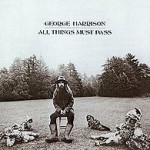 Three years to the day from the release of Magical Mystery Tour, the “quiet one” had the audacity to release a three-LP box set, believed to be the first in rock music history. Many might have thought two records were enough, since the third basically contained jam sessions (although those jams included most of the musicians from what would be known as Derek and the Dominoes). But even had it been limited to two records, the music was impressive. Three years to the day from the release of Magical Mystery Tour, the “quiet one” had the audacity to release a three-LP box set, believed to be the first in rock music history. Many might have thought two records were enough, since the third basically contained jam sessions (although those jams included most of the musicians from what would be known as Derek and the Dominoes). But even had it been limited to two records, the music was impressive.
All Things Must Pass “only” generated two hit singles: “My Sweet Lord” (which a court found Harrison “subconsciously” plagiarized) and “What Is Life.” While those two songs reflected Harrison’s ability to write about spirituality and love, respectively, All Things Must Pass displays great songwriting ability. Harrison covers a broad range, from rock (“Wah-Wah”) to even a country feel (“Behind That Locked Door”), not to mention songs like “Isn’t It a Pity,” “Beware of Darkness” and “Awaiting on You All” or the cover of Bob Dylan’s “If Not For You.”
There’s not really a weak tune in that entire bunch. Harrison clearly established that “Something” and “While My Guitar Gently Weeps” were not one-offs. Even on his spiritual side, Harrison displayed his adeptness at crafting the songs. He intentionally started the chant in “My Sweet Lord” by repeatedly using “hallelujah” before transitioning into a Hindu mantra. Not only was the former more familiar and acceptable to most listeners, Harrison said he was trying to “show that ‘Hallelujah’ and ‘Hare Krishna’ are quite the same thing.” Likewise, while the chorus of “Awaiting On You All” talks of chanting the names of the lord, Harrison explicitly mentions Jesus in the next verse.
To the extent any one has a “favorite Beatle,” there’s no doubt George was mine. It’s bittersweet that the anniversary date of this wonderful recording so closely coincides with the anniversary of his death. But Harrison didn’t change during that time. “Isn’t It a Pity” asks why we fail to love and care for each other. The statement announcing his death at age 58 concluded with a quote from Harrison, the last words of which urge us to “love one another.”
Isn’t it a pity
Isn’t is a shame
How we break each other’s hearts
And cause each other pain
“Isn’t It A Pity,” George Harrison, All Things Must Pass
There’s plenty of things parents of teens hope never happen to their children. Drug or alcohol abuse. Serious injury or death in an accident. Terminal illness. One that’s probably small on the radar screen is having to suddenly commit your teen to a mental hospital.
That is exactly what Michael Greenberg faced when his 15-year-old daughter was, as he puts it, “struck mad” on July 5, 1996. Hurry Down Sunshine details his family’s experiences in dealing with her seemingly sudden bipolar disorder.
Of course, hints of Sally’s problem, once called manic depression, existed before she her psychotic break. She’d spent several weeks reading and studying Shakespeare sonnets and fervently scribbling in the margins and her journals. Her ultimate “crack-up” finds her in a manic state on the streets of Greenwich Village, desperate to share what others cannot see: that we are all born with genius but society suppresses it as we grow older. Although Greenberg initially believed it a drug-induced episode, his wife feels it’s more serious and calls a therapist, who recommends taking Sally to an emergency room. Greenberg does so and by the end of the day Sally is committed to the mental ward of a Manhattan hospital.
Without going into extensive details of Sally’s treatment, Greenberg takes the reader inside the mental ward. He introduces us to a variety of individuals and families likewise struggling with the impact of a loved one suffering from a mental disorder. He leaves us with a feeling that there is shared compassion but, also, a shared feeling of shame, a feeling those whose relatives suffer from physical illness do not suffer.
Hurry Down Sunshine does not just focus on Sally. To the contrary, Greenberg also details his relationship with his brother, Steve, and Steve’s own disabling mental health issues, as well as his distant relationship with his mother. As such, Sally’s problems are a pivot that allows Greenberg to explore other aspects of his own life. As such, this is not a typical firsthand account of mental illness.
There are plenty of memoirs by people who have struggled with mental health issues, whether it be depression (William Styron’s Darkness Visible), schizophrenia (Mark Vonnegut’s Eden Express), bipolar disorder (David Lovelace’s recent Scattershot) or obsessive compulsive disorder (Charles Barber’s Songs from the Black Chair). Greenberg instead takes the approach of Pete Earley’s Crazy, looking at the impact of bipolar disorder not from the patient’s perspective but how Sally’s “crack-up” affects her family.
Greenberg, though, focuses on the events of the summer of 1996. Earley’s story covers a longer period and examines the difficulties in obtaining treatment. Greenberg also takes time to explore the connection between conditions like Sally’s and genius and creativity. In fact, after Sally is released he takes some of her medication to assess its effects. He discovers the drugs “release her not from her cares, but from caring itself. For caring, exorbitant caring … is the psychotic’s curse.” As luck would have it, he takes the medication shortly before a movie producer insists on visiting Greenberg to discuss optioning a film for a novel Greenberg wrote.
Putting your private life and struggles on display for public consumption can never be easy. When it such a personal aspect of your life and involves your teenage daughter, it can only be that much harder. Yet Greenberg’s decision (and Sally’s) to share that harrowing summer in an honest and forthright fashion undoubtedly contributes to the welcome reception Hurry Down Sunshine has received.
We all fear at some point that “our” world and “the” world have become estranged.
Michael Greenberg, Hurry Down Sunshine

How do you feel about wide-spread reading phenomenons – Harry Potter, for instance, or the more current Twilight Saga? Are these books so widely read for a reason, or merely fads or crazes? Do you feel compelled to read – or NOT to read – these books because everyone else is?
I don’t generally indulge in them but think they’re wonderful to the extent they encourage anyone, young or old, to pick up a book and read it.
I read the first couple books in the Harry Potter series as they came out but kind of gave up maybe half way in. There was no real reason I quit. I just had other things I wanted to read. My kids and wife, though, have read every book. More than anything, the series may also be a prime example of encouraging people to read.
As for the Twilight series, I kind of gave up on vampire books with Anne Rice’s Interview With The Vampire. I view the series and the growing array of vampire novels with a “to each his own” eye. If that’s what people want to read, that’s great as long as they’re reading. There just not my taste, regardless of their current popularity.
To read is to empower.
Jane Evershed, More Than a Tea Party
Random Observations
Where was I 45 years ago today? Sitting in a Catholic school second grade classroom.
Why aren’t I surprised? Although U.S. airlines claim to have rescinded or reduced their fuel surcharges because of the dramatic decline in gasoline prices, many of them simply “folded the amount of the surcharge into the airfare.”
Bookish Linkage
A UN organization has designated Iowa City the world’s third City of Literature. The other two are Edinburgh, Scotland, and Melbourne, Australia.
Google, Amazon, the U of Minnesota and two other entities have reached an agreement to digitize and return into print virtually every book the University of Minnesota Press has published since it began in 1925.
C. Max hopes the economy will bring back the paperbacks of yore. I hope he’s right.
As I’ve been known to grab whatever is handy to use as a bookmark, I find Forgotten Bookmarks quite engrossing.
I am not surprised: “Unhappy people watch significantly more television compared with happy people who are more socially active, vote more and read more.”
If you happen to have been out of touch, the National Book Awards were announced. You didn’t see anything here because I was traveling. That said Peter Matthiessen won the fiction award for Shadow Country and Annette Gordon-Reed’s The Hemingses of Monticello: An American Family won the nonfiction award.
Nonbookish Linkage
Monty Python turns the table on YouTubers (assuming that’s a word) and launches The Monty Python Channel on the site.
Billy v. Ed.
Fimoculous began its annual list of “best of” lists.
If you haven’t seen it already, here’s the NYT of July 4, 2009, that was being distributed on streets last week.
I’m of the age where I don’t understand the attraction of getting a tattoo but then to get it from a tattoo artist who can’t spell.
Yes, really dumb questions do exist and here’s a new way to answer them.
Watching television is like taking black spray paint to your third eye.
Bill Hicks
|
Disclaimer 
Additionally, some links on this blog go to Amazon.com. As an Amazon Associate I earn from qualifying purchases. There is no additional cost to you. Contact me You can e-mail me at prairieprogressive at gmaildotcom.
|