|
|
Technically, this album is just called Santana. It became known as Santana III because it was the band’s third album but their first LP was also called Santana.
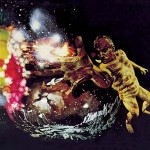 Santana III reached No. 1 on the Billboard charts in the magazine’s Nov. 13, 1971, issue. Even though I have an autographed copy of the album (signed “Joy, love Carlos Santana”) on the wall of my office, it is probably isn’t in my top five list of Santana releases. Yet it’s this week’s music moment because of the demarcation it represents in the musical journey of Carlos Santana and his band. Santana III reached No. 1 on the Billboard charts in the magazine’s Nov. 13, 1971, issue. Even though I have an autographed copy of the album (signed “Joy, love Carlos Santana”) on the wall of my office, it is probably isn’t in my top five list of Santana releases. Yet it’s this week’s music moment because of the demarcation it represents in the musical journey of Carlos Santana and his band.
Santana’s second album, Abraxas, also hit number one on the charts, helping generate buzz and anticipation for III. The latter continued the percussive Latin-influenced rock and produced two top 40 singles. It was the last production by the original Woodstock-era members of the band and included a significant addition — guitarist Neal Schon. In 1973, Schon and Santana keyboardist Gregg Rolie would form a band called Journey.
The dual, but rarely dueling, lead guitars on Santana III made this a more guitar-oriented album and it undoubtedly reached number one on its own merit. But despite back to back number one albums, Santana took a dramatic fork in the road. The next several U.S. albums — Caravanserai, Welcome and Borboletta — were more instrumental, had a jazz fusion bent and reflected Carlos Santana’s growing interest in spirituality. Yet those three records rank among my favorites in the Santana catalog. (I also have a similarly autographed copy of Caravanserai hanging in my office.) While the first two went gold the year of their release, Borboletta would take 15 years to sell enough units to reach that milestone.
In the late ’70s and early ’80s Santana returned more toward the current mainstream but by the late ’90s Carlos would be without a record contract. Surprisingly, the end of that decade would bring another number one album, Supernatural, which was Carlos and a variety of guest collaborators. When that album was released, I remember my kids being surprised that I’d bought something from such a “new artist.” They were even more surprised when I told them I’d been listening to the man for nearly 30 years.
Despite its individual strength, Santana III will never displace its predecessor or immediate successor albums in my personal ranking. Yet it not only marks the end of phase one of Santana, the benefit of hindsight reveals hints of what was forthcoming — the end of the original band and the next step in a wide and varied musical journey by one of the world’s greatest guitarists and the band that bore his name.
Seems like everybody’s waitin’
For the new change
“Everybody’s Everything,” Santana, Santana III

If you keep your books, where do you keep them? And, if you give them away, who do you give them to? Do you participate in Bookcrossing, BookMooch, PaperbackSwap, or the like? Do you give your old books to family & friends, or donate them? Are any of your books in storage due to not having enough space for them all? Or, are you one of the lucky ones who has their own “library”?
I’m someone who has their own “library” but that doesn’t mean I keep all my books.
The room I use as my hideaway has a wall with built-in bookshelves containing roughly 75 linear feet of shelf space. They are not packed tight but that is because within the last year I placed a standalone bookshelf that closely resembles the built-ins next to them, adding another 18 feet of shelf space. There’s also the smaller “to be read” bookshelf on my side of the bed, which has roughly 7.5 feet of shelf space.
Those shelves are basically for my books. My wife has a couple bookshelves elsewhere in the house, and each of the kids’ rooms has bookshelves of varying size.
Although none of my shelves are currently jam packed, the design of the room leaves little space for future expansion. As a result, I continue to occasionally “weed” through the shelves. In addition, just completed books may end up in a designated repository for books I’m not keeping rather than go on the shelves. The “discarded” books go to the used bookstore or are donated to the YMCA for sale at its local thrift store.
The rules have changed. True power is held by the person who possesses the largest bookshelf, not gun cabinet or wallet.
Anthony D’Angelo, The College Blue Book
When we think about vacations, “Where would I like to go?” is probably the most frequent question. Peter Greenberg, the travel editor for NBC’s Today show, CNBC and MSNBC, suggests “Where should I avoid?” should also be on the list.
In Don’t Go There!: The Travel Detective’s Essential Guide to the Must-Miss Places of the World, Greenberg surveys a wide range of things that might cause serious pause about a particular locale or a method of getting there. Greenberg takes a worldwide look at factors ranging from the environment to weather to traffic conditions to the risk of natural disasters while still opining on such things as the worst cruises, hotels, airports and airlines.
His opinions are downright brutal at times:
- “I’m sorry. Unless you like ugly, oily beaches and a totally unimpressive waterfront, Galveston, Texas, is a definite don’t-go-there destination.”
- “Would I go to Haiti? Sure, but it sucks.”
- Even on a good day Miami International Airport is “appropriately initialed MIA. On a bad day, it’s like the last flight out of Saigon.”
- South of the Border, a tourist attraction on the border of North and South Carolina, “is nothing less than a tourist trap marked by every racist stereotype you can imagine about the Mexican community.” (Greenberg doesn’t mention that the internet domain name for the business is “pedroland.”)
- “Gaudy, clashing, and downright corny” is how he describes the Corn Palace in Mitchell, S.D. (about 70 miles from my home). Oh yes, it’s also a “fiasco” and “an eyesore.”
Kind of makes you wonder what Greenberg really thinks?
As Greenberg admits in his introduction, the book is not and is not intended to be objective. It necessarily depends in part on personal opinion and Greenberg closes with the opinions of five experienced world travelers of places they don’t want to go or return to. For the most part, though, Don’t Go There combines personal knowledge and experience with extensive data from hundreds of sources. The result is a handy compendium of information that might otherwise not be readily available to or found by the average traveler.
For example, Greenberg helps explain his statement about Haiti by pointing out that when American Airlines flies from Miami to Port-au-Prince the crew stays on the plane, which contains enough fuel to return without refueling. Passengers are disembarked, new passengers get on and the plane takes off all within an hour due to risks of violence and kidnapping. In fact, some of the pilots on the daily route told Greenberg they’ve never left the airport despite numerous trips to the country.
Who can doubt that it is probably useful to know what your airline thinks of safety in the place it’s flying you or what cities have air pollution levels that may actually cause breathing problems or those that literally have toxic waste issues? Don’t Go There combines such material with basic information, such as the most expensive cities, the dirtiest hotels in the U.S., cruise ships with three or more reported illness outbreaks from 2002 to 2007, dangerous theme parks, and where and when a traveler is likely to encounter traffic bottlenecks.
Given the wide range of topics, the book has the inherent problem that some material may not be pertinent to every reader. That downside is offset in two ways.
First, Greenberg is not afraid to bring a sense of humor to the topic. Even though it may not impact your particular travel plans, there’s at least entertainment value in reading the “Lamest Claims to Fame” (such as the Minnesota community that bills itself as the “Sink Hole Capital of the U.S.A.”) or which cities have the highest per capita fast food consumption (Greenville, N.C., tops the list).
Second, and most important, the breadth of information makes the book useful regardless of whether you’re an occasional or frequent traveler or whether you travel outside the U.S. or prefer a driving vacation. As such, Don’t Go There is a worthy addition to almost any traveler’s library and certainly public libraries.
Is this book not objective? Of course it’s not objective.
Peter Greenberg, Don’t Go There!
Bulletin Board
Look what the election hath wrought already: reports that Bruce will release an album about the time Obama is sworn in. There are also unconfirmed reports brief U.S. and European tours will follow.
Bookish Linkage
Evidently, publishers also find a memoir by President Bush “resistible.” (Via.)
In contrast, Roberto Bolaño’s 900+ page 2666, set for release next week, is already described as a “literary juggernaut.”
The range of biographies, so to speak, of things and ideas you wouldn’t normally anticipate is wide.
So, what books would you pick to teach a course called “Murder, Mayhem and Madness“? (Via.)
City Pages takes a look at Graywolf Press, the independent St. Paul publisher of great works like Per Petterson’s Out Stealing Horses. (Via.)
Interesting thought to ponder: SF works that caused political change.
Add David Halberstam to the list of journalists and authors under government watch. (Via.)
Edward Champion doesn’t believe there’s any such thing as a free book for book bloggers. (I rejected the program out of hand because the I wasn’t interested in the publisher’s topics or it dictating where reviews had to be posted.)
Nonbookish Linkage
Should a person be pleased or disappointed if they don’t have any of the 15 creepiest old album covers?
Esquire gives us its list of the five most misleading propaganda films from the 40’s, 50’s and 60’s.
I could have told you this 40 years or more ago.
What’s the religious world coming to? Time cards for Catholic clergy and talk of “performance-related pay.” Hmmm, just how do you judge a cleric’s performance — ceremonies performed, confessions heard, new members, collection plate income or souls saved? (Via.)
Election-type Linkage
An interesting observation of the historic nature of the presidential election from the perspective of NYT headlines.
Here’s the speech Springsteen gave in Cleveland Nov. 2, the same night he debuted a new song, “Workin’ on a Dream,” and dedicated it to Obama.
Finally, this seems like a good way to close the book on election-related items. By a margin of 56-44 percent, Minnesota voters approved a “Clean Water, Wildlife, Cultural Heritage and Natural Areas” constitutional amendment. It authorizes a sales tax increase of three-eighths of one percent starting next July for dedicated funding for those purposes, including “to preserve our arts and cultural heritage.”
I’m workin’ on a dream
Though sometimes it feels so far away
I’m workin’ on a dream
And I know it will be mine someday
“Workin’ on a Dream,” Bruce Springsteen
Admit it. At some point, some conspiracy theory has enticed you. Maybe it’s not the claim the government was behind 9/11 or that AIDS was created in a government lab or that organized crime was responsible for the assassination of JFK. But at some time one or more such ideas may have gained some credence in your mind.
Don’t be surprised or embarrassed. As Gordon B. Arnold lays out in his cogent Conspiracy Theory in Film, Television, and Politics, conspiracy theory is part and parcel of American culture.
Conspiracy theories are nothing new. Even the long discredited Protocols of the Elders of Zion still finds believers after more than a century. But Arnold sees conspiracy theory as a metaphor. Granted, there are the true believers. Yet for the ordinary person, Arnold says, “the term seldom refers to a literal or criminal conspiracy, but rather to a generalized worldview in which ordinary folks are constantly the targets of manipulation and deception.”
Conspiracy Theory in Film, Television, and Politics posits three stages in the role and meaning of conspiracy theory.
In post-World War II America, the focus was external, such as the U.S.S.R. and its minions conspiring to ensure domination of the U.S. and the world. The threat was represented by alien invasions or portrayed in films about home-grown Communist spies or The Manchurian Candidate. Government and business were not only “overwhelmingly trusted,” they were seen as protection against outside conspirators.
According to Arnold, the movie Seven Days in May was a sign things were changing. Arnold points out that while the main story is a plot to overthrow the government, not only was it an internal plot but, when squelched, the government kept its existence secret. Released just months after the Kennedy assassination — “the linchpin in the modern ascent of conspiracy theory in American consciousness” — the film indicated Americans might think their trusted institutions may not be entirely forthcoming. Events of the ensuing months and decade, such as the Warren Report, the Vietnam War and the Watergate scandal, bolstered such thoughts. Arnold sees cynicism replacing the fear and paranoia of the Cold War as the fuel for conspiracy theory. Government and other institutions could be the potential enemy or, at a minimum, conspire to cover up their wrongdoing.
For Arnold, material like Oliver Stone’s JFK and the popular television series The X-Files reflect the final transition, which began in the 1990s. Cynicism did not disappear; it was supplemented by disaffection. Surprisingly, Arnold points to The Truman Show as one of the prime reflections of this transition, saying that, in some ways, it is “the epitome of conspiracy theory.”
That is certainly open to debate, just as it’s possible to argue whether Arnold should have examined other films (Enemy of the State) or television shows (The Lone Gunmen). Ultimately, though, his analysis supports his thesis. Picking nits about the most significant or relevant films or shows ignores that it is almost impossible for any work on the topic to be all-inclusive. While Conspiracy Theory in Film, Television and Politics doesn’t examine the impact of dozens, if not hundreds, of books, by examining screen portrayals it relies on likely more ubiquitous material.
Arnold, a professor of liberal arts at Montserrat College of Art, generally succeeds in ensuring his book doesn’t take too academic a tone. His writing is clear and both it and his analysis are easy to follow. He does, though, tend to utilize an aspect of academic writing. At various points, he summarizes the premise to be discussed, explores and explains why the premise is valid and then summarizes the premise and its supporting exploration and explanation. While such repetition might be advisable in some settings, it can be bothersome for the average reader.
While Arnold looks at a few post-9/11 screen efforts, Conspiracy Theory in Film, Television and Politics is far from the last word on its topic. It simply is too early to assess or predict the impact of those events on the role and acceptance of conspiracy theory in popular culture. Regardless, this is a credible analysis of how and why conspiracy theory transforms and is transformed by American politics, both literally and metaphorically.
Once the province of the marginalized, the paranoid, or the political extremist, the words “conspiracy theory” are now uttered by ordinary citizens, usually without eliciting much notice.
Gordon B. Arnold, Conspiracy Theory in Film, Television, and Politics
|
Disclaimer 
Additionally, some links on this blog go to Amazon.com. As an Amazon Associate I earn from qualifying purchases. There is no additional cost to you. Contact me You can e-mail me at prairieprogressive at gmaildotcom.
|