|
|
If you hadn’t heard already — and you should have — Kind of Blue is celebrating its 50th anniversary this year. In fact, it was 50 years ago this week — March 2, 1959 — that the first of the two recording sessions that created the best selling jazz album of all time took place.
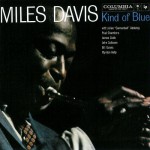 It’s hard to add to what’s already been said and written about the album. That’s particularly so when you consider it was No. 12 on Rolling Stone‘s rock and blues intensive list of the 500 greatest albums of all time. And even if it hadn’t been discussed so much, this album undoubtedly falls within what Elvis Costello said: “Writing about music is like dancing about architecture.” It’s hard to add to what’s already been said and written about the album. That’s particularly so when you consider it was No. 12 on Rolling Stone‘s rock and blues intensive list of the 500 greatest albums of all time. And even if it hadn’t been discussed so much, this album undoubtedly falls within what Elvis Costello said: “Writing about music is like dancing about architecture.”
That said, there’s a couple things about the LP that strike me ever time I listen to it.
There’s always been discussion of how Wynton Kelly was a bit peeved when he showed up for the sessions and Bill Evans, the man he had replaced in Miles’ band, was there. Yet I can’t help but think that helped contribute to the power of Kelly’s solo on “Freddie Freeloader,” the second cut on the LP. It is far more upbeat and bop-influenced than the more reserved and subtle comping approach Evans tends to take on the other tunes.
The bop influence in Kelly’s solo is also another fascinating aspect of the LP. Look at the players. All of them — Miles, Cannonball Adderley, Coltrane, Kelly, Paul Chambers on bass, Jimmy Cobb on drums and even Evans — were considered bop players. Moreover, Miles Cannonball and Coltrane would be among the purveyors of the “hard bop” sound. But that isn’t necessarily the case here. Bop elements are there but this is far more subdued and smoky.
I also believe Kind of Blue should be mandatory listening for anyone who wants to play the drums. In propelling the ensemble, Cobb isn’t letting go with big bass booms or gargantuan runs on the toms. No, he moves the band almost entirely with his cymbal and brush work. There’s some snare work here and there for emphasis but Cobb’s delicate touch is an essential part of an LP that is subdued to mid-tempo at most.
With its modal approach, the framework laid out by the rhythm section is comparatively sparse. Yet it’s stunning what each soloist does when the tune is handed over to him. That is why Kind of Blue is a great jazz album for people who don’t normally listen to jazz. It’s pace and approach provide a perfect introduction to how jazz artists build on and play with basic structures, taking them to levels you wouldn’t anticipate at the beginning of a tune.
The simple fact is that just as you have to look at a building to appreciate the architecture, you’ve got to listen to this album to appreciate the music on it.
When you’re creating your own shit, man, even the sky ain’t the limit.
Miles Davis, Miles: The Autobiography
Access to public records is in the news. Whether it’s via a presidential memorandum or legislation working its way through the South Dakota Legislature, the trend is to create a presumption that records are open. Yet even before those actions, an individual in California took making federal court records publicly available to a new level.
In October 2007, the federal judicial system launched a trial program at 16 libraries around the country granting unlimited free access to PACER (Public Access to Electronic Court Records), the federal judiciary’s database of case and docket information from the its appellate, district and bankruptcy courts. Usually, PACER requires registration and charges 8 cents a page, a fee that “applies whether or not pages are printed, viewed, or downloaded.” Having used PACER quite a bit, it is more than a tad clunky and outdated.
Carl Malamud, the head of a non-profit group that believes public records should be freely available, saw this as an opportunity. He urged volunteers to visit the libraries, download large numbers of court documents and provide them to him so they could be put on the web. Aaron Swartz went above and beyond the call. Swartz downloaded nearly 20 million pages of text, an estimated 20 percent of the entire database. The government shut down the trial program last September “pending an evaluation” and later announced that the security of PACER had been “compromised.”
Most appellate courts make copies of their opinions available online for free. This includes the South Dakota Supreme Court, the U.S. Supreme Court and the U.S. 8th Circuit Court of Appeals, the federal appellate court that handles cases out of South Dakota. That is not true for all the briefs or other pleadings filed with the appellate courts or for trial court filings. There simply is no public computerized access to such filings in South Dakota and, generally, the only way they can be obtained in the federal system is through PACER. Moreover, even in PACER your search is limited and does not include searching all or a certain number of the documents for a particular word or phrase.
There are, of course, some issues with unfettered public access to these filings because they often contain financial or other personal information. Those are not insurmountable problems. For example, the federal courts in South Dakota now use electronic filing and have a standing order specifying what personal identifying information should not be included in or should be removed from documents filed with it. Likewise, in an effort to maximize accessibility to court records, the South Dakota Supreme Court adopted rules several years ago that, among other things, say that court records are open to the public but specify what personal or financial information cannot be made public.
As a result, the issue with access to court records isn’t one of resistance. Particularly at the local level, it’s finding — and funding — a way to provide access to thousands and thousands of pages when and the technology continuously changes. After all, it wasn’t all that many years ago that microfilm was the technology of choice. And ultimately there will need to be a decision on whether the cost of online or other digital access should be borne by the court system (spelled “all taxpayers”) or by user fees.
The information revolution is unthinkable without democracy, and true democracy is unimaginable without freedom of information.
Kofi Annan, June 23, 1997
Each genre of books — whether literature, history or even sports — has its classics. When it comes to sports in general or boxing in particular, Sting Like a Bee: The Muhammad Ali Story by Jose Torres is unquestionably a top-ranked contender for that designation.
First published in 1971 after the first Ali-Joe Frazier bout in March of that year, the book focuses in large part on Ali’s return to the ring after having been suspended from boxing for refusing induction into the U.S. military. Torres, who died in January at the age of 72, brought a professional’s eye to the subject — that of a champion boxer. After winning a silver medal in the light middleweight division at the 1956 Olympics, Torres fought professionally from 1958 to 1969. He won the light heavyweight championship in March 1965, which he successfully defended three times before losing it in December 1966. Torres retired with a a record of 41-3-1. He became interested in writing and this was his first book.
Now reissued by Bison Books, Sting Like a Bee shows some age but not enough to undercut its strengths. As then, the book is divided into three parts. The first looks at Ali’s bouts after his return to the ring and prior to “The Fight of the Century,” as the first Ali-Frazier fight was called. The second is a more general biography of Ali before part three returns to and focuses on the Ali-Frazier fight.
While that may not be the structure of choice today, that breakdown helped serve as a peg for readers who were getting their hands on the book essentially on the heels of Ali-Frazier bout. As Norman Mailer, who befriended Torres, explains in a preface, the first and third parts were written by Torres in June 1971. The middle section is the combined work of Torres and Bert Sugar, the publisher and editor of Boxing Illustrated magazine. The difference is noticeable.
Torres’ writing at times mirrors boxing. Particularly in his description of fights, Torres throws a lot of quick jabs, mixing in almost staccato-like sentences that help reflect the pace of the fight. He also throws some hooks and straight rights and lefts, particularly in describing a boxer’s mindset and training, calling frequently on his own knowledge and experience. Nor does he fear letting go with an occasional haymaker. For example, in describing Frazier’s robe and trunks as he enters the ring, Torres says “he looks ridiculous.” In reflecting the feelings Ali engendered by joining the Black Muslims and refusing to be inducted, he writes of the Ali-Oscar Bonavena fight: “The sleeping crowd has awakened. The white man is hitting the nigger.”
Underlying it all is the fact Torres tends to tell the story from his eyes, giving the book the sheen of the so-called “new journalism” that arose in the 1960s. Part two, in contrast, is a more plodding style, something telegraphed from the outset. After becoming accustomed to Torres’ style, it opens with the following clunker: “Late in Capricorn, coming near to Aquarius, Cassius Clay (six pounds, seven ounces) was born in Louisville at 6:35 p.m. on January 17, 1942.” While this section is fairly essential to getting a complete picture of Ali, the drawback is that it reads like a standard sports biography. Yet even here Torres’ influence shows through. For example, in discussing Ali’s March 1967 fight against Zora Folley, the number one ranked contender, he calls Folley “the first experienced fighter I ever saw looking terrified.”
Plainly, Torres is not just style. As in boxing, he had enough punch to back up the style. With his keen, analytical eye, he takes us inside the gym, inside the locker room and even inside the psyche of the boxer in the ring. He explains the feelings, including fear and exhaustion, that all boxers, even Ali, experience prior to, during and after a fight. This makes Sting Like a Bee more than a valuable insight into a significant period in the career of a boxing legend. It is also a benchmark against which to measure other boxing books, if not sports literature in general.
I don’t have to be what you want me to be. I am free to be who I want.
Muhammad Ali, quoted in
Jose Torres, Sting Like a Bee
For a short month, February sure produced a lot of bibliolust. So much so, in fact, that this month’s installment is broken into two categories. One is books I’m slated to review in the immediate future. As if that list isn’t enough, the other category consists of books already checked out from or for which I am on the “hold” list at the local library.
Up for review:
“Socialism Is Great!”: A Worker’s Memoir of the New China, Lijia Zhang — Having garnered some good reviews when initially released last year, I decided to take a look at the forthcoming paperback edition of this memoir of a Chinese woman born during the Cultural Revolution.
Magic Bus: On the Hippie Trail From Istanbul to India, Rory MacLean — One of several books on the list prompted by recent reviews. This one intrigued me because I’ve always wondered about those members of the “love generation” who took off for the east in search of enlightenment, dope or both.
Dangerous Laughter: Thirteen Stories, Steven Millhauser — I’m not usually big on short stories but the publisher’s description and the fact it made the 2008 NYT Most Notable list leads me to give it a shot.
A Free Life, Ha Jin — Another NYT Most Notable list entrant — this time from the 2007 list — the paperback release of this story of Chinese immigrants prompted me to take a look at something I missed when it was first released.
The Soul of Medicine, Sherwin Nuland — Although I haven’t read much of his work since then, I enjoyed Nuland’s 1994 National Book Award winning How We Die enough that I thought I’d take a look at this forthcoming work.
From the library:
The Bloody White Baron: The Extraordinary Story of the Russian Nobleman Who Became the Last Khan of Mongolia, James Palmer — Let’s see. What isn’t there to intrigue me about the true story of a Baltic German Russian Buddhist officer in the Russian military who believes he is the incarnation of Genghis Kahn and becomes the dictator of Mongolia?
American Rust, Philipp Meyer — Mucho hype and buzz that even compares this debut novel to John Steinbeck leads to it getting on the reserve list when it showed up in the forthcoming library holdings.
Losing My Religion: How I Lost My Faith Reporting on Religion in America-and Found Unexpected Peace, William Lobdell — After hearing an interview with him on NPR, I read Lodbell’s LA Times essay and have been looking forward to the release of his book since.
Lowboy, John Wray — Another debut novel with tons of hype and buzz.
To me reading isn’t a progression of events, it’s a sensory wash; every part of the imagination is engaged, verbal, visual, empathetic, olfactory. Reading is a virtual reality that’s entirely personalised to you.
Ian McDonald, “How Soon is Now?“
Random Rant
I don’t wish ill on people. But I may consider an exception for spammers. For grins and giggles, I kept track of how many e-mails sent me last week were caught by the spam filter at work — more than 1,600. Of those, four — .002 percent — were legit e-mails inadvertently caught by the filter.
Bookish Linkage
Philadelphia’s One Book program reaches and deals with homelessness with The Soloist, the story of a reporter’s involvement with a homeless man playing Beethoven on the street.
SF author Charlie Stross gives us his FAQ on the 21st Century.
Philip José Farmer died this week at the age of 91. I thoroughly enjoyed his Riverworld series in the 1970s. The first book in the series, To Your Scattered Bodies Go, won him the 1972 Hugo Award for best novel.
Book Awards Linkage
The longlist for this year’s Independent Foreign Fiction Prize was announced this week. I haven’t read any of 16 books on the list, although I read last year’s winner. I found it interesting but not superlative by any means.
I’m also an 0-fer for the 18 books on the longlist for The Orwell Prize, which says it is “the pre-eminent British prize for political writing.” The organization also has an award for political blogs but they all appear to be UK-based.
Joseph O’Neill’s Netherland won the 2009 PEN/Faulkner Award for Fiction. I read it last year after having seen various favorable reviews and, again, while interesting I did not find it superlative.
The finalists for the Nebula Awards have been announced. I’ve actually read two of the best novel nominees.
Nonbookish Linkage
Mmmmmm, good?
Roger Ebert: “Snarking is cultural vandalism.”
Proof we’ve moved from a recession into a depression? Even with all the bad economic news, alcohol sales plummet.
Apparently even UFOs aren’t all that interested in “flyover country.”
While I don’t know if there’s scientific support for work driving you crazy, it may lead to dementia.
Man knows so much and does so little.
R. Buckminster Fuller, Time magazine, Jan. 10, 1964
|
Disclaimer 
Additionally, some links on this blog go to Amazon.com. As an Amazon Associate I earn from qualifying purchases. There is no additional cost to you. Contact me You can e-mail me at prairieprogressive at gmaildotcom.
|