|
|
Since February has Valentine’s Day and the birthdays of two of my three daughters, I’m going to switch from lust to love this month. Rather than list the books I am lusting after, I’m going to list a few of those I loved enough to now have waiting on the headboard of the bed or the bookshelf next to it. Sadly, they are only the top of the TBR list.
- Yalo, Elias Khoury — I actually got this book to do a review (so I will be reading and writing soon) and to scratch my world literature itch. Since then, it has made the shortlist for Best Translated Book of 2008.
- Vilnius Poker, Ricardas Gavelis — The fact this is the January installment in my Open Letter subscription shows how far behind I’m getting on my reading. I am particularly interested in this because it will be the first Lithuanian work I’ve ever read.
- Daemon, Daniel Suarez. Appearing on last month’s Bibliolust list, I picked this up from the library and am hoping I can get to it before the two-week loan expires.
- Searching for Bobby Orr, Stephen Brunt. This has been on my wish list for months. Hockey season, a gift card and a discount coupon combined to move it from there to the headboard bookshelf.
As if that weren’t enough, I’m number one on the reserve list at the library for The Forgotten Man: A New History of the Great Depression, which was amidst December’s Bibliolust, and the February book from Open Letter will surely arrive any day now.
Well, I better not be heard complaining that I can’t find anything to read.
The greatest gift is a passion for reading. It is cheap, it consoles, it distracts, it excites, it gives you the knowledge of the world and experience of a wide kind. It is a moral illumination.
Elizabeth Hardwick, The Paris Review, 1985
reprinted in The Paris Review Book
Bulletin Board
I’ve started posting at the KELOLAND blogs, which will have both original material and items cross-posted here.
I posted a review of the DVD 2012: Science Or Superstition at Blogcritics.
Bookish Linkage
The short list for Best Translated Book of 2008 has been announced at three percent. I’ve read two of the 10 (both works by Roberto Bolaño), have one next in line in my “to be read” stack and a fourth has been on my Amazon wishlist for a number of months.
Sebastian Barry’s The Secret Scripture, my favorite novel published in 2008, won the Costa Book of the Year award. Formerly the Whitebread Book Awards, the Costa awards are for contemporary British writing.
One more reason not to read John Grisham. (Just imagine if the guy actually had to do legal research.)
David Barnett of The Guardian‘s book blog gives his take on what I’ve referred to as SciFi v. LiFi.
A wiki on how to stop accumulating books. Which begs the question, Why?
Hey Bruuuuuccee, what are you reading?
I noted this item about the impact of author interviews on The Daily Show in part because I just saw that a book by an author interviewed the week before hit this weekend’s NYT Book Review nonfiction bestseller list.
The Distance Learning Net blog, of all places, comes up with a list of the top 100 SF blogs.
Yes, I know John Updike died but, for whatever reason, the only book of his I’ve read is The Terrorist, and I was not a fan.
And this does not encourage me to go read David Foster Wallace.
Sorry, but when comic books hit $3.99, I have to haul out the “standard ‘I remember when they were only 12 cents‘ rejoinder.”
Nonbookish Linkage
So what does your tattoo really say?
Is loss of solitude one of the prices of technology?
If any of you, like me, love foreign films, there’s a big sale going on at Amazon.
The percentage you’re paying is too high-priced
While you’re living beyond all your means
And the man in the suit has just bought a new car
From the profit he’s made on your dreams
Title track, Traffic, The Low Spark of High Heeled Boys
Mind-numbing. That’s the only way to describe the casualties from America’s Civil War. For example:
- An estimated 620,000 soldiers died between 1861 and 1865, roughly the same number as in the Revolution, the War of 1812, the Mexican War, the Spanish-American War, World War I, World War II, and the Korean War combined.
- While three out of four white men of military age in the South became soldiers, one in five did not survive the war, three times the death rate of their Yankee counterparts.
- Following the three-day battle at Gettysburg in July 1863, n estimated six million pounds of human and animal carcasses lay on the battlefield.
- About half of all the soldiers who died ended up “unknown” due to lack of record-keeping, an inability to identify them or even being vaporized.
- So many families lost loved ones that stores and catalogs specialized in mourning apparel.
But numbers never can and do not tell the story. As Drew Gilpin Faust explores in This Republic of Suffering: Death and the American Civil War, the massive number of deaths embarked America on “a new relationship with death,” one that transformed society, culture and politics. By relying heavily on letters and other personal documents of combatants, their families and others, she puts more of an individual prism on the societal and personal effects.
Faust, president of Harvard University and the author of five previous books dealing with the South or the Civil War, starts with the 19th Century concept of death. Nearly 150 years later, it’s easy to miss the fact that when the Civil War broke out, most people did not die in hospitals; they died at home with family members in attendance. In part because of that, the concept of a “Good Death” prevailed. This was a death in which an individual not only had time to accept their fate but to ensure their family and friends knew they were looking forward to salvation and to express their last words. By being present, family members could assure themselves that they would all be reunited some day. Yet with thousands of soldiers dying far from home and family and often alone, the Civil War was “an exemplary text on how not to die.” This would bring at least one change to our views of “good” deaths that exists today. Dying bravely in service to the country became an avenue of dying well.
Still, the concept of the Good Death led many soldiers to write the families of their deceased comrades, assuring them their husband, son or brother had died a good death. And while the governments attempted to begin keeping records of fatalities during the war, none of the paperwork was used to notify the deceased’s family. As a result, absent a letter or information obtained through private relief organizations, families had no idea if their loved one was alive. Even though the war would show the need for gathering accurate information, some families were left wondering for years after the war had ended, helping spur the growth of the spiritualist movement
The thousands of fatalities meant something else — thousands of bodies. Yet neither the North nor the South had any system in place to deal with the bodies. There were no regular burial details or any graves registration units. Complicating the situation was that battles could last for days and by the time they were over, thousands of bodies lay strewn across the fields. Heat and decomposition merely made the task that much worse. One letter writer said the “mephitic effluvia” of rotting bodies could be smelled for miles. Quoting from that same letter, Faust writes, “Men had become putrefied meat, “not so much killed as slaughtered, with ‘nothing to distinguish them from so many animals.'” Although dealing with a charnel house, This Republic of Suffering explores how the development of embalming and undertaking advanced because of such mass slaughter.
Likewise, the massive number of deaths would lead to the creation of our national cemetery system. It was only after the war, though, that a concerted effort was made to locate graves on and near battlefields. Yet even that caused division. The efforts focused exclusively on Union soldiers. Not only were residents of the former Confederate States left to deal with locating and reburying their dead without government help, Faust points out that not only did the Southern funerals and cemetery dedications serve to honor the dead, they become a mechanism and symbol for honoring the principles of the Confederacy. It would prove fertile ground for the coming Jim Crow years.
Faust’s well-written analysis of the scope of the impact extends even to literature. Walt Whitman’s experience as a hospital volunteer during the war impacted his writing from that point. In addition, Faust keenly observes that while the American public was grasping to comprehend all this death, many of the same questions were crucial to the writing of Ambrose Bierce, Herman Melville and Emily Dickinson. These writers, according to Faust, “transformed the need to grapple with the meaning of national conflagration into broad and lasting questions about the foundations of religion and human understanding.”
Insight and observations like that placed This Republic of Suffering on many “best of” lists for 2008 and made it a finalist for both the National Book Award and the still to be awarded National Book Critics Circle Book Awards. Near the conclusion of the book, Faust observes a particular dilemma at the core of trying to understand the deaths caused by the war: “how to grasp the significance of a single death and the meaning of hundreds of thousands.” That dilemma exists with every armed conflict. But Faust’s unique perspective takes us beyond the obvious achievements of the Civil War to see how broadly it impacted our society and culture.
Battle changed the living to the dead, humans into animals, and strong men into “boys … crying like children[.]”
Drew Gilpin Faust, This Republic of Suffering

First. Go read this great article from Time Magazine: Books Gone Wild: The Digital Age Reshapes Literature. (Well worth reading.)
Second. Stop and think about it for moment. Computers and digital media are changing everything we do these days, whether we realize it or not, and that includes our beloved books.
Third. DISCUSS! Tell us what you think. Do you have an ebook reader? Do you read e-books on your computer? Do you hate the very thought? How do you feel about the fact that book publishing is changing and facing much the same existential dilemma as the music industry upon the creation of MP3s?
Although I have a number of them both on my laptop and my home desktop, I’ve never read a complete book on my computer. Doing so on a desktop is too confining because you can’t just go somewhere else to read. While the laptop is portable, it still isn’t that conducive for, say, reading outdoors or in bed. Plus you just can’t tuck it under your arm and open it up to read right away.
I would perhaps consider an ebook reader for travel and reading outside the home. I like the thought of being able to carry a number of books in a small amount of space rather than wondering about which books you take or leave behind on a trip. But one of my complaints is something the article glosses over. While it is cheaper to publish and distribute electronically, to my knowledge we’re not seeing that with e-books. Much like the music industry, downloading music from licensed sources wasn’t really a workable model until you could get individual downloads for about a buck (and thus get only the songs you liked from a CD) and complete CDs for the same price or less than the actual CD. Unless and until publishers and distributors find a comparable economic model, I’ll be reluctant to buy an ebook reader, even without regard for DRM and technological issues.
The story also notes in passing something else that concerns me about e-books. It says, “Reading on a screen speeds you up: you don’t linger on the language; you just click through.” While I may not always linger on the language, this implies almost cursory reading, as if what’s next is more important than the sentence you are currently reading. If no one lingers on the language, then what is the incentive to improve the quality of the writing?
While I’m far from a Luddite, I am one of those who wonders if convenience is worth losing the sensory aspect of curling up somewhere with bound dead wood.
All our lauded technological progress … is like the axe in the hand of the pathological criminal.
Albert Einstein, 1917
If any one artist ruled the mid-1970s, it was Stevie Wonder. He moved from “Little Stevie Wonder” to one of the world’s most talented and bestselling musicians. It wasn’t by chance. His talent produced a string of superb albums: Talking Book (1972), Innervisions (1973), Fulfillingness’ First Finale (1974) and 1976’s Songs in the Key of Life. I know my first college roommate and I probably wore out the grooves on the first three during the time we lived together.
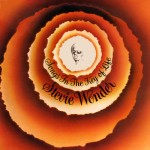 The highly anticipated Songs in the Key of Life debuted at number one on the albums chart and spent the last 11 weeks of 1976 and the first two weeks of 1977 there. It was displaced for two weeks by Hotel California and Wings Over America before returning to the top one last time the week of January 29, 1977. I still remember the day the two LP album (with a bonus EP) was released. I went to the local record store to get it the day it was released, returned home and spent the afternoon listening to it straight through (more than once) with headphones. It is still the Wonder album to which I am most likely to turn when I have the urge to listen to his music (such as occurred seeing him play at the pre-inauguration concert at the Lincoln Monument). The highly anticipated Songs in the Key of Life debuted at number one on the albums chart and spent the last 11 weeks of 1976 and the first two weeks of 1977 there. It was displaced for two weeks by Hotel California and Wings Over America before returning to the top one last time the week of January 29, 1977. I still remember the day the two LP album (with a bonus EP) was released. I went to the local record store to get it the day it was released, returned home and spent the afternoon listening to it straight through (more than once) with headphones. It is still the Wonder album to which I am most likely to turn when I have the urge to listen to his music (such as occurred seeing him play at the pre-inauguration concert at the Lincoln Monument).
Songs in the Key of Life shows the breadth of Wonder’s talent both as a songwriter and as a musician. On many of the tracks, he is the only one playing the instruments. And part of the theme is made clear from the opening track. “Love’s in Need of Love Today” urges that love is endangered by the amount of hate in the world, a topic he visits a couple times on the LP. Showing there’s still truth to his message, Wonder also performed the song on the post-9/11 “America: A Tribute to Heroes” telethon. But love isn’t the only topic on the album and Wonder covers a full range of matters.
For example, there’s the politics of “Village Ghetto Land” (“Tell me would you be happy in village ghetto land”). There’s a Return to Forever-like fusion piece, “Contusion, followed by “Sir Duke,” a burning, big brass tribute to music and jazz in particular (“For there’s Basie, Miller, Satchmo/And the king of all, Sir Duke/And with a voice like Ella’s ringing out/There’s no way the band can lose”). There’s also the personal side of “Isn’t She Lovely,” Wonder’s celebration of the birth of his daughter, including sounds of him and her while she’s being bathed. (I must say, though, if the version of the song on Lee Ritenour’s 1977 Captain Fingers, with Bill Champlin on vocals, doesn’t surpass the original, it certainly matches it.)
This is also an LP that again supports one of my complaints about CDs. One side of the original LPs — side four — comes off as utterly classic and a perfect ensemble of songs. But on the CD version, not only is it preceded by side 3 of the original LPs, two of the songs on the EP follow it. As a result, the exquisite closing to the original LP is taken out of its original context.
Side four consists entirely of songs of and about love and Wonder simply excels on Side 4. Each song makes you think he has magically and beautifully captured the essence of the emotion, only to hear him use a different style and surpass himself with the next. The first, “Ngiculela – Es Una Historia – I Am Singing,” uses Zulu, Spanish and English — with Wonder the only instrumentalist — to again urge the importance of love in the world and individually. As it fades out, Wonder changes the mood dramatically on “If It’s Magic.” Here, he is accompanied only by a harp and a bit of closing harmonica and asks why we aren’t as careful about love as we are “making sure we dress in style.” The pace shifts again immediately on “As,” a personal song of love again advocating the importance of love, saying it should and must exist “Until the dolphin flies and parrots live at sea” and “Until the day that eight times eight times eight times eight is four.” The song, which includes Herbie Hancock on keyboards, has an up-tempo, ultimately driving beat that will have you tapping a foot or a finger or nodding your head. It actually hit number 2 on the disco/dance charts. As the extended outro of “As” fades, Wonder closes by moving from the universal to the personal and from a dance rhythm to an infectious Latin beat. “Another Star” tells of how “no other love could do” and that the protagonist was left heartbroken.
Any one of Wonder’s mid-70s quartet could easily be considered a must for any record collection. All four made Rolling Stone‘s list of the top 500 albums of all time, three of them, including Songs in the Key of Life, in the top 100. But if you want a full sample of Wonder’s talents — with the added bonus of four consecutive songs that are as incomparable as they are varied — Songs in the Key of Life does that. It is as grand as it is ambitious.
Did you know that life has given love a guarantee
To last through forever and another day
“As,” Stevie Wonder, Songs in the Key of Life
|
Disclaimer 
Additionally, some links on this blog go to Amazon.com. As an Amazon Associate I earn from qualifying purchases. There is no additional cost to you. Contact me You can e-mail me at prairieprogressive at gmaildotcom.
|