|
|
When Rolling Stone announced its list of the 100 Greatest Guitarists of All Time in 2003, there were plenty of letters and comments complaining about artists excluded (and some who were included). Yet there was one wholly inexcusable omission — Terry Kath.
 Kath was the lead guitarist of Chicago until his untimely (and foolish) death on January 23, 1978. A gun hobbyist, Kath put a pistol to his temple, supposedly said, “Don’t worry, it’s not loaded,” and pulled the trigger. Thing was, there was a round in the chamber. But such a careless fate, barely a week shy of his 32nd birthday, does not diminish Kath’s guitar talents. Kath was the lead guitarist of Chicago until his untimely (and foolish) death on January 23, 1978. A gun hobbyist, Kath put a pistol to his temple, supposedly said, “Don’t worry, it’s not loaded,” and pulled the trigger. Thing was, there was a round in the chamber. But such a careless fate, barely a week shy of his 32nd birthday, does not diminish Kath’s guitar talents.
Chicago’s current reputation makes it easier to discount Kath. It became a relatively middle of the road, ballad-oriented group. But Kath was a driving force behind a harder rock tinge to its fusion of jazz and rock. In fact, Chicago keyboardist Bobby Lamm has been quoted as saying that Kath’s death cost the band it’s rock and roll heart and soul.
How good was Kath? Legend has it that Jimi Hendrix, for whom Chicago was an opening act, told others when the band was performing at an L.A. nightclub that Kath was a better guitar player than him. Take a listen to the guitar work on “Poem 58” or “Liberation,” extended pieces that close album one and album two, respectively, of the band’s initial release, Chicago Transit Authority. Or if you want a more familiar song, listen to the full length version of Chicago II‘s “25 or 6 to 4” (the single version cut most of Kath’s three minute guitar solo). I am among those, though, who exclude “Free Form Guitar” from the CTA album because even though it shows Kath’s ability to get sounds from his instrument, by itself it comes off as largely electronic noise. Kath was always at his best driving the band on rhythm or wailing away in the context of a particular song’s structure. Notably, the latter opportunities seemed to decline a bit with Chicago V and the other releases before his death as the band moved from longer tunes and suites to more radio friendly fare.
In addition to the fact Kath wasn’t as predominant on later albums as on the first three, there are a couple reasons Kath likely didn’t garner the attention and reputation he deserved. As a horn-based band, much of the public focus, particularly with singles, was on the horns and the vocals, not the rhythm section. Thus, he didn’t get the attention of Jimmy Page or Pete Townshend, who were up front in smaller ensembles. Instead, the focus was on a band sound, not particular players. This is particularly crucial when you consider Kath was the band’s only guitarist. Thus, unlike Hendrix or Eric Clapton or Keith Richards, Kath spent more time playing rhythm than lead. Yet even when playing underneath the lead, his style and performance add immensely to the feel and the sound. Consider two of the band’s hit singles, “Beginnings” and “Dialogue,” where Kath’s rhythm work is a hallmark.
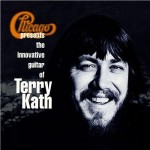
The band recognized Kath’s talent in 1997 when it released a CD on its own label called The Innovative Guitar of Terry Kath (the cd pictured with this post). Perhaps reflective of the respect Kath earned among fans, because the CD is no longer produced, it sells for more than $40 on Amazon to $100 or more on eBay. Similarly, one of the most powerful of Kath’s solos on “25 or 6 to 4” appears on the band’s Live in Japan 1972. Also released on the band’s own in 1997 and unavailable now, it sells for more than $125 on Amazon and far more than that on eBay. (I have both and would part with neither.)
Kath also had excellent vocal talents. Endowed with a bluesy, husky voice, Kath could surprise with his range. It’s hard to believe that the same guy who belts out “Make Me Smile” is also the one singing “Colour My World.” His songwriting may have been a weaker spot and he tended to balance songs of love and loss, particularly on the last three or four albums he cut with the group, with somewhat lighter pieces, such as “Jenny,” a song about his dog, or “An Hour in the Shower.” Outside that spectrum, he truly scored with “Introduction,” the opening cut on Chicago Transit Authority, which really does serve as an introduction to the range and scope of the band at that time.
Undoubtedly, I am influenced by the fact I was a Chicago fanatic until shortly before and about the time of Kath’s death. The first real rock concert I went to was when two friends and I snuck off to Minneapolis for a weekend in 1972 to catch the band at the old Met Center. I would see the band on each of its next two tours and one other time before Kath’s death. I’ve seen them twice since but, to me, the heart is gone.
Sadly, Kath has now been dead nearly as long as he was alive. And even though the more recent versions of Chicago certainly tinge people’s views of the band, it should not reflect on Kath’s immense contribution to the band in its power years or his talent. Whether viewed from the standpoint of ability or influence, Kath is undoubtedly one of the most overlooked and underrated guitarists of all time.
But then again
So sad but true
There’s always someone waiting
Just to shit on you
“Jenny,” Chicago VI
As with his last release, Bruce Springsteen’s Working on a Dream, set for release next week, leaked to the internet. That isn’t all that surprising given the existence of advance review copies and, among other things, NPR will begin streaming the entire album just before midnight tonight.
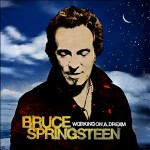 As a result of the leak, I had the opportunity to listen to Working on a Dream a few times over the weekend. Like Magic, I’ll hold off on a final verdict until I’ve listened to it more. But I have a variety of general and specific impressions, not all of them positive. As a result of the leak, I had the opportunity to listen to Working on a Dream a few times over the weekend. Like Magic, I’ll hold off on a final verdict until I’ve listened to it more. But I have a variety of general and specific impressions, not all of them positive.
First, unlike Magic and The Rising, the new record isn’t built around any political or social issues. Instead, many of the songs are more personal, looking at aging, loss and, primarily, love.
Second, although it’s would be easy to say a particular cut could fit on one of the last few E Street Band albums (or even the Seeger Sessions work), there is a different sound to this album. For example, it is more heavily orchestrated than prior E Street Band releases. Likewise, some of the background vocals seem to be more from the pop school than what we usually expect from Springsteen and the band.
Third, as usuaal, Springsteen incorporates a variety of styles and influences. Thus, in addition to a couple noted below, the short (barely two minutes) “Tomorrow Never Knows” uses a guitar opening seemingly straight off a Creedence Clearwater Revival tune to introduce its predominantly country shuffle feel.
Undoubtedly, there are what appear to be a few misfires. For example, the lengthy opening track, “Outlaw Pete,” seems a bit strained and almost overwrought. A fable about an extremely young outlaw who later seeks to change his life, it contains a riff that could have come right off Magic but is swamped by orchestration, leaving the music feeling almost like a takeoff on Coldplay’s Viva La Vida.
“Good Eye,” in contrast, sounds much like Nebraska‘s “Reason to Believe” as Springsteen performed it on his Devils and Dust tour: fuzzed up harmonica and distorted vocal built around a blues structure. “Surprise, Surprise” is a song about a birthday, one in which the title word is repeated more than 40 times in three and a half minutes. (Gee, does that mean there was a surprise birthday party?) I’m also somewhat ambivalent about “Queen of the Supermarket,” another orchestrated piece, this one dealing with unrequited love for a supermarket cashier (with some pretty serious feelings about the supermarket itself).
Some songs are more standard E Street Band fare, such as “My Lucky Day” and “Kingdom of Days.” Both are essentially love songs, with the latter even reflecting on aging with lines like “We laugh beneath the covers/And count the wrinkles and the grays.” Also falling squarely in the love song category is “This Life,” with an expansive Beach Boys feel similar to that on Magic’s “The Girls in Their Summer Clothes.” The lyrics are even more spacious than the sound, with lines like “My universe at rest” and “This lonely planet never looked so good.” Just as the songs I consider misfires will garner split opinions, these will too.
“The Last Carnival” is likely the most emotional for fans. It’s a remembrance of Danny Federici, the E Street Band’s organ and accordion player who died of cancer last April. Built around a carnival getting ready to move on to the next town, Springsteen asks “Where have you gone my handsome Billy?” and “Where are you now darling Billy?”. Longtime Springsteen fans will immediately recognize the setting and those lines as referring to “Wild Billy’s Circus Story,” a track off 1973’s The Wild, the Innocent & the E Street Shuffle that featured Federici’s accordion work. Springsteen sings that the carnival will be “be riding the train without you tonight” and although “The light that was in your eyes is gone away … The thing in you that made me ache is gonna stay.”
I do have a criticism with regard to the song, though. Although it supposedly closes the album, “The Wrestler,” for which Springsteen recently won a Golden Globe award, appears 20 or so seconds later as a “bonus track.” Although that’s a fine tune, the homage to Federici would have carried more impact and meaning had it truly been the last song on the CD.
At bottom, I am not as impressed with Working on a Dream as I initially was with The Rising, Devils and Dust or Magic. But Springsteen’s songs always seem to reveal additional layers on further listening. That’s held true on my first few listens to this release and, thus, my overall impression may change with time. There certainly is enough of merit to make it a decent addition to the E Street canon.
Finally, I want to repeat what I said following the internet release of Magic: If you stumble across the music online, consider this leak nothing more than a preview. There’s no reason or excuse for not buying the CD when it hits the shelves next week. I know I will, even with my mixed feelings toward it.
I don’t see the summer as it wanes
Just a subtle change of light upon your face
“Kingdom of Days,” Bruce Springsteen, Working on a Dream
How does your being sick (or injured) affect your reading? Do you read more? Less? Do you pick out a different book than you had already planned? Do you have a “comfort book” that makes you feel better?
Most of the time if I’m sick I end up reading less, either because I don’t feel up to it or I tend to sleep. For injuries, it depends on the nature of the injury. Most of the time I probably read a little more if I am housebound. It tends to decline a bit if the pain medication, if any, tends to make you drowsy. Then, I end up reading with my eyes closed.
The worst for me was several years ago when I had surgery for a detached retina. One of the post-op restrictions was no reading for six weeks. I about climbed the wall and I discovered that audio books just make me sleepy. Between that and being unable to drive, my wife was about ready to shoot me.
You aren’t ill: it is just that you are made of second-rate materials.
Natalia Ginzburg, Family Sayings
Random Observations
It’s nice to know there are still real heroes. And my guess is one of his first comments will be, “I was just doing my job.”
Back in the day when I was a paperboy (and had to deliver in 6 feet of snow, uphill both ways), there was both the Minneapolis Star (evening) and the Minneapolis Tribune (morning). Thus, it is with sadness I read that the StarTribune has filed for bankruptcy.
Bookish Linkage
The 2009 Tournament of Books is on the horizon. (I’ve read three of the 16 contenders.)
I am always fearful when movie studios buy the rights to classic SF works.
Nonbookish Linkage
An American Stonhenge — under a lake??? Hope this isn’t like the “monuments on Mars.”
Planet Earth porn.
Thinking about it kind of makes my head hurt, but is Planet Earth simply a hologram?
After that, beer and sci-fi sounds like an enjoyable weekend.
Self-trust is the essence of heroism.
Ralph Waldo Emerson, William Faulkner, Heroism
Innumerable obstacles stand between an author and gaining the widest possible audience. For John W. Kiser, the problem is subject matter. There probably aren’t a lot of Americans interested in a favorable biography of an Islamic jihadist. And that’s a shame because not only did that jihadist die 125 years ago, shortly before his death the New York Times described him “among the foremost of the few great men of the century.” Equally important, Commander of the Faithful: The Life and Times of Emir Abd el-Kader sheds light on today.
Kiser takes us inside the life of the Arab leader who headed a 17-year-struggle against the French colonization of Algeria. Yet Kiser does not focus just on warfare and strategy. Rather, he seeks to give a view that is as complete as possible. Toward that end, Commander of the Faithful is broken into three parts, one covering the events leading up to Abd el-Kader leading the fight against the French, another looking at the tactics and diplomacy he used against the French and, finally, his years of exile. With this approach, we see not only the source and development of Abd el-Kader’s religious devotion but how those precepts played a role in virtually every action he took. Likewise, we learn how someone whose name was detested by the French would gain their admiration during his exile to that country.
Born the son of a religious-trained sheik in northern Algeria in 1808, Abd el-Kader was far better educated than most of his fellow tribesmen. In addition to study and memorization of the Koran, his father took him on a two-year pilgrimage that included not only Mecca and Medina but the capitals and cities of other states, such as Egypt. Kiser explores how the wide-ranging travel not only bolstered Abd el-Kader’s interest in religion but also in western thought. Shortly after they returned, though, the French invaded Algeria. Soon, the French were committing many of the mistakes and dealing with many of the problems that continue to plague western action in today’s world.
Initially greeted somewhat gratefully by a population tired of corrupt Turkish rule, French ignorance of and attitudes toward cultural differences and the prominent role of Islam in Arab life led to revolt. In 1832, various tribes elected Abd el-Kader’s father to lead a jihad against the invaders. The first thing he did in pursuit of that jihad was to abdicate in favor of his son, who became “commander of the faithful.” Building various alliances among the Arab tribes — alliances that would always seem to shift — Abd el-Kader relied on the skills and weapons available to his forces to combat the more modern French military. Those alliances also helped him establish some order and exercise general sovereignty over the tribes, power frequently exercised with a view toward religious principles and the suras. By 1837, the French signed a treaty recognizing Abd el-Kader’s sovereignty over two-thirds of Algeria. Kiser details not only the Arab strategy and tactics leading to that and other interim treaties but also Abd el-Kader’s approach toward negotiating and how he intended to adhere to his word although the French rarely did.
The French soon broke the treaty and Abd el-Kader embarked on a guerrilla war. Realizing that a traditional military approach didn’t work, the French engaged in what was essentially a scorched earth policy and produced what the New York Times called “a veritable carnage.” To perhaps bring a sense of what was happening within the grasp of American readers, Kiser’s chronology at the end of the book shows the events Abd el-Kader’s life next to events in the decline and decimation of Native American tribes. Still, when a French general announced in November 1843 that “all serious fighting is over,” it would be nearly four years before Abd el-Kader surrendered. Even then, it was largely because many tribes had succumbed to French tactics and Abd el-Kader felt further fighting would “only create vain suffering.”
Abd el-Kader’s surrender in December 1847 was in large part predicated on his agreement — and a French promise to allow him — to leave Algeria for Alexandria, Egypt, or Acre, in what is now Israel. As before, though, France reneged. Abd el-Kader and his large household of more than 100 people were transferred to and held captive in France, albeit for much of the time on estates as opposed to prison cells. It is here that Kiser perhaps gives us the most insight into the man. He details how Abd el-Kader continued to adhere to his word and religious principles throughout this trying period. Commander of the Faithful also explores Abd el-Kader’s interest in and study of theology, including Christian theology, and how his personality and intelligence ended up charming the French public.
After four years, he and his household were released, returning first to Turkey and eventually settling in Damascus, where he would reside until his death in 1883. There, he continued his study of Islam and theology became acquainted with a number of Western figures, including Sir Richard Burton. Most notably, in 1860 he personally sheltered numerous Christians who were the subject of a Turkish pogrom. When a mob demanded he turn them over, Abd el-Kader told them it violate Islam to kill innocent people. He was credited with saving thousands. His actions only bolstered his reputation and standing around the world and he would later visit France and other parts of Europe to great acclaim.
Today, it is virtually impossible to imagine major world publications praising an Arab Muslim who led his people in a jihad against an invading superpower. Commander of the Faithful helps us understand how that could occur and, more important, sheds light on how our views of Islam and the Middle East continue to be affected by misconceptions or ignorance.
My career in politics is over. … From now on, I want onlyl the sweet pleasures of family, prayer and peace.
Abd el-Kader quoted in John W. Kiser, Commander of the Faithful
|
Disclaimer 
Additionally, some links on this blog go to Amazon.com. As an Amazon Associate I earn from qualifying purchases. There is no additional cost to you. Contact me You can e-mail me at prairieprogressive at gmaildotcom.
|